

A Look At Babcock & Wilcox Enterprises (BW) Valuation After Recent Share Price Volatility
Babcock & Wilcox Enterprises Inc BW | 0.00 |
Recent share performance context
Babcock & Wilcox Enterprises (BW) has seen mixed short term trading, with the stock down about 7% over the past day and 13% over the past week, yet higher over the past month and over the past 3 months.
Even after the recent pullback, Babcock & Wilcox Enterprises’ 30 day share price return of 19.67% and 90 day share price return of 118.35% sit alongside a very large 1 year total shareholder return. This suggests strong momentum tempered by short term profit taking as investors reassess risk and growth potential.
If you are watching BW’s moves and want to see what else is charging ahead in related areas, now could be a good time to scan 88 nuclear energy infrastructure stocks
With BW shares up 19.67% over 30 days, significantly higher over 90 days and trading below the average analyst price target, the key question is whether this is an undervalued turnaround story or a stock that has already priced in future growth.
Most Popular Narrative: 128.5% Overvalued
At a last close of $19.04 versus a narrative fair value of $8.33 based on a 10.89% discount rate, BW’s valuation hinges on a very specific growth story.
The company is tying a large part of its long term story to AI data center power demand, including a US$1.5b Applied Digital project and a US$3b to US$5b AI opportunity pipeline. If AI related electricity needs or data center build outs slow or are met by alternative technologies, the expected uplift in backlog conversion and revenue may not materialize, which could pressure earnings and compress margins.
Want to see what underpins that valuation gap? The narrative leans on rapid revenue expansion, improving margins and a future earnings profile that points to a much richer profit multiple.
Result: Fair Value of $8.33 (OVERVALUED)
However, investors still need to watch for any slowdown in AI driven data center power demand, or delays and weaker terms on large projects that could strain earnings and cash flow.
Another angle on BW’s valuation
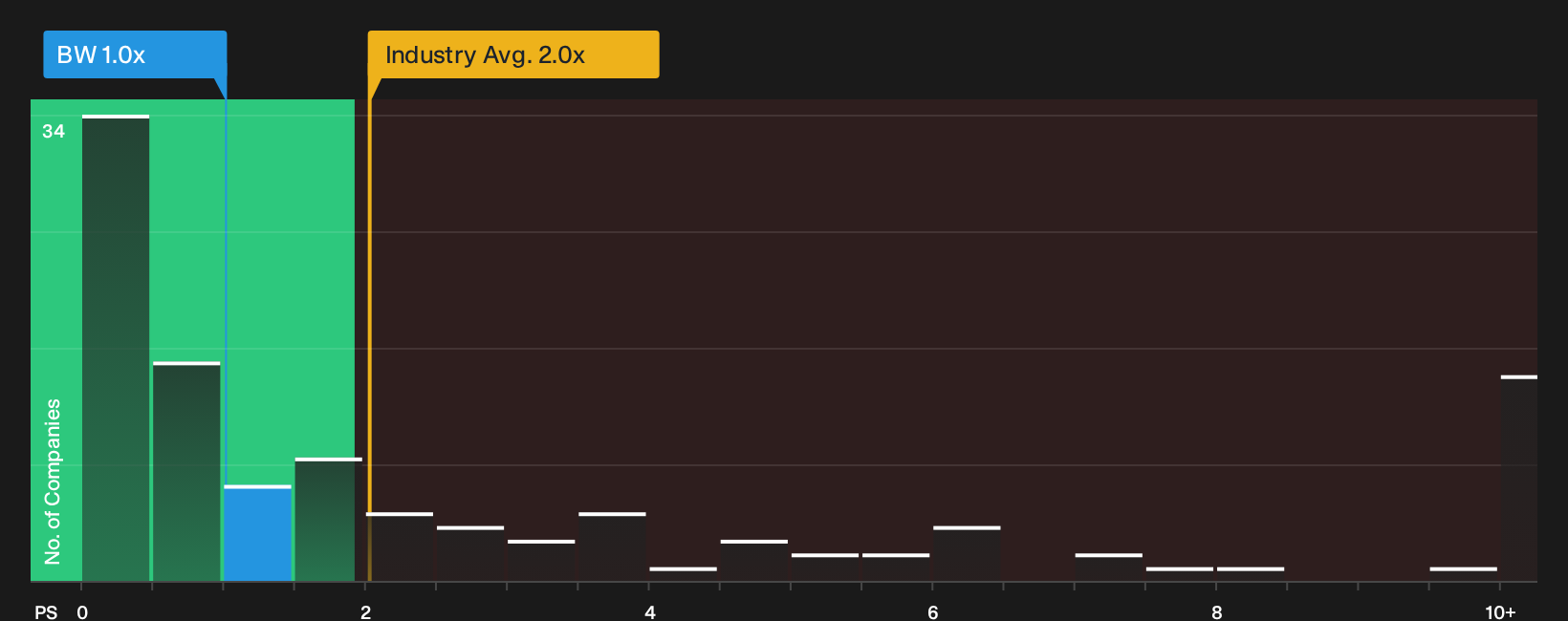
The narrative fair value suggests BW is overvalued, but the current P/S ratio of 4.3x paints a more mixed picture. It sits above the US Electrical industry average of 2.5x, yet below a fair ratio of 9.7x and close to the 4.5x peer average, which points to both valuation risk and potential rerating room if expectations hold.
Before leaning on this comparison too heavily, it helps to see exactly how the numbers stack up in context, including how sensitive that P/S ratio could be to changes in revenue or sentiment, and whether that fair ratio is a realistic anchor for you or a stretch.
Next Steps
Given the mixed signals across valuation and sentiment, it makes sense to review the full picture yourself and move quickly to form your own view using 3 key rewards and 3 important warning signs
Looking for more investment ideas?
If BW has caught your attention, do not stop here. The market is full of other opportunities that could fit your goals even better.
- Target resilient income by scanning companies that have built reputations as dependable payers with 10 dividend fortresses.
- Hunt for potentially mispriced opportunities where quality and valuation line up using the 49 high quality undervalued stocks.
- Zero in on companies with stronger balance sheets and fundamentals than the crowd through the solid balance sheet and fundamentals stocks screener (46 results).
This article by Simply Wall St is general in nature. We provide commentary based on historical data and analyst forecasts only using an unbiased methodology and our articles are not intended to be financial advice. It does not constitute a recommendation to buy or sell any stock, and does not take account of your objectives, or your financial situation. We aim to bring you long-term focused analysis driven by fundamental data. Note that our analysis may not factor in the latest price-sensitive company announcements or qualitative material. Simply Wall St has no position in any stocks mentioned.