

How Cloudnine Deal Talks And Liquidity Scrutiny At KKR (KKR) Have Changed Its Investment Story
KKR & Co KKR | 0.00 |
- In recent days, KKR has been linked to a potential acquisition of a 25% stake in India’s Cloudnine maternity and pediatric hospital chain at an implied value of about INR 100,000 million (US$1.00 billion), while also progressing plans to open a new Milan office to deepen its Italian private markets and wealth footprint.
- At the same time, sector-wide liquidity concerns triggered by Partners Group’s decision to cap withdrawals from a large private equity fund have put a spotlight on how KKR’s diversified, largely long-lockup capital base might respond to heightened scrutiny of private market liquidity and asset quality.
- We’ll now examine how the private-market liquidity worries highlighted by Partners Group’s withdrawal caps affect KKR’s longer-term investment narrative.
Capitalize on the AI infrastructure supercycle with our selection of the 48 best 'picks and shovels' of the AI gold rush converting record-breaking demand into massive cash flow.
KKR Investment Narrative Recap
To own KKR, you need to believe in its shift from deal-by-deal private equity to a diversified fee and insurance platform with largely locked-up capital. The key short term catalyst is how resilient that capital base proves as private market liquidity is questioned after Partners Group’s withdrawal caps. The biggest current risk is that any broader pullback in private credit or asset-based finance exposes valuation and liquidity strains. So far, the recent news has highlighted these questions but not fundamentally changed them.
The Milan office plan is especially relevant here, because it shows KKR still building out its European private markets and private wealth presence even as liquidity concerns flare up. By deepening local sourcing and distribution in Italy, KKR is reinforcing the same fee and wealth channels that consensus analysts see as central to future earnings, which matters for how the firm absorbs any short term volatility in private markets sentiment.
Yet behind KKR’s long lockups and growing fee base, investors should still be aware that...
KKR’s narrative projects $13.7 billion revenue and $5.4 billion earnings by 2028. This implies a 13.9% yearly revenue decline and roughly a $3.4 billion earnings increase from $2.0 billion today.
Uncover how KKR's forecasts yield a $140.24 fair value, a 50% upside to its current price.
Exploring Other Perspectives
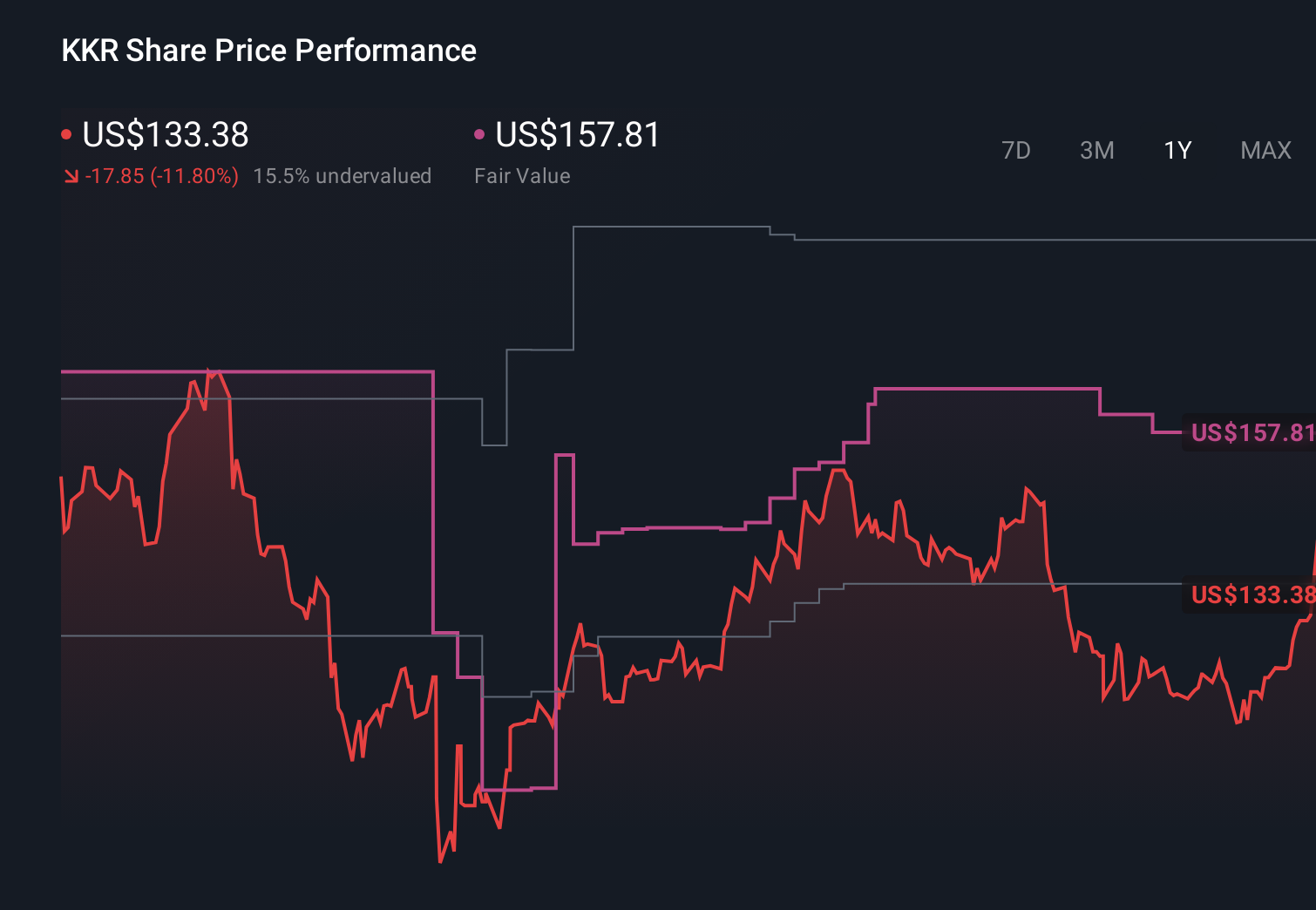
Some of the most cautious analysts were already assuming KKR’s revenue could shrink about 21.5% a year even as earnings climbed toward roughly US$6.0 billion, so this latest liquidity scare may either validate those worries around market dependence and competition in private credit or prompt a rethink of how much its insurance and wealth franchises can offset cyclical pressure.
Explore 8 other fair value estimates on KKR - why the stock might be worth 10% less than the current price!
Decide For Yourself
Don't just follow the ticker - dig into the data and build a conviction that's truly your own.
- A great starting point for your KKR research is our analysis highlighting 3 key rewards that could impact your investment decision.
- Our free KKR research report provides a comprehensive fundamental analysis summarized in a single visual - the Snowflake - making it easy to evaluate KKR's overall financial health at a glance.
Interested In Other Possibilities?
Our top stock finds are flying under the radar-for now. Get in early:
- AI is about to change healthcare. These 39 stocks are working on everything from early diagnostics to drug discovery. The best part - they are all under $10b in market cap - there's still time to get in early.
- Find 49 companies with promising cash flow potential yet trading below their fair value.
- Explore 30 top quantum computing companies leading the revolution in next-gen technology and shaping the future with breakthroughs in quantum algorithms, superconducting qubits, and cutting-edge research.
This article by Simply Wall St is general in nature. We provide commentary based on historical data and analyst forecasts only using an unbiased methodology and our articles are not intended to be financial advice. It does not constitute a recommendation to buy or sell any stock, and does not take account of your objectives, or your financial situation. We aim to bring you long-term focused analysis driven by fundamental data. Note that our analysis may not factor in the latest price-sensitive company announcements or qualitative material. Simply Wall St has no position in any stocks mentioned.