

Is HP (HPQ) Using Dividends And Cost Cuts To Reinvent Its Capital Allocation Playbook?
HP Inc. HPQ | 0.00 |
- HP Inc. recently declared a quarterly cash dividend of US$0.30 per share, its third in fiscal 2026, payable on 1 July 2026 to shareholders of record on 10 June 2026.
- This dividend decision lands as analysts debate HP’s earnings outlook, cost-saving program targeting US$2.00 billion annually, and shifting demand across its PC and printing businesses.
- Next, we’ll examine how HP’s latest dividend declaration and ongoing US$2.00 billion cost reduction program may reshape its broader investment narrative.
We've uncovered the 10 dividend fortresses yielding 5%+ that don't just survive market storms, but thrive in them.
HP Investment Narrative Recap
To own HP today, you have to believe its PC and printing cash flows can be refreshed by AI PCs, services and a large cost-saving program, even as print demand and hardware pricing remain pressured. The fresh US$0.30 dividend itself does not materially change that near term narrative, but it lands just as earnings expectations, cost cuts of about US$2.0 billion a year, and PC demand forecasts are under close scrutiny.
Among recent news, the most relevant alongside this dividend is HP’s structural cost reduction push targeting US$2.0 billion in annual savings, including manufacturing diversification and automation. This matters because any improvement in margins could offset weak print trends and price competition in PCs, which are central to both the bullish AI PC story and the risk that hardware revenues and supplies keep grinding lower.
Yet despite the steady dividend, investors should also be aware that structural headwinds in printing and tougher PC pricing could still...
HP’s narrative projects $57.4 billion revenue and $2.7 billion earnings by 2029. This implies fairly flat yearly revenue growth and an earnings increase of about $0.2 billion from $2.5 billion today.
Uncover how HP's forecasts yield a $19.43 fair value, a 23% downside to its current price.
Exploring Other Perspectives
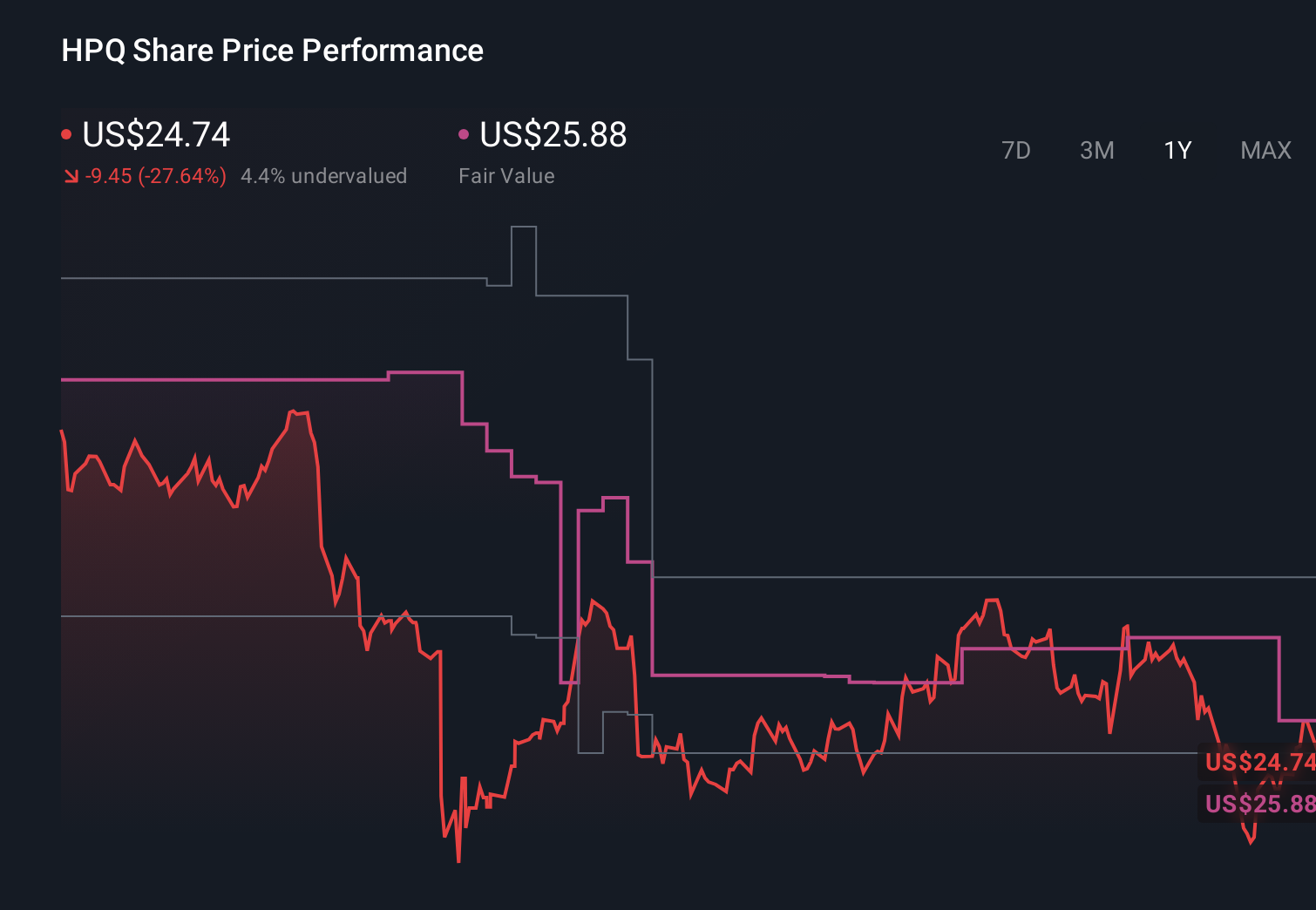
Some of the most optimistic analysts saw HP reaching about US$60.2 billion in revenue and US$3.2 billion in earnings by 2029, so if you believe AI PCs and new cost savings really can offset print and pricing pressures, you may see much more upside than others, but it is worth comparing several viewpoints before treating that dividend as a simple green light.
Explore 9 other fair value estimates on HP - why the stock might be worth 37% less than the current price!
The Verdict Is Yours
Don't just follow the ticker - dig into the data and build a conviction that's truly your own.
- A great starting point for your HP research is our analysis highlighting 2 key rewards and 3 important warning signs that could impact your investment decision.
- Our free HP research report provides a comprehensive fundamental analysis summarized in a single visual - the Snowflake - making it easy to evaluate HP's overall financial health at a glance.
Looking For Alternative Opportunities?
Our daily scans reveal stocks with breakout potential. Don't miss this chance:
- Invest in the nuclear renaissance through our list of 88 elite nuclear energy infrastructure plays powering the global AI revolution.
- The future of work is here. Discover the 35 top robotics and automation stocks leading the charge in AI-driven automation and industrial transformation.
- AI is about to change healthcare. These 34 stocks are working on everything from early diagnostics to drug discovery. The best part - they are all under $10b in market cap - there's still time to get in early.
This article by Simply Wall St is general in nature. We provide commentary based on historical data and analyst forecasts only using an unbiased methodology and our articles are not intended to be financial advice. It does not constitute a recommendation to buy or sell any stock, and does not take account of your objectives, or your financial situation. We aim to bring you long-term focused analysis driven by fundamental data. Note that our analysis may not factor in the latest price-sensitive company announcements or qualitative material. Simply Wall St has no position in any stocks mentioned.