

What Charter Communications (CHTR)'s New COO Appointment Means For Shareholders
Charter Communications, Inc. Class A CHTR | 0.00 |
- In late February 2026, Charter Communications appointed veteran telecom executive Nick Jeffery as Chief Operating Officer, tasking him with leading Marketing and Sales, Field Operations and Customer Operations across Spectrum’s residential and business services from September 1, 2026.
- Jeffery’s track record of operational overhauls and customer satisfaction gains at Frontier Communications and Vodafone UK signals a meaningful shift in how Charter may approach service quality and execution across its connectivity and entertainment portfolio.
- We’ll now explore how Jeffery’s operational and customer-experience focus could influence Charter’s existing investment narrative around broadband execution and cost efficiency.
Find 50 companies with promising cash flow potential yet trading below their fair value.
Charter Communications Investment Narrative Recap
To own Charter today, you need to believe its broadband and connectivity platform can remain essential despite rising competition and regulatory and debt pressures. The key near term catalyst is execution on broadband performance and cost control, while the biggest risk remains high leverage alongside competitive subscriber losses. Nick Jeffery’s appointment as COO looks directionally supportive of operational and customer-experience execution, but it does not materially change those core risks or the near term thesis yet.
Among recent announcements, Spectrum Business expanding Managed Network Services and unified communications under California’s CALNET contract feels most connected to the Jeffery news. It highlights Charter’s push beyond basic connectivity into higher value, service intensive offerings for government and business customers, where operational discipline and customer satisfaction are crucial. How well Jeffery can translate his prior experience into better service quality could matter for sustaining this kind of enterprise and public sector momentum.
Yet, while these developments may look encouraging on the surface, investors should be aware that Charter’s heavy debt load and competitive pressures could still...
Charter Communications’ narrative projects $56.8 billion revenue and $6.0 billion earnings by 2028. This implies a 0.9% yearly revenue decline and about a $0.7 billion earnings increase from $5.3 billion today.
Uncover how Charter Communications' forecasts yield a $282.81 fair value, a 22% upside to its current price.
Exploring Other Perspectives
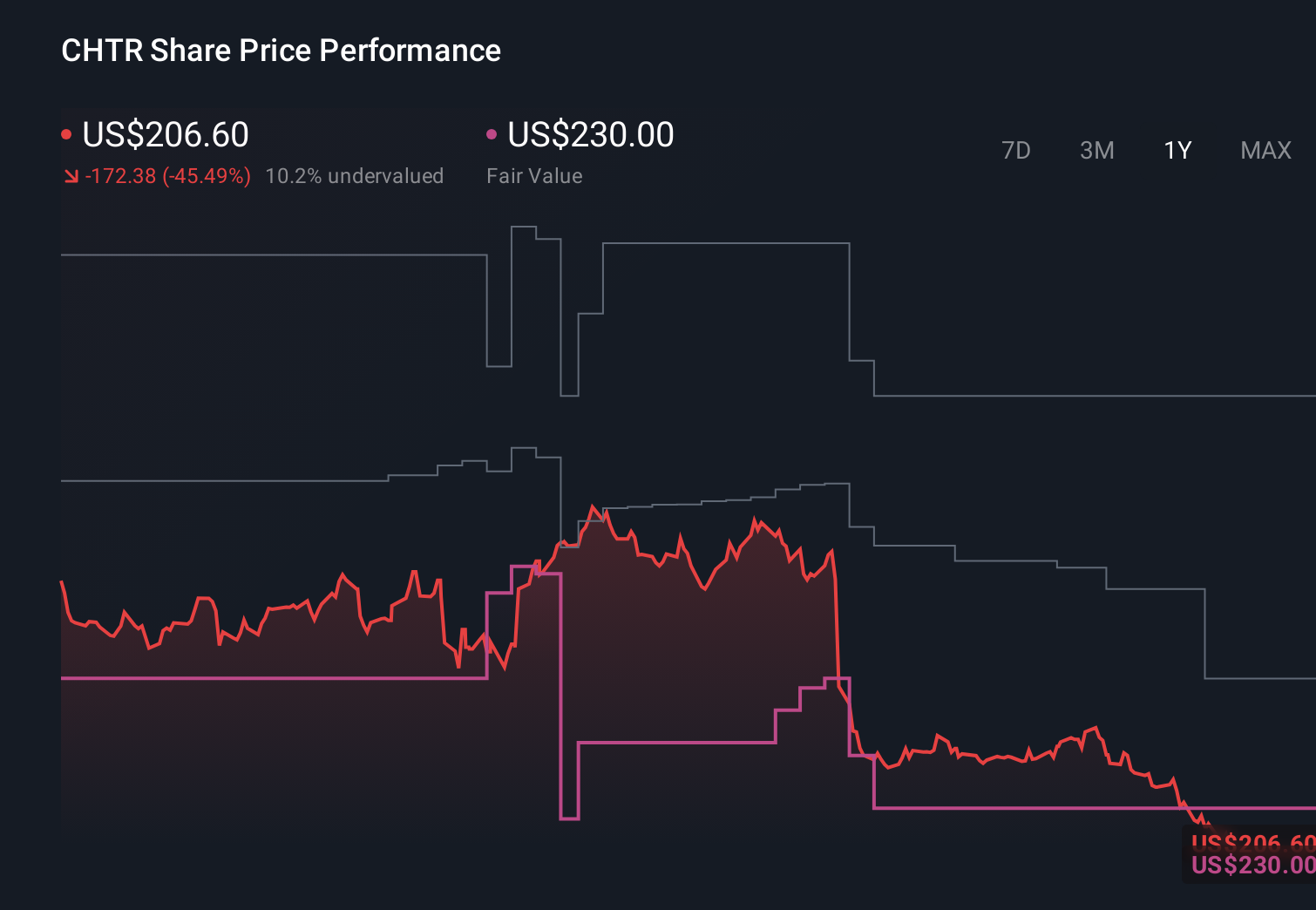
Some of the most optimistic analysts, who once projected revenue of about US$58.1 billion and earnings near US$7.0 billion by 2028, see far more upside than consensus, but the latest operational and competitive shifts could either support that bull case or highlight how different your own expectations might be.
Explore 6 other fair value estimates on Charter Communications - why the stock might be worth 28% less than the current price!
Reach Your Own Conclusion
Disagree with existing narratives? Extraordinary investment returns rarely come from following the herd, so go with your instincts.
- A great starting point for your Charter Communications research is our analysis highlighting 3 key rewards and 1 important warning sign that could impact your investment decision.
- Our free Charter Communications research report provides a comprehensive fundamental analysis summarized in a single visual - the Snowflake - making it easy to evaluate Charter Communications' overall financial health at a glance.
Curious About Other Options?
These stocks are moving-our analysis flagged them today. Act fast before the price catches up:
- Uncover the next big thing with 31 elite penny stocks that balance risk and reward.
- We've uncovered the 16 dividend fortresses yielding 5%+ that don't just survive market storms, but thrive in them.
- Invest in the nuclear renaissance through our list of 85 elite nuclear energy infrastructure plays powering the global AI revolution.
This article by Simply Wall St is general in nature. We provide commentary based on historical data and analyst forecasts only using an unbiased methodology and our articles are not intended to be financial advice. It does not constitute a recommendation to buy or sell any stock, and does not take account of your objectives, or your financial situation. We aim to bring you long-term focused analysis driven by fundamental data. Note that our analysis may not factor in the latest price-sensitive company announcements or qualitative material. Simply Wall St has no position in any stocks mentioned.