

Why Compass (COMP) Is Down 8.8% After New York AG Opens Antitrust Probe Into Anywhere Deal
Compass COMP | 0.00 |
- Earlier this week, New York’s Attorney General opened an antitrust investigation into Compass following its US$1.60 billion acquisition of Anywhere Real Estate, a deal that created the largest residential brokerage in the United States and concentrated market power in key hubs such as New York City.
- The probe shines a spotlight on how Compass’s enlarged market footprint and control of major brands like Century 21, Coldwell Banker, Sotheby’s International Realty, and Better Homes could influence competition across residential real estate services.
- We’ll now examine how the New York antitrust probe into Compass’s Anywhere acquisition could reshape the company’s investment narrative and risks.
Find 48 companies with promising cash flow potential yet trading below their fair value.
Compass Investment Narrative Recap
To own Compass, you need to believe its AI powered platform and expanded brokerage footprint can translate into durable profitability despite a volatile housing market and a leveraged balance sheet. In the near term, the key catalyst is delivering on revenue and margin guidance after the Anywhere Real Estate deal, while the New York antitrust probe heightens the top risk of regulatory and legal pressure on Compass’s commission economics, agent model, and M&A driven scale story.
The most relevant recent development alongside the probe is Compass’s Q1 2026 result, where it reported US$2,704 million in sales and returned to profitability with US$22 million in net income. That improvement, plus Q2 revenue guidance of US$4.0 billion to US$4.2 billion, had reinforced the idea that scale and cost control could start to pay off, but the regulatory overhang now sits directly against this profitability and growth catalyst.
Yet beneath the improving numbers, investors should also be aware of how ongoing regulatory scrutiny could affect Compass’s ability to sustain its current commission model and...
Compass' narrative projects $15.9 billion revenue and $668.9 million earnings by 2029. This requires 31.6% yearly revenue growth and a $727.4 million earnings increase from -$58.5 million today.
Uncover how Compass' forecasts yield a $13.25 fair value, a 72% upside to its current price.
Exploring Other Perspectives
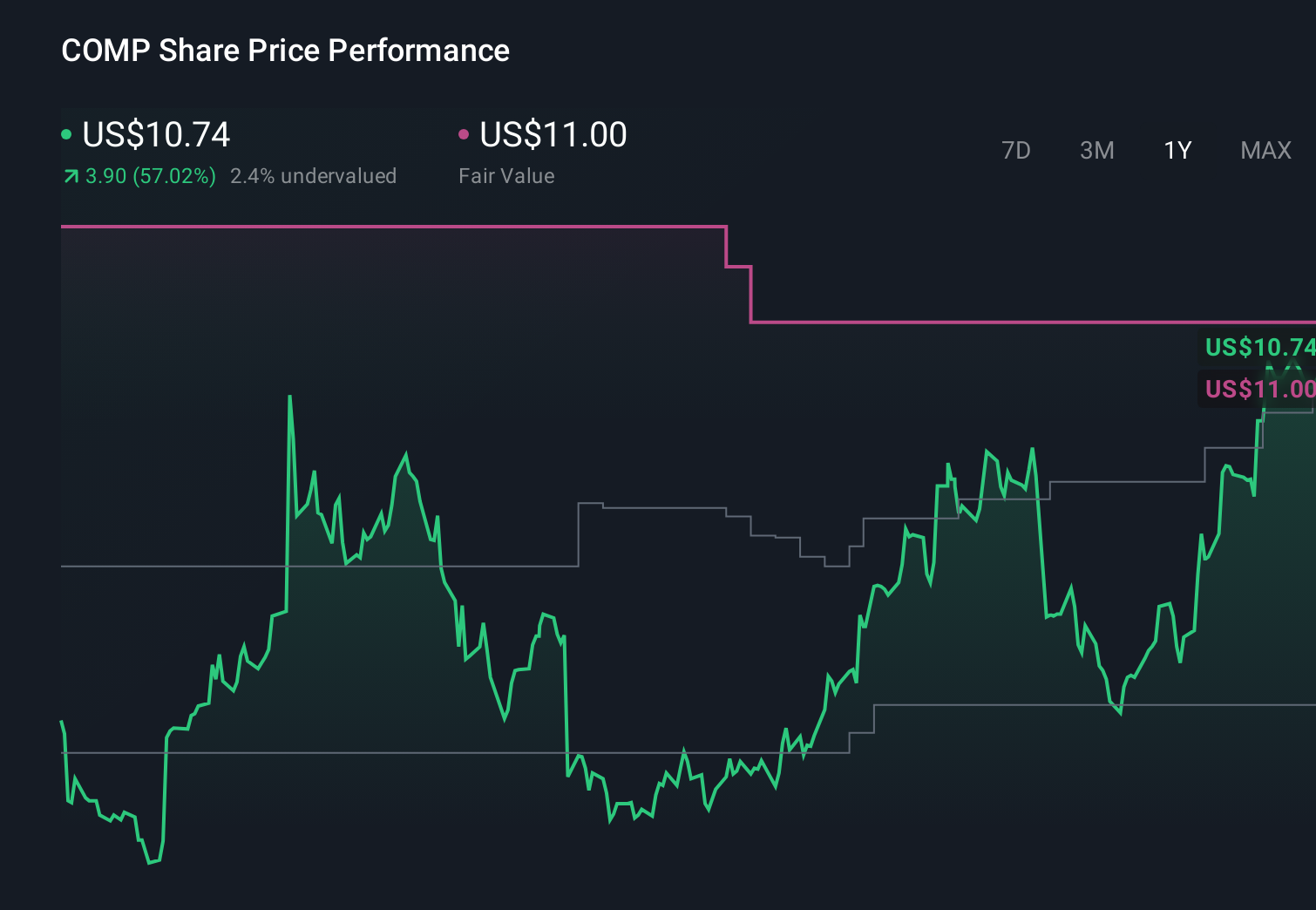
Before this news, the most optimistic analysts were banking on Compass hitting about US$17.4 billion in revenue and US$779.9 million in earnings by 2029, but the antitrust probe creates a clear test of those ambitious assumptions and reminds you that opinions on Compass’s risks and upside can differ widely.
Explore 3 other fair value estimates on Compass - why the stock might be worth just $13.25!
Decide For Yourself
Disagree with existing narratives? Extraordinary investment returns rarely come from following the herd, so go with your instincts.
- A great starting point for your Compass research is our analysis highlighting 4 key rewards and 4 important warning signs that could impact your investment decision.
- Our free Compass research report provides a comprehensive fundamental analysis summarized in a single visual - the Snowflake - making it easy to evaluate Compass' overall financial health at a glance.
Curious About Other Options?
Early movers are already taking notice. See the stocks they're targeting before they've flown the coop:
- AI is about to change healthcare. These 38 stocks are working on everything from early diagnostics to drug discovery. The best part - they are all under $10b in market cap - there's still time to get in early.
- Explore 30 top quantum computing companies leading the revolution in next-gen technology and shaping the future with breakthroughs in quantum algorithms, superconducting qubits, and cutting-edge research.
- Uncover the next big thing with 24 elite penny stocks that balance risk and reward.
This article by Simply Wall St is general in nature. We provide commentary based on historical data and analyst forecasts only using an unbiased methodology and our articles are not intended to be financial advice. It does not constitute a recommendation to buy or sell any stock, and does not take account of your objectives, or your financial situation. We aim to bring you long-term focused analysis driven by fundamental data. Note that our analysis may not factor in the latest price-sensitive company announcements or qualitative material. Simply Wall St has no position in any stocks mentioned.