


يرجى استخدام متصفح الكمبيوتر الشخصي للوصول إلى التسجيل - تداول السعودية
حسنًا
Is TrueBlue (NYSE:TBI) A Risky Investment?
TrueBlue, Inc. TBI | 3.71 | -5.12% |
Warren Buffett famously said, 'Volatility is far from synonymous with risk.' When we think about how risky a company is, we always like to look at its use of debt, since debt overload can lead to ruin. We can see that TrueBlue, Inc. (NYSE:TBI) does use debt in its business. But is this debt a concern to shareholders?
Debt is a tool to help businesses grow, but if a business is incapable of paying off its lenders, then it exists at their mercy. Part and parcel of capitalism is the process of 'creative destruction' where failed businesses are mercilessly liquidated by their bankers. However, a more usual (but still expensive) situation is where a company must dilute shareholders at a cheap share price simply to get debt under control. Of course, the upside of debt is that it often represents cheap capital, especially when it replaces dilution in a company with the ability to reinvest at high rates of return. The first step when considering a company's debt levels is to consider its cash and debt together.
The image below, which you can click on for greater detail, shows that at September 2025 TrueBlue had debt of US$68.2m, up from none in one year. On the flip side, it has US$19.9m in cash leading to net debt of about US$48.3m.
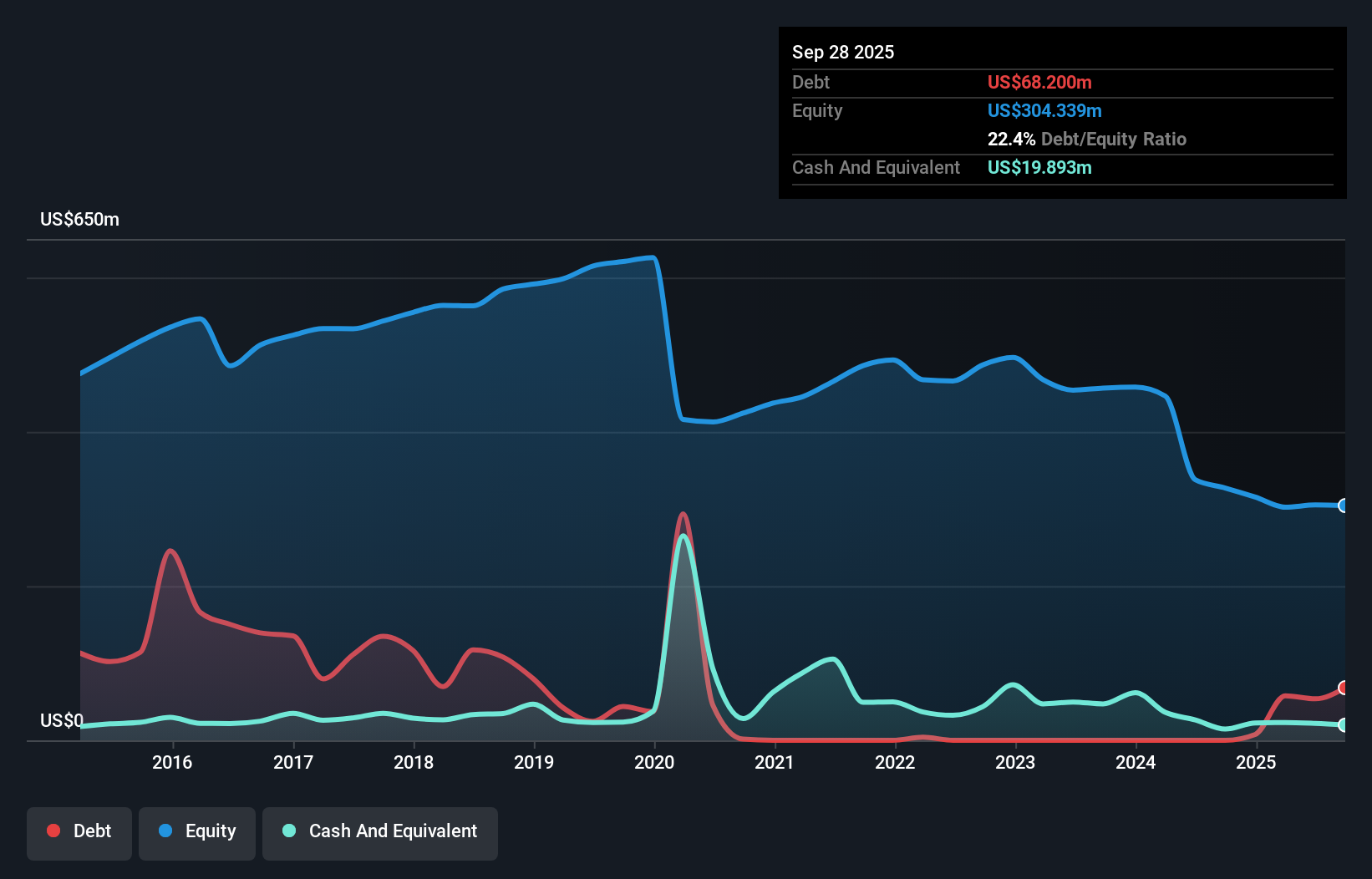
The latest balance sheet data shows that TrueBlue had liabilities of US$155.7m due within a year, and liabilities of US$230.5m falling due after that. Offsetting these obligations, it had cash of US$19.9m as well as receivables valued at US$253.2m due within 12 months. So it has liabilities totalling US$113.1m more than its cash and near-term receivables, combined.
This is a mountain of leverage relative to its market capitalization of US$149.1m. This suggests shareholders would be heavily diluted if the company needed to shore up its balance sheet in a hurry. The balance sheet is clearly the area to focus on when you are analysing debt. But ultimately the future profitability of the business will decide if TrueBlue can strengthen its balance sheet over time. So if you want to see what the professionals think, you might find this free report on analyst profit forecasts to be interesting.
In the last year TrueBlue had a loss before interest and tax, and actually shrunk its revenue by 5.4%, to US$1.6b. That's not what we would hope to see.
Over the last twelve months TrueBlue produced an earnings before interest and tax (EBIT) loss. Its EBIT loss was a whopping US$37m. Considering that alongside the liabilities mentioned above does not give us much confidence that company should be using so much debt. So we think its balance sheet is a little strained, though not beyond repair. However, it doesn't help that it burned through US$65m of cash over the last year. So suffice it to say we consider the stock very risky. For riskier companies like TrueBlue I always like to keep an eye on whether insiders are buying or selling. So click here if you want to find out for yourself.
When all is said and done, sometimes its easier to focus on companies that don't even need debt. Readers can access a list of growth stocks with zero net debt 100% free, right now.
This article by Simply Wall St is general in nature. We provide commentary based on historical data and analyst forecasts only using an unbiased methodology and our articles are not intended to be financial advice. It does not constitute a recommendation to buy or sell any stock, and does not take account of your objectives, or your financial situation. We aim to bring you long-term focused analysis driven by fundamental data. Note that our analysis may not factor in the latest price-sensitive company announcements or qualitative material. Simply Wall St has no position in any stocks mentioned.