

A Look At RadNet (RDNT) Valuation After Recent Share Price Weakness
RadNet, Inc. RDNT | 0.00 |
Recent price performance and business overview
RadNet (RDNT) has drawn investor attention after the stock fell about 4% in the latest session and is now down roughly 11% over the past month and 22% over the past 3 months.
The company operates imaging centers and a digital health segment that together produced about US$2.14b in revenue, largely from the United States. Imaging services such as MRI, CT, PET, mammography, ultrasound, and related procedures form the core of its business.
At a share price of US$51.87, RadNet’s recent 1 month share price return of down about 11% and year to date share price return of down roughly 27% contrast with a 3 year total shareholder return of about 69%. This suggests near term momentum has faded even though longer term holders have still seen gains.
If healthcare AI interests you, this could be a good moment to broaden your research beyond RadNet and scan opportunities across 39 healthcare AI stocks
With RadNet stock down over the past year but still carrying a value score of 4 and trading below some intrinsic estimates, is this weakness indicating a potential opportunity, or is the market already pricing in future growth?
Most Popular Narrative: 42.3% Undervalued
RadNet's most widely followed narrative pegs fair value at about $89.88 per share, well above the recent $51.87 close. This sets up an ambitious long term earnings story for investors to weigh.
Ongoing investments in AI-powered imaging solutions (e.g., DeepHealth, See-Mode, iCAD) are materially increasing center throughput, boosting capacity utilization, and driving more high-margin advanced procedures, directly enhancing both revenue growth and EBITDA margins as adoption scales through 2026.
Want to see what kind of revenue trajectory, margin lift, and future earnings multiple sit behind that fair value? The underlying narrative leans on brisk top line expansion, a swing from losses to profits, and a rich valuation multiple usually reserved for faster growing sectors.
Result: Fair Value of $89.88 (UNDERVALUED)
However, this hinges on execution, as higher AI and digital health spending and any pressure on imaging reimbursement could quickly challenge those optimistic margin and earnings assumptions.
Wall Street's queuing for one rocket. While SpaceX counts down to its IPO, other companies tied to the new space race are already in orbit. → 20 Compelling Space Companies watchlist · Global Space Race Investing Ideas screener · Scan the sector by valuation on Rocket Lab's valuation page.
Another way to look at valuation
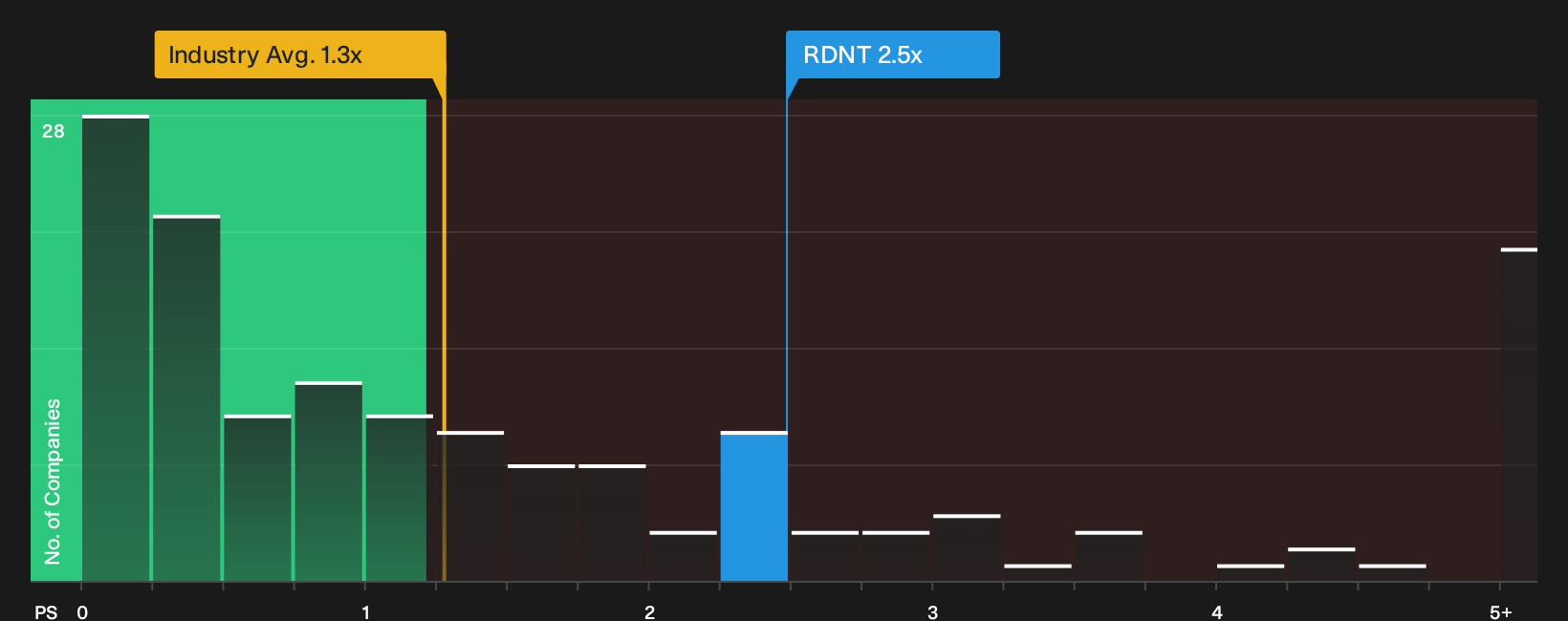
The first view leans on analyst earnings forecasts and an implied P/E of about 120x in 2029 to call RadNet undervalued. On a simpler yardstick like P/S of 1.9x today, the stock looks expensive versus a fair ratio of 1x and a US Healthcare average of 1.2x. This points to valuation risk if those rich earnings assumptions fall short.
Before you lean on one framework over the other, it is worth seeing how the current numbers stack up against the detailed ratios and peer set in our valuation breakdown, starting with See what the numbers say about this price — find out in our valuation breakdown.
Next Steps
With sentiment clearly mixed, this is a good moment to look through the data yourself, decide how much risk you are comfortable with, and weigh the potential upside by reviewing the 3 key rewards and 2 important warning signs.
Looking for more investment ideas?
If RadNet has caught your attention, do not stop here. The best next move is to widen your net and see how other opportunities stack up.
- Spot potential mispricings early by scanning 47 high quality undervalued stocks, where companies combine quality fundamentals with prices that may not fully reflect them.
- Prioritise resilience by reviewing 63 resilient stocks with low risk scores, which highlights stocks with lower risk scores for investors who want steadier sleep at night.
- Hunt for underfollowed opportunities using the screener containing 22 high quality undiscovered gems, so you are not only reacting to what everyone else already watches.
This article by Simply Wall St is general in nature. We provide commentary based on historical data and analyst forecasts only using an unbiased methodology and our articles are not intended to be financial advice. It does not constitute a recommendation to buy or sell any stock, and does not take account of your objectives, or your financial situation. We aim to bring you long-term focused analysis driven by fundamental data. Note that our analysis may not factor in the latest price-sensitive company announcements or qualitative material. Simply Wall St has no position in any stocks mentioned.