

Accenture Stock And Other Dividend Payers Yielding More Than 3%
Accenture Plc Class A ACN | 0.00 |
With global bond markets focused on US 10 year yields near multi decade highs, investors are being paid more to sit in cash and government debt. That raises the bar for any stock in a long term portfolio. High yield dividend powerhouses that combine 5% income with coverage and stable growth can help bridge that gap. This article highlights three such stocks from the Dividend Powerhouses screener.
The three dividend stocks below are only a small sample, and the full screen surfaced 1,863 more companies with similarly compelling income profiles and narratives that do not fit into a single article. To zero in on the ideas that match your risk tolerance and income goals, head straight to the Dividend Powerhouses (3%+ Yield) Dividend Powerhouses (3%+ Yield) screener.
Accenture (ACN)
Accenture is a global consulting and technology services company that helps large enterprises and governments run and modernize their operations, with a big focus on long term systems integration, cloud, managed services and outsourcing work that generates steady cash flow to support its dividend. The business is diversified across Products (about US$22.3b of revenue), Financial Services (US$13.8b), Health & Public Service (US$14.9b), Communications, Media & Technology (US$12.4b) and Resources (US$9.8b), so the dividend is not tied to a single industry. Accenture has a market cap of about US$114.1b, which puts it firmly in large cap territory.
Investors looking for income may want to pay attention to Accenture because its consulting and technology services generate significant recurring cash flow that supports a 3.49% dividend yield. The stock trades on a P/E below the broader US market and IT sector. At the same time, the business is investing heavily in AI driven services, cloud migrations and long running managed service contracts that can influence its dividend capacity. One consideration is that AI could also affect parts of Accenture’s traditional labour based model, and management is working through restructuring and slower bookings. How that balance between cash generation and business change develops is what makes Accenture a notable name for dividend focused investors right now.
Accenture’s push into AI driven services and long term managed contracts could be masking an important shift in its income story. Before assuming the 3.49% yield tells you everything, skim the analysis report for Accenture

Canadian Natural Resources (TSX:CNQ)
Canadian Natural Resources is a large Canadian oil and gas producer that acquires, develops and operates crude oil, natural gas and natural gas liquids assets, with long life production that supports a substantial, stable dividend payout. Most revenue comes from Exploration and Production in North America at about CA$21.3b and Oil Sands Mining and Upgrading at about CA$20.8b, with smaller contributions from midstream and refining and the North Sea and Offshore Africa units. The company has a market cap of roughly CA$144.9b, putting it among the biggest listed energy producers in Canada.
Income focused investors may want to pay attention to Canadian Natural Resources because its long life oil sands and conventional assets are currently generating enough cash to fund a 3.64% dividend that has risen for 26 consecutive years, while also covering sizeable buybacks and debt reduction. Record production, raised 2026 guidance and recent acquisitions indicate meaningful cash flow potential if operational efficiencies and infrastructure projects such as new pipelines and LNG capacity continue to support pricing. The flip side is clear: reliance on higher cost oil sands, carbon regulation and pipeline constraints could test that dividend strength if commodity prices weaken or policy tightens.
Canadian Natural Resources’ long life assets and 26 year dividend track record suggest a stronger income story than a simple 3.64% yield. Use the 4 key rewards and 3 important warning signs (1 is major!) to explore what that payout profile might be hiding.

Commonwealth Bank of Australia (ASX:CBA)
Commonwealth Bank of Australia is a major retail and commercial bank that earns most of its money from everyday banking products like deposits, home loans and business lending, which in turn fund its sizeable, regular dividends. Retail Banking Services, including Bankwest, contribute about A$13.4b of revenue, Business Banking adds roughly A$9.7b, with New Zealand and Institutional Banking and Markets providing around A$3.0b each, giving a diversified earnings mix behind that dividend stream. The bank has a market cap of about A$262.5b, placing it among the largest listed companies in Australia.
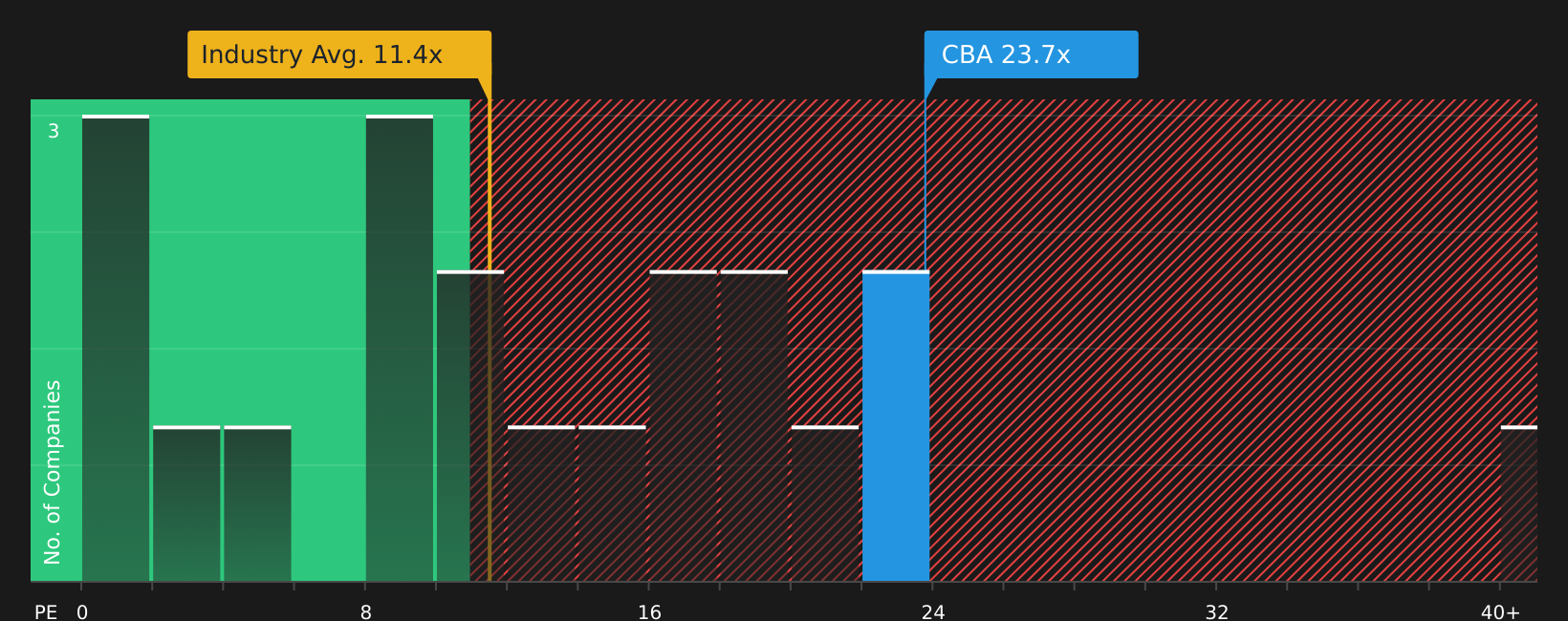
Income investors looking at Commonwealth Bank of Australia are really asking if its dividend stream is worth paying a premium for. On one hand, net interest income from mortgages and deposits, net profit margins above 37% and recent fully franked dividends, including the A$2.70 per share final dividend announced on 11 August 2026, all reflect a substantial cash-generating business. On the other hand, a relatively high P/E, exposure to the housing cycle and rising digital competition mean that even small changes in earnings or margins could affect future payouts. The overall picture depends on how these competing factors influence future dividend policy and capital returns.
Commonwealth Bank of Australia’s premium valuation and rich dividend profile are pulling in opposite directions. Before you assume that balance holds, scan the 1 key reward and 3 important warning signs
Seeking Fresh Alternatives Before Others?
Markets move fast and the next breakout opportunities can slip away while investors hesitate. Scan these fresh ideas before the crowd and act while the data still matters, get in early.
- Target resilient income and capital stability by reviewing a curated 74 resilient stocks with low risk scores that currently show stronger balance sheets and milder swings than many headline stocks.
- Ride the momentum behind AI adoption by assessing a hand picked group of 55 AI infrastructure stocks positioned to support the hardware and backbone these systems rely on.
- Position ahead of potential power system upgrades by checking a focused selection of 38 power grid technology and infrastructure stocks that may benefit if grid spending gains momentum.
This article by Simply Wall St is general in nature. We provide commentary based on historical data and analyst forecasts only using an unbiased methodology and our articles are not intended to be financial advice. It does not constitute a recommendation to buy or sell any stock, and does not take account of your objectives, or your financial situation. We aim to bring you long-term focused analysis driven by fundamental data. Note that our analysis may not factor in the latest price-sensitive company announcements or qualitative material. Simply Wall St has no position in any stocks mentioned.