

AI Isn't The Real Reason Behind Layoffs, Says Agentic Trading Platform Co-Founder
The fear is everywhere. Scroll through LinkedIn on any given day, and you will find another post about AI replacing writers, analysts, coders, and customer service teams. The question of whether artificial intelligence is coming for jobs has moved from an academic debate to dinner-table anxiety.
But is the panic warranted? Can the Agentic market actually take our jobs? In an interview, Andrew Isaacs, co-founder of agentic trading platform Neyro, talked more about what most market leaders actually think about how AI is going to influence our future.
AI Won’t Take Down the Job Market. It Takes Care of Itself.
Whether people push to bash data centers or not, the Agentic market is already coming through the final maturity stages and is on track to become widespread. The global Agentic AI market was valued at $7.6 billion in 2025 and is projected to reach as high as $324 billion by 2034, growing at a compound annual rate of over 40%.
IBM and Salesforce estimate that more than one billion AI agents will be operational worldwide by the end of 2026 alone. But AI isn’t the main job market crisis catalyst, and, actually, the opposite, it’s a way out, sort of.
AI hype and the Agentic market have 2 things in common:
- COVID loans
- Fed hikes
The job market downturn started during COVID cost cuts. Major tech firms woke up to the new reality. I mean, why pay for 4 office floors in NY or Silicon Valley, when they don’t need to? They started to cut costs, and look where to cut even more costs.
COVID added a major catalyst to the market: cheap corporate loans from the Fed. For a brief moment in time, the Federal Reserve rate reached its lowest level in more than 70 years. In 2020, the USA lowered the Fed rate for Corporate Loans to the lowest level ever at 0.25%.

Source: Federal Reserve
The layoffs of the past few years are usually blamed on AI. Isaac disagreed. According to him, the trend had started much earlier, long before ChatGPT entered the conversation.
“The lower the rate, the cheaper the loans, the more companies take loans, and this is generally a good thing when done in moderation. Plot twist, nobody took loans in moderation," Isaac said. "In 2019 alone, total corporate loans grew to $3T, dipped to only $2.4T, then reversed and continued to grow, and so did the FED rate.”
So, Where Does AI Enter the Picture?
At this point, the market needed a way out of the loan circle. According to the Federal Reserve, in 2020, every S&P 500 title had some kind of loan they needed to repay, and shareholders demanded more profits.

With companies already under pressure to repay cheap COVID-era loans and satisfy shareholders demanding returns, something had to give. AI walked in at exactly that moment, and it was very noticeable.
“In 2023, ChatGPT and similar tools gave false hope: replace some workers with AI and cut some costs. Add tariff wars and real wars on top of it, just because why not add more pressure?" Isaacs said.
The co-founder added that many companies were forced to exit certain markets, change their revenue models, and adapt to sanctions, leaving them with little choice but to cut costs.
Mass layoffs in top tech firms followed. Oracle, Google, Amazon, Payoneer, Intel, HP, Apple, Meta, Fiverr, xAI, Salesforce, CISCO, Peloton, according to TechCrunch’s list for 2025.
In total, over 100,000 layoffs were attributed to AI in 2025, and in the first six months of 2026 alone, more than 150,000 additional roles have been cut.
According to him, lots of people lost jobs because companies wanted to cut costs and repay cheap COVID loans they took in a panic. "LLMs and AI were just an obvious scapegoat," and it provided a way out for these companies.
Why Will Humans Remain Relevant In the AI age?
Few frameworks capture the lifecycle of emerging technology better than Gartner’s Hype Cycle. The pattern repeats itself with remarkable consistency: a new technology arrives, people get their hopes up, place every bet on the new thing, burn out, realize it’s still useful, research some more, and find an applicable solution.
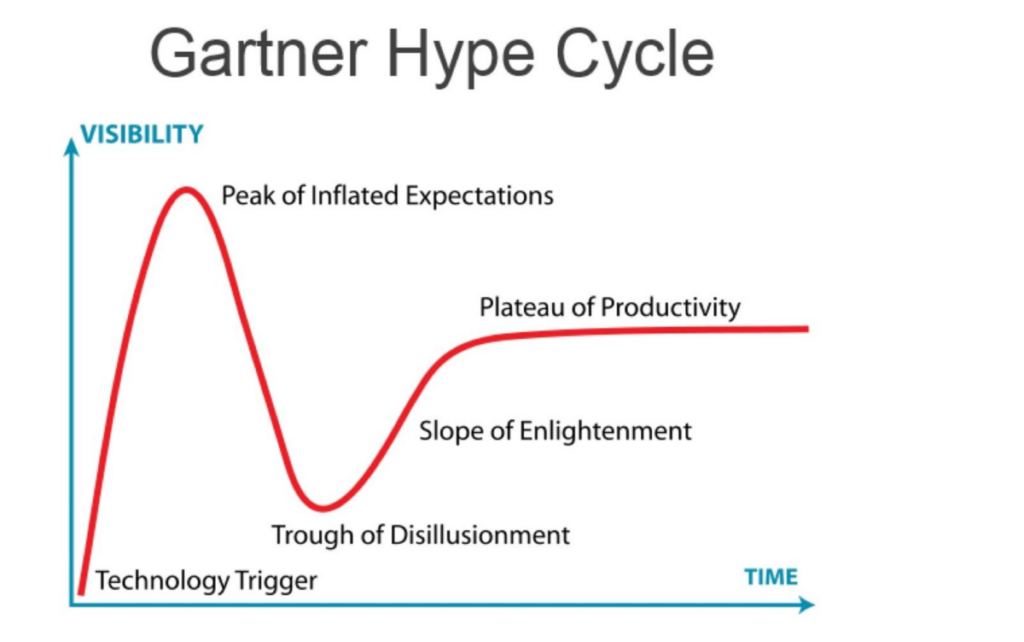
Source: Gartner
Neyro’s founder shared that the sentiment is currently bouncing around inflated expectations and disillusionment.
“With AI, we’re somewhere between the peak of inflated expectations and the trough of disillusionment, where companies start to look at actually productive use for the tech,” he said.
Companies started to realize people are cheaper than inflated AI use. Microsoft acknowledged it first. Uber doubled down and decided to cut the HR department while burning through the AI budget for 2026 in 4 months.
The VP of Nvidia says AI costs “far” more than humans. This is consistent with what the data shows. Gartner estimates that over 40% of agentic AI projects could be cancelled by 2027 due to unclear value, rising costs, and weak governance.
AI won’t go away. It’s like Pandora’s box, once unlocked, the thing’s out, no take-backs. Goldman Sachs realized it too and estimated 120 quadrillion tokens being used by 2030, which is roughly x24 times the current levels. In a recent Fortune report, Bank of America claims AI spending could reach $155 billion by 2030.
AI has made remarkable strides since its inception. It can help with solving protein chains, find new cures for old diseases, push cancer research by decades, save lives by unconventional means, discover new materials people never thought of, and make medicine cheaper.
It’s not a silver bullet; people still need to understand what they do, but if they do, AI can make them ten times better at what they’re doing.
However, AI can still be misused. For example, LLMs are used to increase refusal rates in the insurance industry, which is a bad thing to do. Meanwhile, Alfred Nobel founded his Nobel Prize with money he made from inventing dynamite, so don’t blame the tool, blame those who misuse it.
Why Agentic Market Will Take Mundane Parts of Your Job
Many may be wondering what the Agentic market actually means for the average worker in finance. While financial firms are increasingly embracing AI, Isaacs believes there should be a clear line between using AI to assist with decisions and allowing it to make them.
“Here’s a thing from my work experience: all major financial firms want to automate the number-crunching parts as much as possible. That’s inevitable if they want any competitive edge, he said. "There’s a catch, and IBM said it in 1970. A computer cannot be held accountable for a decision; therefore, it should not be able to make a management decision.”
The line between execution and judgment, in his view, is where the human remains essential. Agents handle the inputs. People make the calls.
That distinction extends beyond finance. People are already using LLMs to code MVP products in their spare time, crunch through things they don’t know how to do, research topics much faster, and educate themselves better. LLMs are tools everyone can deploy and get their own Jarvis in the garage, running locally on their own PCs.
Anyone can ask an LLM how to learn something they have absolutely zero experience in and get a full step-by-step explanation. The barrier to capability has never been lower.
“In future, it won’t be ‘person with agents vs person without agents’, it will be ‘person with ideas vs person without ideas’. The value of creativity will actually rise, because that’s what agents empower. If you’re good at what you do, agents will only make you better,” the founder added.
The Rails Are Being Built, And the Trains Are Coming
The practical upside, as Isaacs sees it, is straightforward. Agents free up time by handling the tedious and repetitive parts of work that drain energy without requiring real judgment. It is not about delegating everything. It is about delegating the right things.
But none of this works without infrastructure, and Isaacs pointed to how quickly that infrastructure is being built. Visa, Mastercard, Solana, Coinbase, LG, and Stripe are all developing payment and verification layers specifically designed for agent-to-agent transactions.
“Agentic market is maturing. The railroads for the future agents are being built already. Visa, Mastercard, Solana, Coinbase, LG, Stripe are all building payment and verification layers for the tech. They know it’s coming, so they build tools,” he said.
The numbers back that up. OpenAI closed a $40 billion funding round in April 2025, earmarking agent revenues projected at $29 billion annually by 2029. Microsoft’s AI-related business reached an annual revenue run rate of $13 billion in Q2 2025, a 175% year-over-year increase. The companies building the rails clearly believe the trains are coming.
In trading and finance specifically, Isaacs sees agents as the helping hand that makes the work sustainable again. The number-crunching, the trend-spotting, the pattern recognition, all of it can be handled without a human in the loop for every step.
“Market monitoring, for instance, can take up to 14 hours for some people and it sucks out all the fun from trading. This is where Agentic use can actually speed things up, save time and provide benefits from doing so.”
Agents will come whether we want it to happen or not. But it always helps to be in touch with tech that can change your life for the better.
Benzinga Disclaimer: This article is from an unpaid external contributor. It does not represent Benzinga’s reporting and has not been edited for content or accuracy.