

Assessing BancFirst (BANF) Valuation As Recent Returns Send Mixed Signals
BancFirst Corporation BANF | 0.00 |
Recent performance context for BancFirst stock
BancFirst (BANF) has drawn attention after recent trading left the stock with a last close of $113.24, set against a backdrop of mixed return figures across the past week, month, and past 3 months.
At a share price of $113.24, BancFirst’s recent 1-day share price decline of 1.11% comes after a 6.36% year to date share price gain. The 3-year total shareholder return of 61.60% and 5-year total shareholder return of 69.20% reflect a longer track record that contrasts with the 6.39% total shareholder return decline over the past year, suggesting shorter term momentum has cooled relative to earlier periods.
If you are comparing BancFirst with other opportunities, this could be a good moment to broaden your watchlist and check out 19 top founder-led companies
With a recent 1 year total shareholder return decline alongside stronger 3 and 5 year figures, and an indicated intrinsic discount of about 39%, the key question is whether BancFirst is now undervalued or if the market is already pricing in future growth.
Price-to-Earnings of 15.4x: Is it justified?
On a P/E basis, BancFirst trades at 15.4x, which aligns with a stock that appears to offer good value on cash flow models but looks expensive relative to peers.
The P/E ratio compares the share price to earnings per share. A higher figure usually reflects stronger market expectations for future profitability or a perceived quality premium.
For BancFirst, the current P/E of 15.4x is above both the US Banks industry average of 11.5x and an estimated fair P/E of 10.7x. This indicates that the market is paying a clear premium compared with sector peers and is pricing the stock above the level that regression analysis identifies as a potential equilibrium the valuation could move toward if sentiment cools.
Result: Price-to-Earnings of 15.4x (OVERVALUED)
However, the recent 1 year total shareholder return decline and a P/E above the US Banks industry average could indicate that sentiment and valuation expectations are vulnerable.
Another angle on value: cash flows point the other way
While the 15.4x P/E suggests BancFirst trades at a premium to both the US Banks industry average of 11.5x and an estimated fair ratio of 10.7x, the SWS DCF model presents a different perspective. It shows a fair value estimate of $184.34 versus the current $113.24, which implies the stock screens as undervalued on cash flows.
When one model flags a premium and another signals a discount, it puts the focus on which set of assumptions about future earnings and cash flows investors consider more reliable.
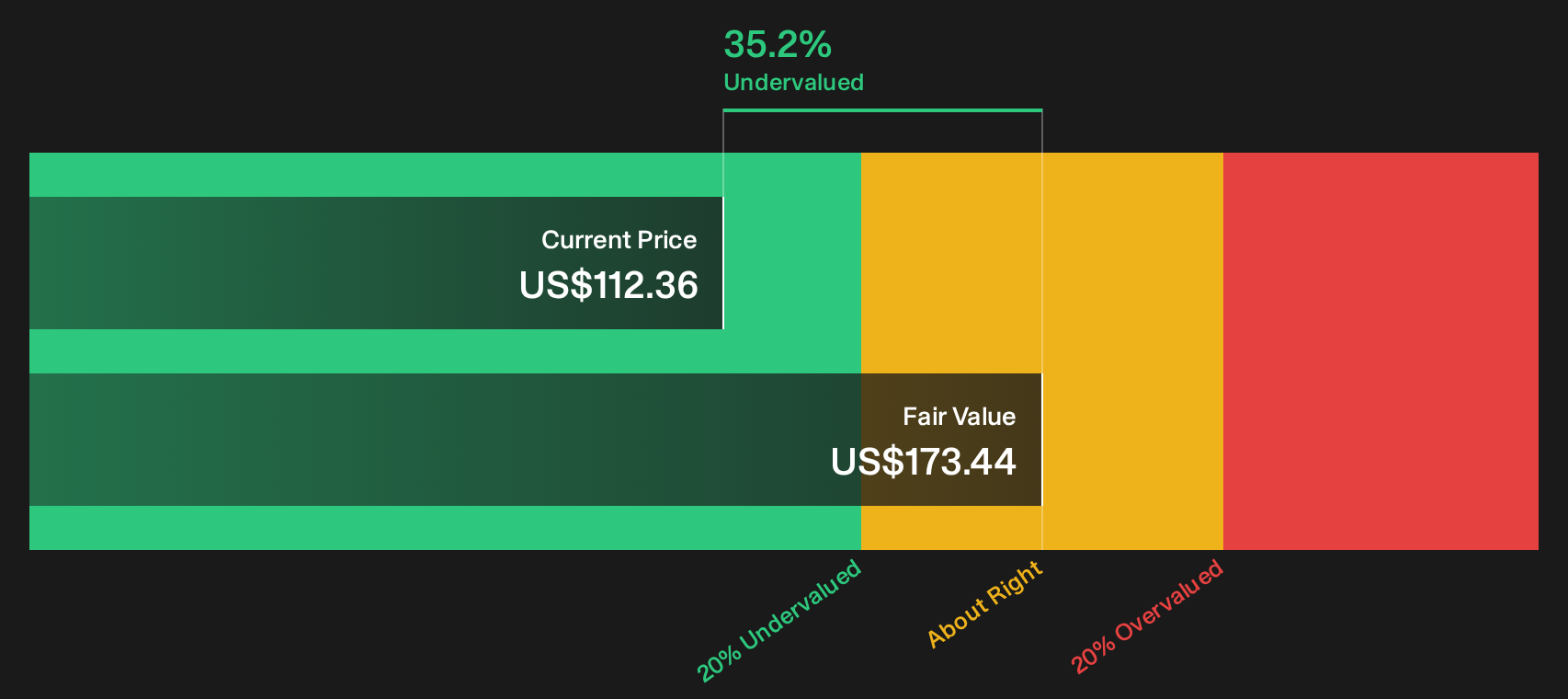
Simply Wall St performs a discounted cash flow (DCF) on every stock in the world every day (check out BancFirst for example). We show the entire calculation in full. You can track the result in your watchlist or portfolio and be alerted when this changes, or use our stock screener to discover 51 high quality undervalued stocks. If you save a screener we even alert you when new companies match - so you never miss a potential opportunity.
Next Steps
Mixed signals on valuation can be confusing, so acting while the data is fresh can help you form a clear view. To weigh up both the concerns and the potential upside, take a closer look at the 3 key rewards and 1 important warning sign.
Looking for more investment ideas?
If BancFirst has sharpened your thinking, do not stop here. Use this momentum to scan for other stocks that might better fit your goals and risk comfort.
- Target potential mispricings by reviewing companies that screen well on valuation and quality through the 51 high quality undervalued stocks.
- Strengthen the income side of your portfolio by checking out the 12 dividend fortresses for ideas with higher yields.
- Prioritise resilience by reviewing the 72 resilient stocks with low risk scores to spot stocks with lower overall risk scores before others do.
This article by Simply Wall St is general in nature. We provide commentary based on historical data and analyst forecasts only using an unbiased methodology and our articles are not intended to be financial advice. It does not constitute a recommendation to buy or sell any stock, and does not take account of your objectives, or your financial situation. We aim to bring you long-term focused analysis driven by fundamental data. Note that our analysis may not factor in the latest price-sensitive company announcements or qualitative material. Simply Wall St has no position in any stocks mentioned.