

Block (SQ) Stock Still Looks Undervalued On A 71% Five Year Slump
Block XYZ | 0.00 |
Block’s share price has climbed in the short term but is still down about 70.5% over the past five years, and its valuation checks now send mixed messages, with an Excess Returns intrinsic value estimate pointing to upside while market multiples suggest the stock is priced more richly. Recent AI driven restructuring and product momentum add to the debate over whether the current US$79.00 level offers enough compensation for those risks.
- Over five years, Block’s share price has declined about 70.5%, which puts extra focus on whether today’s valuation leaves room for a meaningful recovery.
- Recent AI driven changes to Block’s operations and products can support higher profitability expectations, while execution risks around the leaner workforce and new tools may weigh on what investors are willing to pay.
- On Simply Wall St’s broader checks, Block scores 3 out of 6 on valuation, which points to a mixed picture rather than a clear bargain or clear overvaluation.
The issue now is whether Block’s current price better reflects the upside suggested by the Excess Returns intrinsic value estimate or the caution implied by richer earnings based multiples.
Is Block Still Cheap on Excess Returns?
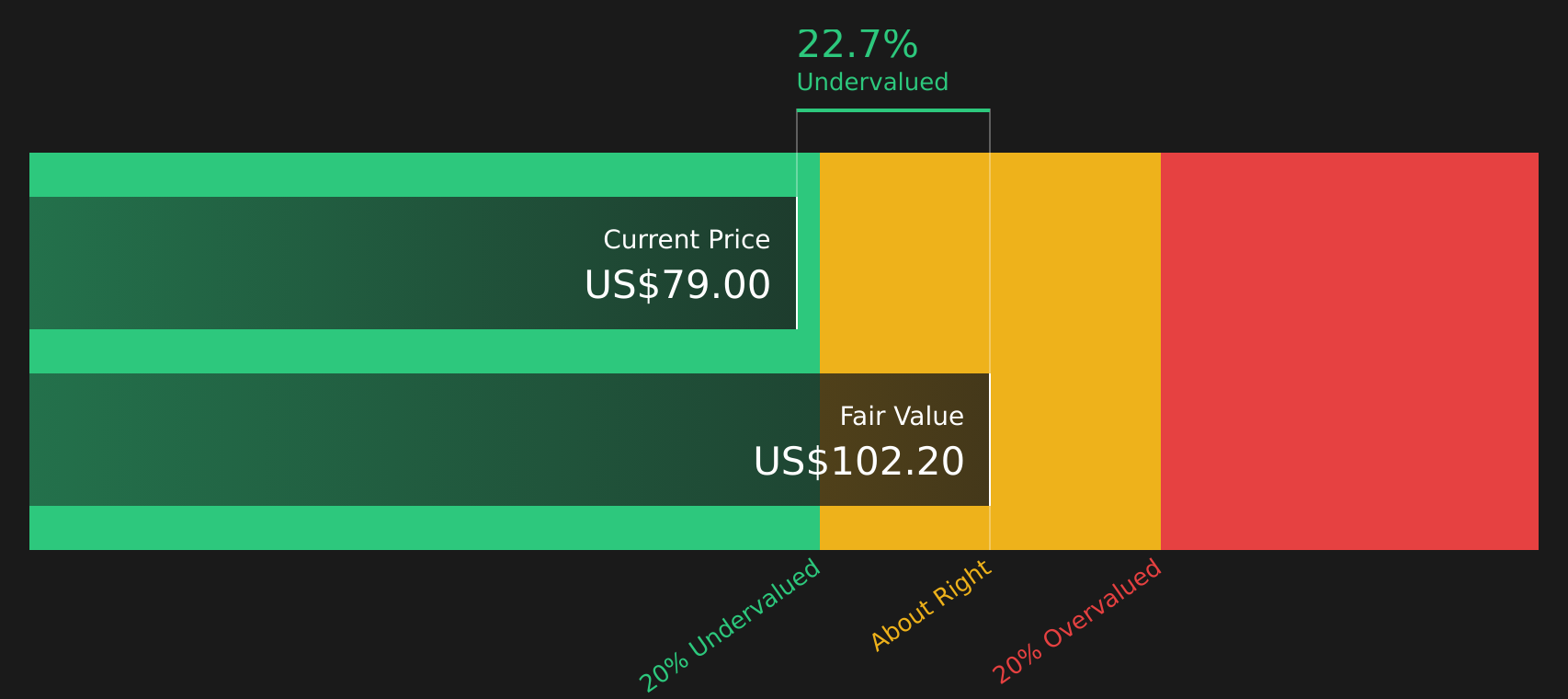
The Excess Returns model evaluates how much profit Block can earn on its equity above its estimated cost of equity. On this basis, the model arrives at an intrinsic value of about $102 per share. This is above the current $79 price and implies the stock is 22.8% undervalued.
For Block, the inputs suggest earnings power that stands meaningfully above its funding cost. Book value is set at $36.70 per share and is projected to move toward a stable $46.52 per share. Stable EPS is modeled at $5.68 per share against an equity cost of $3.52 per share, which leaves an excess return of $2.16 per share and an average return on equity of 12.21%. The gap between return on equity and cost of equity is what drives the model’s view of upside potential.
Because Block has recently reported strong Q2 gross profit and margins following its AI driven restructuring, the model’s assumption that the company can sustain returns above its equity cost helps explain why intrinsic value sits above the current share price.
On the Excess Returns view, Block screens as undervalued, with the share price sitting below the model’s estimate of its long term earnings power.
Our Excess Returns analysis suggests Block is undervalued by 22.8%. Track this in your watchlist or portfolio, or discover 51 more high quality undervalued stocks.
Has Block Run Too Far on Earnings?
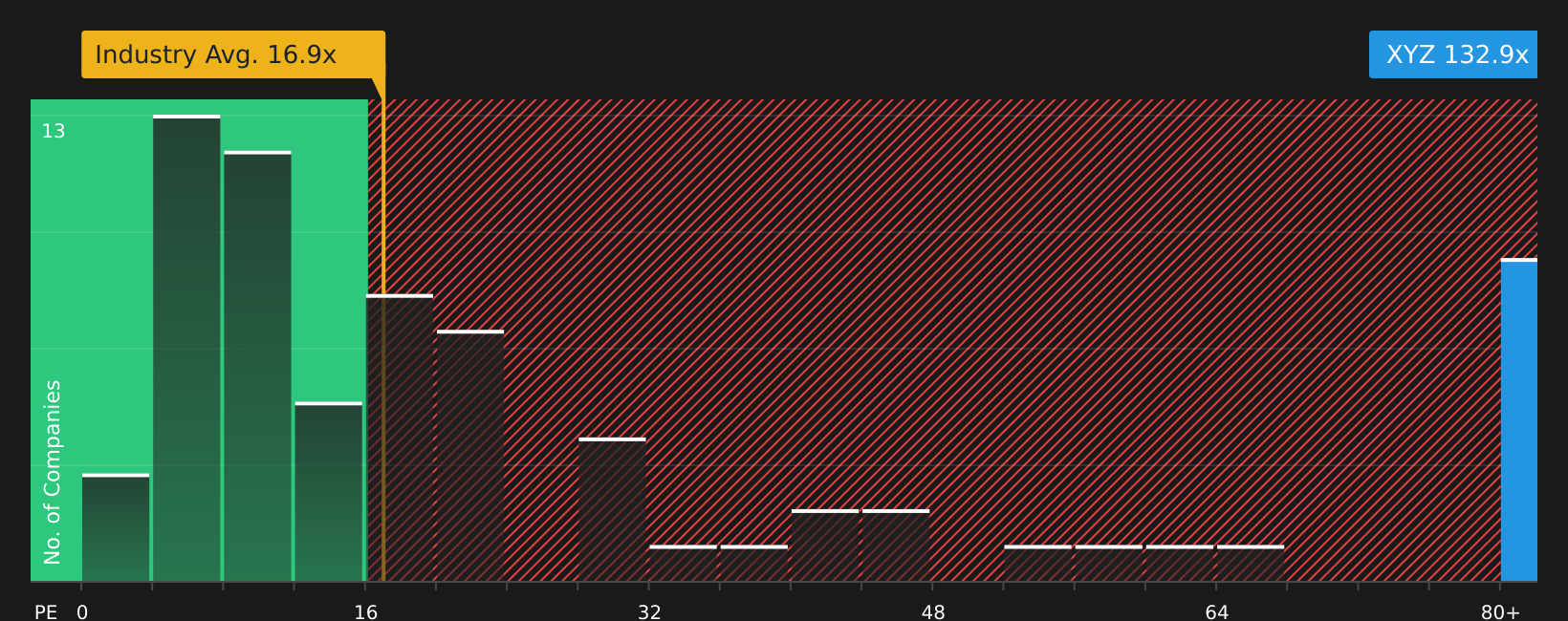
The P/E ratio is the cleanest way to see what you are paying today for each dollar of Block’s reported earnings. On this measure, Block trades on a P/E of about 132.9x at a share price near US$79.00.
That compares with an industry average P/E for Diversified Financial stocks of about 16.9x and a broader peer average of roughly 12.3x. Even after allowing for Block’s business mix and risk profile, Simply Wall St’s fair P/E ratio for the stock is about 34.7x. The model is heavily penalising the company on this framework, so the gap between the current multiple and this fair ratio is best read as a warning that the stock screens very expensively on earnings rather than as a precise target level.
Taken on its own, Block appears overvalued on the P/E multiple, with the market pricing its earnings at a substantial premium to sector norms and the model’s fair ratio.
The Block Narrative: What Would Justify Today's Price?
Simply Wall St Narratives pick up where the valuation puzzle around Block leaves off. They set out the specific growth, margin and earnings paths that would need to hold for the stock to be worth materially more or less than today’s price, all in one place on the Community page. Each narrative ties a fair value to a particular storyline about Block's potential catalysts and risks so you can track over time which version feels closest to what is actually unfolding.
Community views on Block are split between an AI and ecosystem powered upside story and a tougher regulatory and competition risk story.
Bull case: 15% undervalued
"Continued expansion of embedded banking and lending products (Borrow and BNPL) within Cash App, fueled by proprietary credit scoring and increasing eligibility/limits, is opening new user cohorts and higher ARPU segments..."
Bear case: 10% overvalued
"Expanding regulatory pressures, cyber threats, and dependence on cryptocurrency inflows add cost burdens and amplify earnings volatility for Block..."
Do you think there's more to the story for Block? Head over to our Community to see what others are saying!
The Bottom Line
Block’s Excess Returns intrinsic value estimate points to meaningful upside, while the P/E multiple screens as overvalued compared with both peers and the model’s fair ratio. That gap reflects a market that is paying a high headline multiple for earnings, even as the intrinsic view focuses on Block’s ability to earn above its equity cost over time. With broader valuation checks sitting in a mixed range, the key question is whether Block’s AI driven restructuring and product momentum can deliver the margin and earnings profile that justifies both the premium multiple and the intrinsic value estimate, rather than the current price proving to be a value trap.
This article by Simply Wall St is general in nature. We provide commentary based on historical data and analyst forecasts only using an unbiased methodology and our articles are not intended to be financial advice. It does not constitute a recommendation to buy or sell any stock, and does not take account of your objectives, or your financial situation. We aim to bring you long-term focused analysis driven by fundamental data. Note that our analysis may not factor in the latest price-sensitive company announcements or qualitative material. Simply Wall St has no position in any stocks mentioned.