

Did Declining Margins and Rising Costs Just Shift Peabody Energy's (BTU) Investment Narrative?
Peabody Energy BTU | 0.00 |
- Recently, Peabody Energy reported that its annual revenue has declined by 2.7% over the past decade, while high extraction costs have compressed gross margins and contributed to a weaker EBITDA margin over the last five years.
- This deterioration in operational efficiency has prompted some analysts to urge caution on the company, highlighting how rising costs can erode profitability even when headline revenue trends appear relatively stable.
- Next, we will examine how Peabody’s declining EBITDA margin and broader operational pressures might reshape the previously positive investment narrative around policy support and efficiency gains.
Uncover the next big thing with 28 elite penny stocks that balance risk and reward.
Peabody Energy Investment Narrative Recap
To own Peabody, you have to believe that policy support, resilient coal demand and portfolio shifts toward metallurgical coal can offset long term decarbonization and regulatory headwinds. The latest confirmation of revenue decline and margin pressure directly challenges the near term efficiency catalyst, while reinforcing the biggest current risk that rising costs and weaker EBITDA could constrain flexibility just as policy and demand conditions are most supportive.
The most relevant recent announcement here is Peabody’s Q1 2026 update, where revenue of US$973.3 million came alongside a net loss of US$32.4 million. That mix of solid top line and negative earnings, together with the company’s volume guidance for 2026, underscores how cost inflation and compressed margins are now central to the story and may influence how investors weigh policy tailwinds against execution risk on profitability.
Yet beneath this supportive policy backdrop, investors should be aware of...
Peabody Energy’s narrative projects $4.8 billion revenue and $449.0 million earnings by 2029. This implies 7.9% yearly revenue growth and a $501.7 million earnings increase from -$52.7 million today.
Uncover how Peabody Energy's forecasts yield a $39.75 fair value, a 63% upside to its current price.
Exploring Other Perspectives
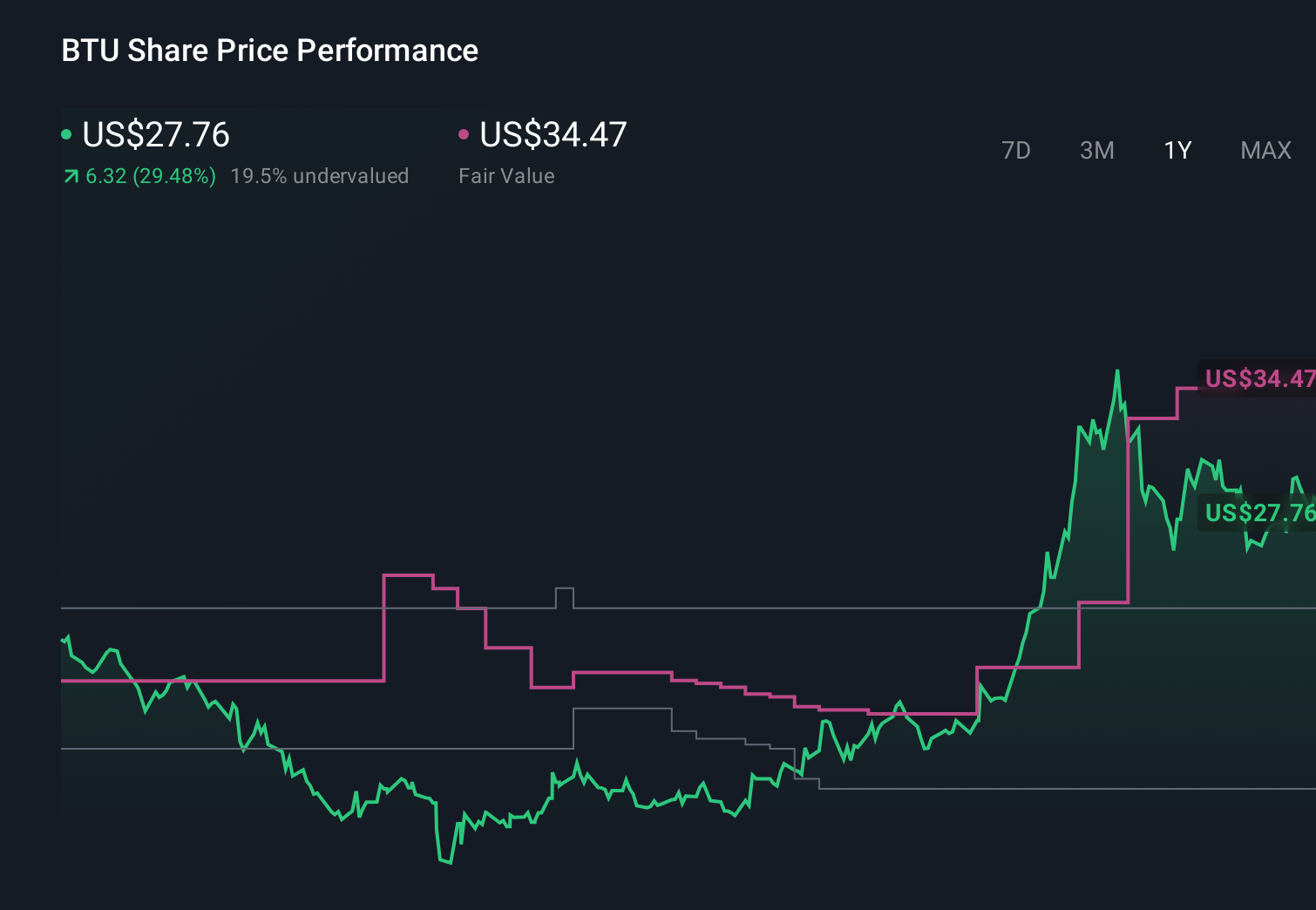
Some of the lowest ranked analysts were already cautious, assuming revenue of about US$4.4 billion and earnings of US$463.9 million by 2029, and the latest EBITDA margin squeeze may push their more pessimistic view of decarbonization risks and fixed cost pressure even further, so you should compare these assumptions with your own and see how your expectations differ.
Explore 6 other fair value estimates on Peabody Energy - why the stock might be worth just $33.78!
Reach Your Own Conclusion
Disagree with existing narratives? Extraordinary investment returns rarely come from following the herd, so go with your instincts.
- A great starting point for your Peabody Energy research is our analysis highlighting 4 key rewards and 1 important warning sign that could impact your investment decision.
- Our free Peabody Energy research report provides a comprehensive fundamental analysis summarized in a single visual - the Snowflake - making it easy to evaluate Peabody Energy's overall financial health at a glance.
Seeking Other Investments?
Right now could be the best entry point. These picks are fresh from our daily scans. Don't delay:
- Explore 26 top quantum computing companies leading the revolution in next-gen technology and shaping the future with breakthroughs in quantum algorithms, superconducting qubits, and cutting-edge research.
- Outshine the giants: these 14 early-stage AI stocks could fund your retirement.
- Rare earth metals are an input to most high-tech devices, military and defence systems and electric vehicles. The global race is on to secure supply of these critical minerals. Beat the pack to uncover the 27 best rare earth metal stocks of the very few that mine this essential strategic resource.
This article by Simply Wall St is general in nature. We provide commentary based on historical data and analyst forecasts only using an unbiased methodology and our articles are not intended to be financial advice. It does not constitute a recommendation to buy or sell any stock, and does not take account of your objectives, or your financial situation. We aim to bring you long-term focused analysis driven by fundamental data. Note that our analysis may not factor in the latest price-sensitive company announcements or qualitative material. Simply Wall St has no position in any stocks mentioned.