

Did Trinity’s New Debt and Equity Raises Plus Revenue Jump Just Shift Trinity Capital's (TRIN) Investment Narrative?
Trinity Capital, Inc. TRIN | 0.00 |
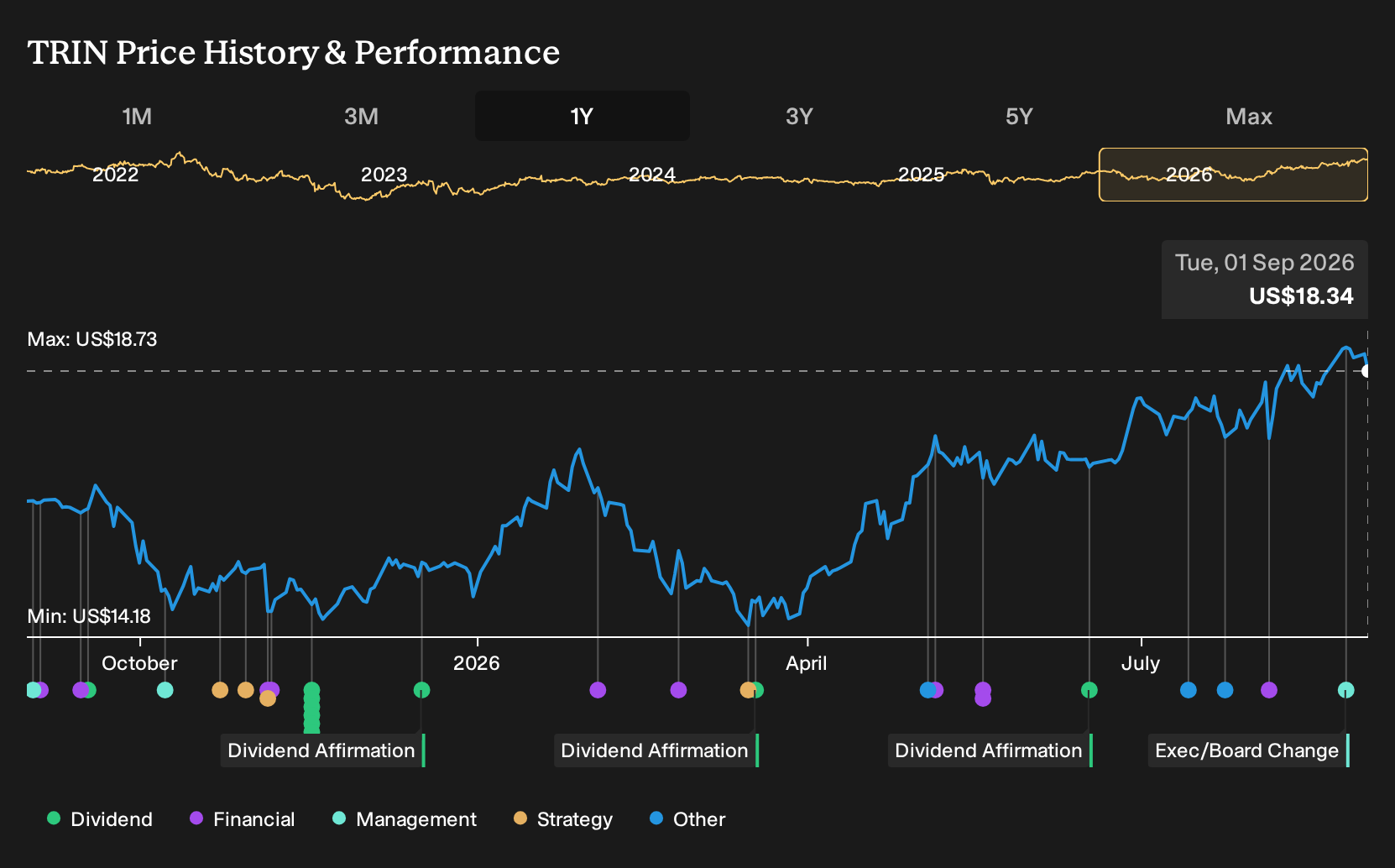
- In May 2026, Trinity Capital completed a US$297.54 million fixed-income offering and announced a US$300.00 million follow-on equity raise, alongside first-quarter revenue of US$90.13 million versus US$65.39 million a year earlier and a slight dip in earnings per share.
- Insider share purchases during this period highlight management’s confidence in the business, even as the company continues to rely on external capital to fund its growth.
- We’ll now examine how Trinity’s recent fixed-income and follow-on equity offerings may reshape its investment narrative and future risk‑reward profile.
We've uncovered the 9 dividend fortresses yielding 5%+ that don't just survive market storms, but thrive in them.
Trinity Capital Investment Narrative Recap
To own Trinity Capital, you need to believe in its niche as a lender to high growth companies and its ability to turn that position into durable income. The recent US$297.54 million fixed income raise and US$300.00 million follow on equity plan strengthen funding capacity, but they do not materially change the near term balance between the key catalyst of sustained revenue growth and the ongoing risk of dilution and elevated funding costs.
The follow on equity offering of up to US$300.00 million is the announcement most closely tied to this capital raising story, because it directly influences how Trinity funds new loans and equipment financings. For investors watching revenue momentum and credit quality as the primary upside drivers, the size and timing of this equity program sit alongside the company’s high dividend payout and interest coverage as factors that could shape future returns.
Yet even with insider buying and rising revenue, the combination of shareholder dilution and interest coverage pressures is something investors should be aware of...
Trinity Capital's narrative projects $459.5 million revenue and $240.3 million earnings by 2029.
Uncover how Trinity Capital's forecasts yield a $17.78 fair value, a 5% upside to its current price.
Exploring Other Perspectives
Four members of the Simply Wall St Community currently value Trinity Capital between US$5.49 and US$27.09 per share, showing a wide spread of expectations. When you set those views against Trinity’s reliance on external capital raises to support revenue growth, it underlines how differently people weigh funding risk and growth potential, and why it can help to explore several alternative viewpoints before forming your own.
Explore 4 other fair value estimates on Trinity Capital - why the stock might be worth less than half the current price!
Decide For Yourself
Don't just follow the ticker - dig into the data and build a conviction that's truly your own.
- A great starting point for your Trinity Capital research is our analysis highlighting 3 key rewards and 4 important warning signs that could impact your investment decision.
- Our free Trinity Capital research report provides a comprehensive fundamental analysis summarized in a single visual - the Snowflake - making it easy to evaluate Trinity Capital's overall financial health at a glance.
Interested In Other Possibilities?
Markets shift fast. These stocks won't stay hidden for long. Get the list while it matters:
- Invest in the nuclear renaissance through our list of 88 elite nuclear energy infrastructure plays powering the global AI revolution.
- This technology could replace computers: discover 30 stocks that are working to make quantum computing a reality.
- AI is about to change healthcare. These 39 stocks are working on everything from early diagnostics to drug discovery. The best part - they are all under $10b in market cap - there's still time to get in early.
This article by Simply Wall St is general in nature. We provide commentary based on historical data and analyst forecasts only using an unbiased methodology and our articles are not intended to be financial advice. It does not constitute a recommendation to buy or sell any stock, and does not take account of your objectives, or your financial situation. We aim to bring you long-term focused analysis driven by fundamental data. Note that our analysis may not factor in the latest price-sensitive company announcements or qualitative material. Simply Wall St has no position in any stocks mentioned.