

DiDi Global (OTCPK:DIDI.Y) Could Be 80% Undervalued As Earnings Return To Profit
Why DiDi Global’s Latest Earnings Matter For Investors
DiDi Global (OTCPK:DIDI.Y) has drawn fresh attention after second quarter 2026 earnings showed sales of CNY 62,522 million and net income of CNY 866 million, compared with a net loss in the prior year period.
Since these results, DiDi Global’s share price has moved to $3.94, with a 1 month share price return of 11.61% and a 3 month share price return of 13.54%, although the year to date share price return has declined 29.14%. Over a longer horizon, the 3 year total shareholder return of 21.60% contrasts with a 1 year total shareholder return that has declined 36.86%. This suggests that recent momentum has been weaker, even as the latest earnings may be shifting how investors view the company’s risk and recovery prospects.
If DiDi Global’s recent move has you looking at other transport and infrastructure trends linked to AI, it could be a useful time to scan 54 AI infrastructure stocks
After DiDi Global’s earnings swing back to profit and there is a quick rebound in the share price, the real decision is whether to accept today’s valuation or wait for a clearer entry point. Here is how that trade off looks.
Preferred Price-to-Sales Multiple of 0.5x: Is It Justified?
On the current numbers, DiDi Global trades on a P/S ratio of 0.5x, which screens as inexpensive compared with both its peers and the broader US Transportation industry.
The P/S ratio compares the company’s market value with its revenue. For a platform business like DiDi Global, where earnings only recently turned positive and can still be affected by large one off items, revenue based measures often give a cleaner snapshot of what investors are paying for the underlying business activity.
At 0.5x, DiDi Global is described as trading at good value compared with similar companies and the sector, where peer averages are around 2x and the US Transportation industry average is 1.3x. The estimated fair P/S ratio of 1.2x is also well above today's level. This indicates a large gap between current pricing and the level the market could move toward if sentiment and fundamentals remain aligned with these estimates.
Result: Price-to-Sales of 0.5x (UNDERVALUED)
However, DiDi Global still faces risks from regulatory changes in key markets and any slowdown in revenue growth, which could challenge the current P/S narrative.
Another View on DiDi Global’s Value
The SWS DCF model paints an even stronger picture for DiDi Global. It suggests a fair value of $20.01 per share versus the current $3.94 price, which screens as very undervalued. That is a wide gap. The key question is whether you trust long term cash flow forecasts more than simple sales multiples.
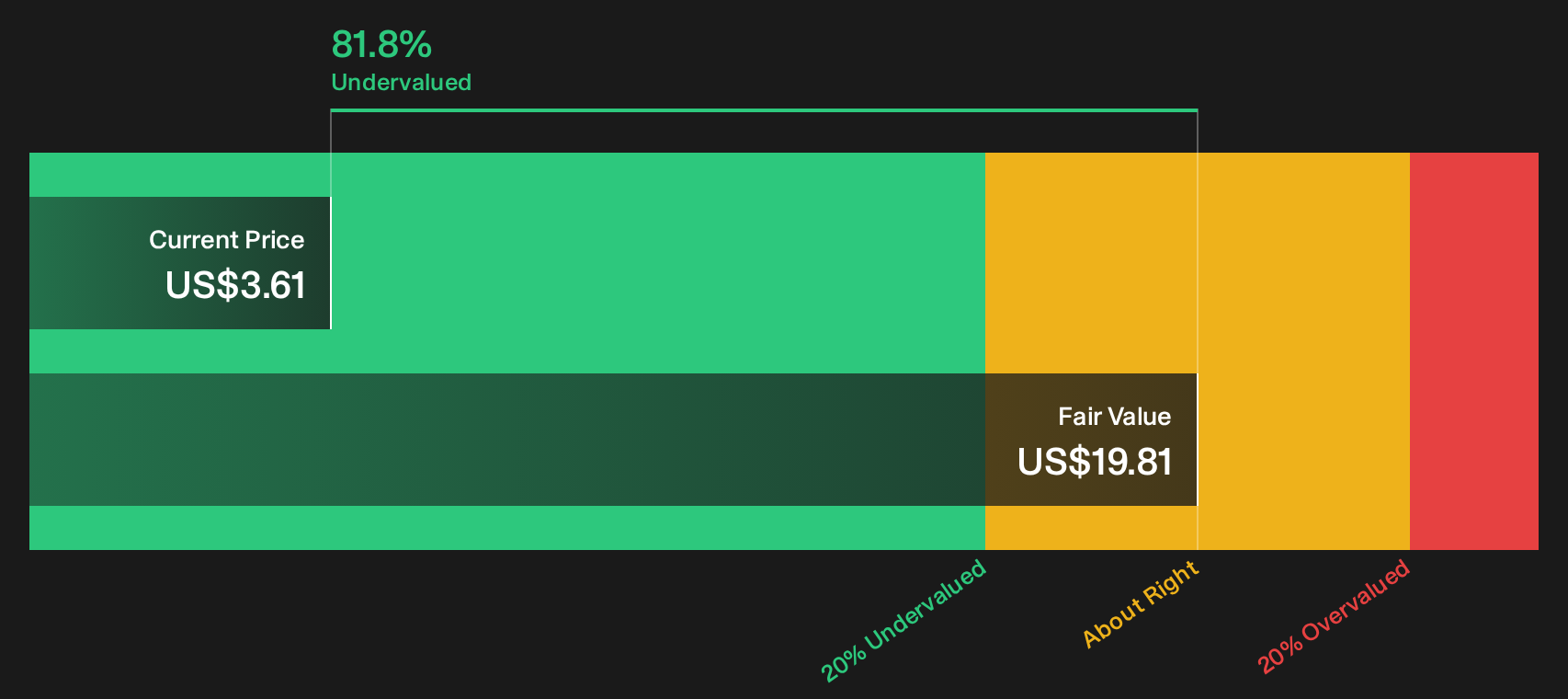
Simply Wall St performs a discounted cash flow (DCF) on every stock in the world every day (check out DiDi Global for example). We show the entire calculation in full. You can track the result in your watchlist or portfolio and be alerted when this changes, or use our stock screener to discover 50 high quality undervalued stocks. If you save a screener we even alert you when new companies match - so you never miss a potential opportunity.
Next Steps
With sentiment on DiDi Global split between opportunity and caution, it makes sense to review the key data points yourself and move promptly to form a view. To help balance both the concerns and the optimism around the stock, start with the 4 key rewards and 1 important warning sign.
Looking For More Investment Ideas Beyond DiDi Global?
If DiDi Global has sharpened your focus, do not stop there. Use the Simply Wall St screener to compare other opportunities, refine your watchlist, and sharpen your next move.
- Target companies with strong fundamentals by reviewing the solid balance sheet and fundamentals stocks screener (50 results) that prioritise resilient balance sheets and consistent financial profiles.
- Spot potential value opportunities early by scanning the screener containing 19 high quality undiscovered gems before wider market attention increases interest.
- Reduce portfolio volatility by considering the 79 resilient stocks with low risk scores that filters for stocks with more measured risk profiles.
This article by Simply Wall St is general in nature. We provide commentary based on historical data and analyst forecasts only using an unbiased methodology and our articles are not intended to be financial advice. It does not constitute a recommendation to buy or sell any stock, and does not take account of your objectives, or your financial situation. We aim to bring you long-term focused analysis driven by fundamental data. Note that our analysis may not factor in the latest price-sensitive company announcements or qualitative material. Simply Wall St has no position in any stocks mentioned.