

Do JLL’s Constrained Free Cash Flow Margins Undermine Its Ability To Translate Scale Into Profitability?
Jones Lang LaSalle Incorporated JLL | 0.00 |
- In recent months, commentary on Jones Lang LaSalle has underscored concerns about its long-term revenue growth, constrained free cash flow margins, and stagnant return on invested capital. These pressures have raised questions about how effectively the company can convert its large revenue base and recent investments into stronger, sustainable profitability.
- We’ll now examine how these concerns about JLL’s constrained free cash flow margins may reshape the company’s broader investment narrative.
Invest in the nuclear renaissance through our list of 88 elite nuclear energy infrastructure plays powering the global AI revolution.
Jones Lang LaSalle Investment Narrative Recap
To stay invested in Jones Lang LaSalle, you need to believe its large, global real estate platform can steadily translate scale into healthier margins and more dependable cash generation. The recent share price underperformance, alongside concerns over long term revenue growth, free cash flow margins, and return on invested capital, puts the spotlight on whether improved profitability, rather than sales alone, can drive the next leg of value creation. For now, the key risk is that weak cash conversion limits flexibility just as the real estate cycle remains uncertain.
The most relevant recent update is JLL’s Q1 2026 earnings, where the company reported sales of US$6,386.5m and net income of US$159m. While these figures show JLL can grow revenue and earnings, they do not directly answer the concerns around structurally low free cash flow margins or stagnant returns on invested capital. Instead, they set the backdrop for investors to judge if continued earnings growth can eventually translate into stronger cash generation and better capital efficiency.
Yet beneath that headline, one underappreciated risk investors should be aware of is JLL’s exposure to structurally weaker office leasing demand and...
Jones Lang LaSalle's narrative projects $32.4 billion revenue and $1.3 billion earnings by 2029. This requires 6.6% yearly revenue growth and roughly a $400 million earnings increase from $895.8 million today.
Uncover how Jones Lang LaSalle's forecasts yield a $383.00 fair value, a 31% upside to its current price.
Exploring Other Perspectives
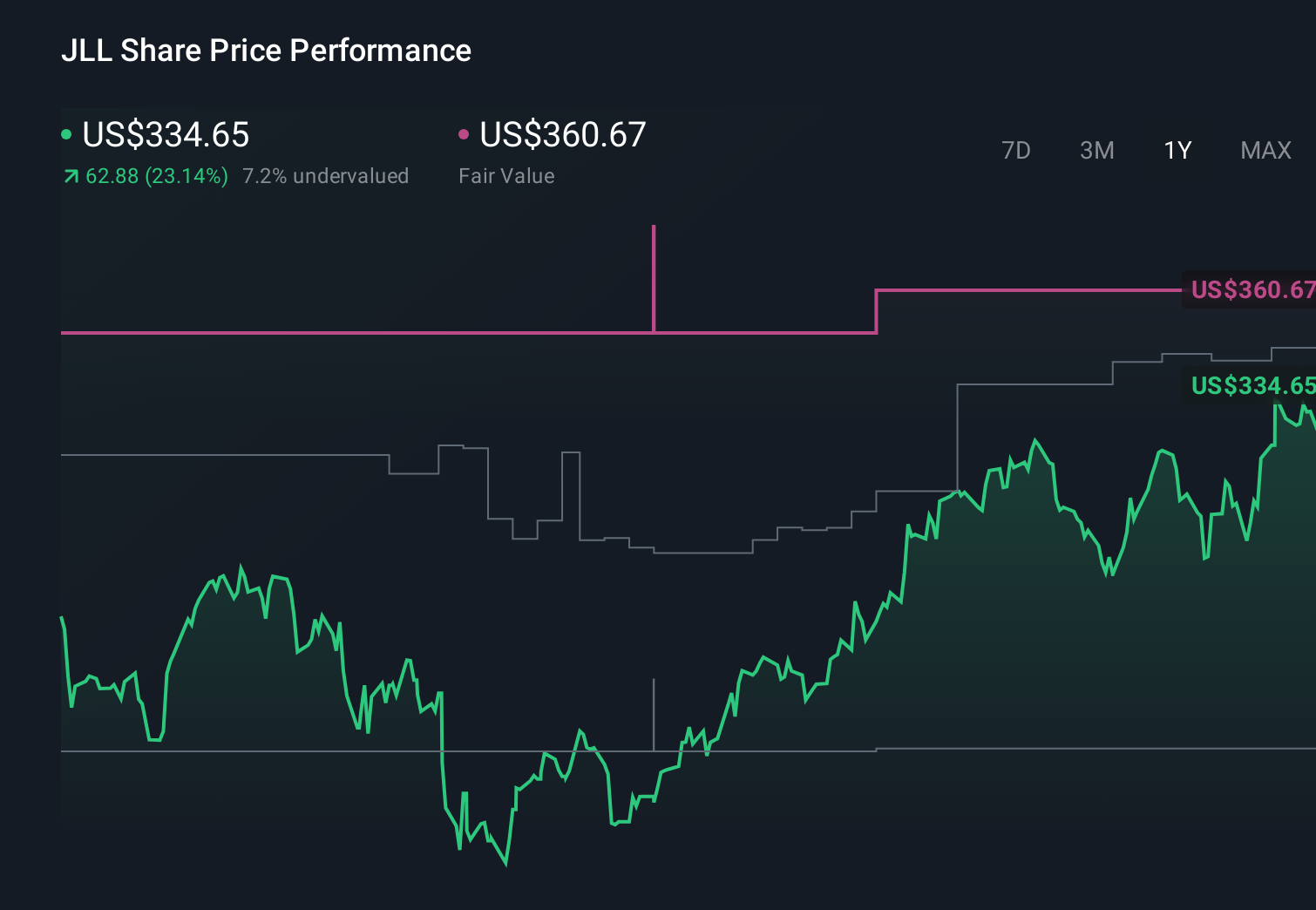
Compared with consensus worries about muted growth and thin cash flow, the most optimistic analysts once expected revenues near US$33.7b and earnings of about US$1.4b, showing how far views can diverge and why you should test both the bullish upside and the risk that structural shifts in office demand could still reshape JLL’s story after this latest news.
Explore 2 other fair value estimates on Jones Lang LaSalle - why the stock might be worth as much as 71% more than the current price!
Decide For Yourself
Disagree with existing narratives? Extraordinary investment returns rarely come from following the herd, so go with your instincts.
- A great starting point for your Jones Lang LaSalle research is our analysis highlighting 5 key rewards that could impact your investment decision.
- Our free Jones Lang LaSalle research report provides a comprehensive fundamental analysis summarized in a single visual - the Snowflake - making it easy to evaluate Jones Lang LaSalle's overall financial health at a glance.
Ready For A Different Approach?
The market won't wait. These fast-moving stocks are hot now. Grab the list before they run:
- The future of work is here. Discover the 35 top robotics and automation stocks leading the charge in AI-driven automation and industrial transformation.
- AI is about to change healthcare. These 33 stocks are working on everything from early diagnostics to drug discovery. The best part - they are all under $10b in market cap - there's still time to get in early.
- Explore 28 top quantum computing companies leading the revolution in next-gen technology and shaping the future with breakthroughs in quantum algorithms, superconducting qubits, and cutting-edge research.
This article by Simply Wall St is general in nature. We provide commentary based on historical data and analyst forecasts only using an unbiased methodology and our articles are not intended to be financial advice. It does not constitute a recommendation to buy or sell any stock, and does not take account of your objectives, or your financial situation. We aim to bring you long-term focused analysis driven by fundamental data. Note that our analysis may not factor in the latest price-sensitive company announcements or qualitative material. Simply Wall St has no position in any stocks mentioned.