

DocuSign (DOCU) Could Be 16% Undervalued Following The Software Rally
DOCUSIGN INC DOCU | 0.00 |
DocuSign (DOCU) jumped 5.6% on July 24, 2026, as part of a broad rally in software stocks. This move gave investors fresh reason to reassess how the stock fits into current sector trends.
For context, DocuSign’s 14.01% 1 month share price return and 9.13% 3 month share price return contrast with a year to date share price decline of 22.22% and a 1 year total shareholder return decline of 36.85%. This points to short term momentum but a still weak longer term record.
If this rebound in DocuSign has you looking across the software space, it could be a useful time to broaden your watchlist with 65 profitable AI stocks that aren't just burning cash
After a sharp one day jump and a mixed track record over the past year, the question for DocuSign is simple: lean into the rebound now, or wait for a pullback that brings the valuation closer to your comfort zone?
Most Popular Narrative: 16.2% Undervalued
With DocuSign closing at $50.44 against a narrative fair value of $60.16, the current price sits below what this widely followed framework suggests.
Sustained adoption of digital workflows across global industries and increased prevalence of remote/hybrid work environments is driving persistent demand for eSignature, contract lifecycle management (CLM), and AI-powered agreement management (IAM) solutions. This is reflected in accelerating direct sales, healthy new bookings, and improving renewal rates, providing strong ongoing support for revenue and billings growth.
Curious what justifies that higher fair value for DocuSign? The narrative leans on compounding revenue, expanding margins, and a future earnings multiple that assumes meaningful execution. The exact mix of those inputs may surprise you.
Result: Fair Value of $60.16 (UNDERVALUED)
However, this DocuSign narrative can quickly look different if core eSignature growth slows further, or if competition and AI tools pressure pricing and renewal rates.
Another View: What DocuSign’s P/E Is Telling You
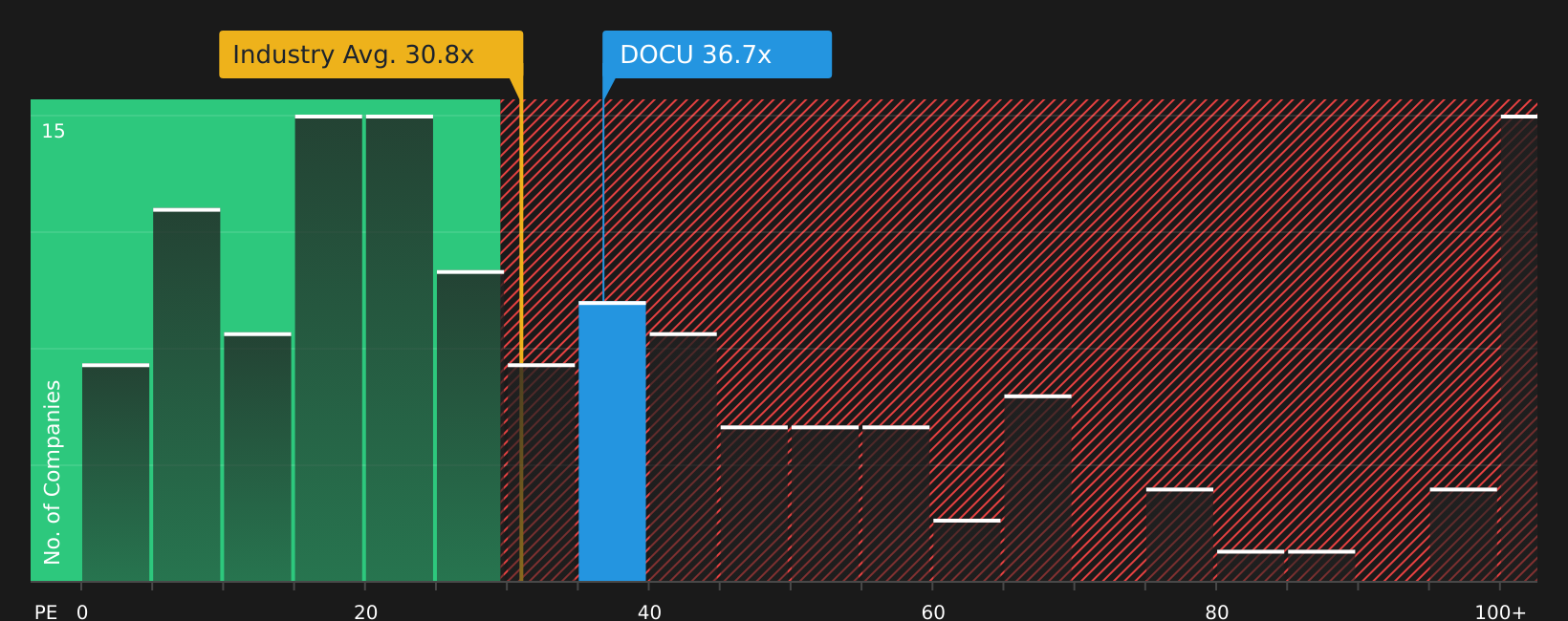
While the narrative fair value for DocuSign points to undervaluation, the P/E picture is less comfortable. At 30.6x, the stock trades above the US software average of 27.8x and above a fair ratio of 28.9x, which implies less room for error if expectations slip.
That gap between today’s pricing and the fair ratio may reflect confidence in DocuSign’s agreement platform, but it also raises the question of how much optimism is already in the share price, and how you would feel if growth or margins track closer to the sector average instead.
Next Steps
Seeing both optimism and caution around DocuSign, it makes sense to move quickly, review the underlying data for yourself, and decide where you stand. To weigh those mixed signals in one place, take a closer look at the 2 key rewards and 1 important warning sign
Looking for more investment ideas beyond DocuSign?
If DocuSign has sharpened your focus, do not stop there. Spread your attention across other opportunities that match your risk tolerance and income goals.
- Target potential mispricing by scanning a focused set of quality stocks that currently look cheaper than their fundamentals suggest with 49 high quality undervalued stocks.
- Strengthen your income stream by reviewing companies that have paid higher yields, starting with a curated group of 9 dividend fortresses.
- Protect your capital first by prioritizing businesses with sturdier finances, using a hand picked universe from the 81 resilient stocks with low risk scores.
This article by Simply Wall St is general in nature. We provide commentary based on historical data and analyst forecasts only using an unbiased methodology and our articles are not intended to be financial advice. It does not constitute a recommendation to buy or sell any stock, and does not take account of your objectives, or your financial situation. We aim to bring you long-term focused analysis driven by fundamental data. Note that our analysis may not factor in the latest price-sensitive company announcements or qualitative material. Simply Wall St has no position in any stocks mentioned.