

Does Patterson-UTI Energy’s (PTEN) Higher-Cost Refinancing Quietly Redefine Its Balance Sheet Strategy?
Patterson-UTI Energy, Inc. PTEN | 0.00 |
- On May 19, 2026, Patterson-UTI Energy, Inc. completed a US$500 million offering of 6.050% senior unsecured notes due May 15, 2036, with proceeds earmarked to redeem its existing 3.95% senior notes due 2028 and for general corporate purposes.
- This refinancing extends the company’s debt maturity profile while potentially raising interest costs, reshaping its balance sheet flexibility and long-term funding mix.
- We’ll now examine how this higher-coupon refinancing and extended debt maturity profile affects Patterson-UTI Energy’s existing investment narrative.
AI is about to change healthcare. These 40 stocks are working on everything from early diagnostics to drug discovery. The best part - they are all under $10b in market cap - there's still time to get in early.
Patterson-UTI Energy Investment Narrative Recap
To stay invested in Patterson-UTI, you really have to believe in the long-term need for high-spec drilling and completions, supported by its digital and LNG-linked offerings, despite current earnings volatility. The new US$500,000,000, 6.050% notes extend debt maturities but modestly raise interest expense, so they do not meaningfully change the near term catalyst of activity recovery or the key risk of softer drilling and completion demand.
The recent refinancing sits alongside the April 2026 amendment to Patterson-UTI’s US$500,000,000 revolving credit facility, which extended a large portion of bank commitments to 2031. Together, these moves reinforce liquidity and term out funding while the company works through recent net losses and capital intensive technology investments, which remain central to the thesis that higher spec, more automated fleets can command better pricing and utilization as activity normalizes.
However, against this more flexible balance sheet, investors still need to watch the risk that sustained weakness in drilling and completion activity could...
Patterson-UTI Energy's narrative projects $4.8 billion revenue and $337.4 million earnings by 2028. This assumes revenues decline by 1.3% per year and earnings increase by about $1.44 billion from -$1.1 billion today.
Uncover how Patterson-UTI Energy's forecasts yield a $8.84 fair value, a 23% downside to its current price.
Exploring Other Perspectives
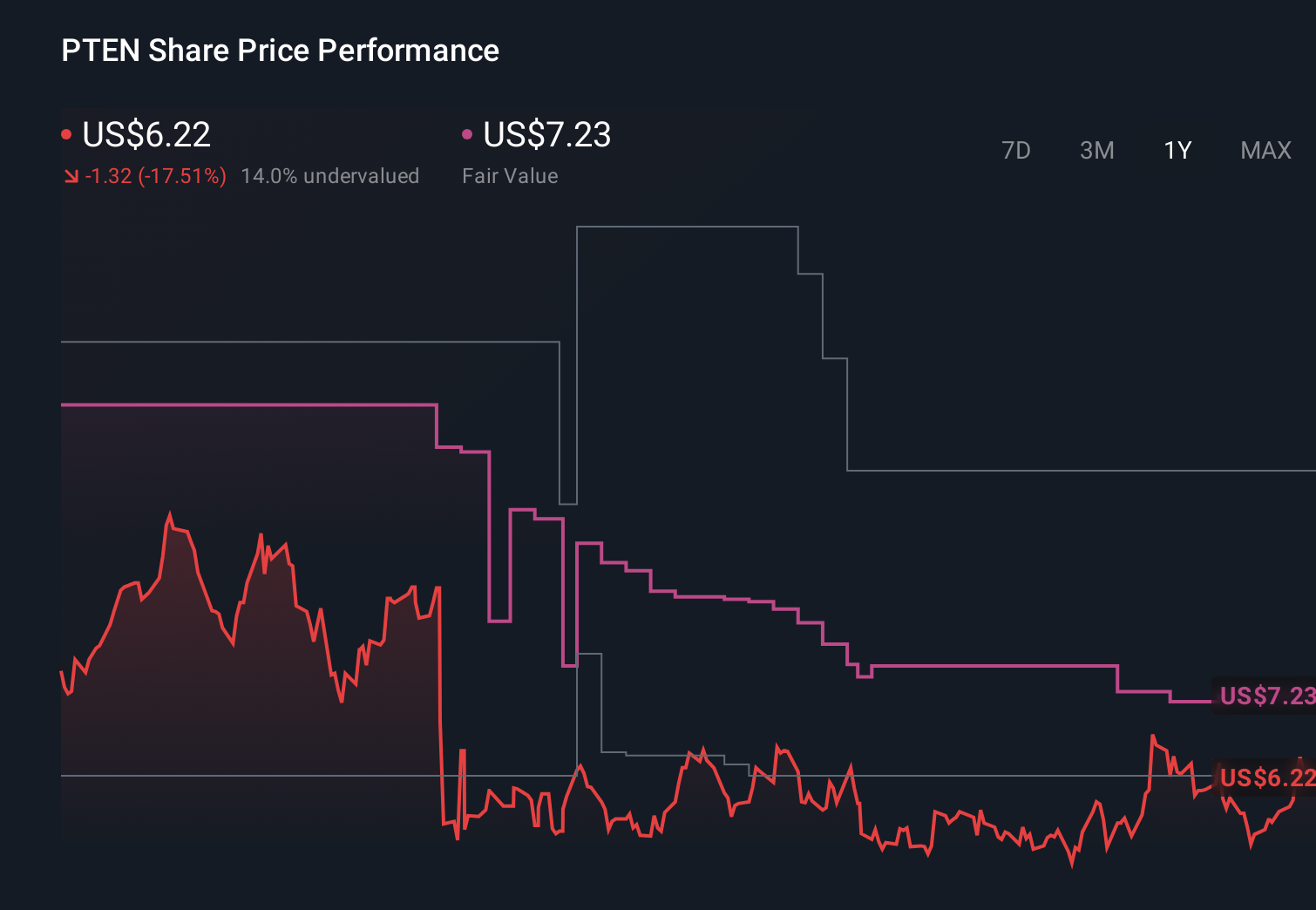
Some of the most optimistic analysts were assuming flat revenue near US$4.8 billion and earnings of about US$150 million by 2029, yet this new, higher cost refinancing could challenge that view while others may still see it as a necessary step to support long term automation and digital growth.
Explore 3 other fair value estimates on Patterson-UTI Energy - why the stock might be worth as much as 55% more than the current price!
Decide For Yourself
Disagree with existing narratives? Extraordinary investment returns rarely come from following the herd, so go with your instincts.
- A great starting point for your Patterson-UTI Energy research is our analysis highlighting 2 key rewards and 2 important warning signs that could impact your investment decision.
- Our free Patterson-UTI Energy research report provides a comprehensive fundamental analysis summarized in a single visual - the Snowflake - making it easy to evaluate Patterson-UTI Energy's overall financial health at a glance.
Curious About Other Options?
Don't miss your shot at the next 10-bagger. Our latest stock picks just dropped:
- We've uncovered the 10 dividend fortresses yielding 5%+ that don't just survive market storms, but thrive in them.
- Invest in the nuclear renaissance through our list of 88 elite nuclear energy infrastructure plays powering the global AI revolution.
- Capitalize on the AI infrastructure supercycle with our selection of the 47 best 'picks and shovels' of the AI gold rush converting record-breaking demand into massive cash flow.
This article by Simply Wall St is general in nature. We provide commentary based on historical data and analyst forecasts only using an unbiased methodology and our articles are not intended to be financial advice. It does not constitute a recommendation to buy or sell any stock, and does not take account of your objectives, or your financial situation. We aim to bring you long-term focused analysis driven by fundamental data. Note that our analysis may not factor in the latest price-sensitive company announcements or qualitative material. Simply Wall St has no position in any stocks mentioned.