

Equity Residential (EQR) Stock May Be Undervalued While Earnings Look Fair
Equity Residential EQR | 0.00 |
Equity Residential stock has delivered a 16.8% total return over the past three years, while a fresh Discounted Cash Flow (DCF) intrinsic value estimate suggests the shares may still trade below what the underlying cash flows imply, and recent merger headlines add a new layer of uncertainty to that picture.
- The 16.8% three year return points to steady shareholder gains, rather than a sharp rerating that would clearly exhaust valuation upside.
- Expected revenue and operating income growth, along with the proposed merger with AvalonBay Communities, can support the intrinsic value case for Equity Residential, while execution risk around that merger and the associated legal review may weigh on how quickly the market is willing to close any gap.
- On Simply Wall St's broader checks, Equity Residential scores 4 out of 6, which points to a mixed picture rather than a clear bargain or clear overvaluation.
The issue now is whether the current share price already reflects the intrinsic value suggested by the DCF work or still leaves a margin between market price and underlying cash flow expectations.
Does Equity Residential Look Undervalued on Cash Flow?
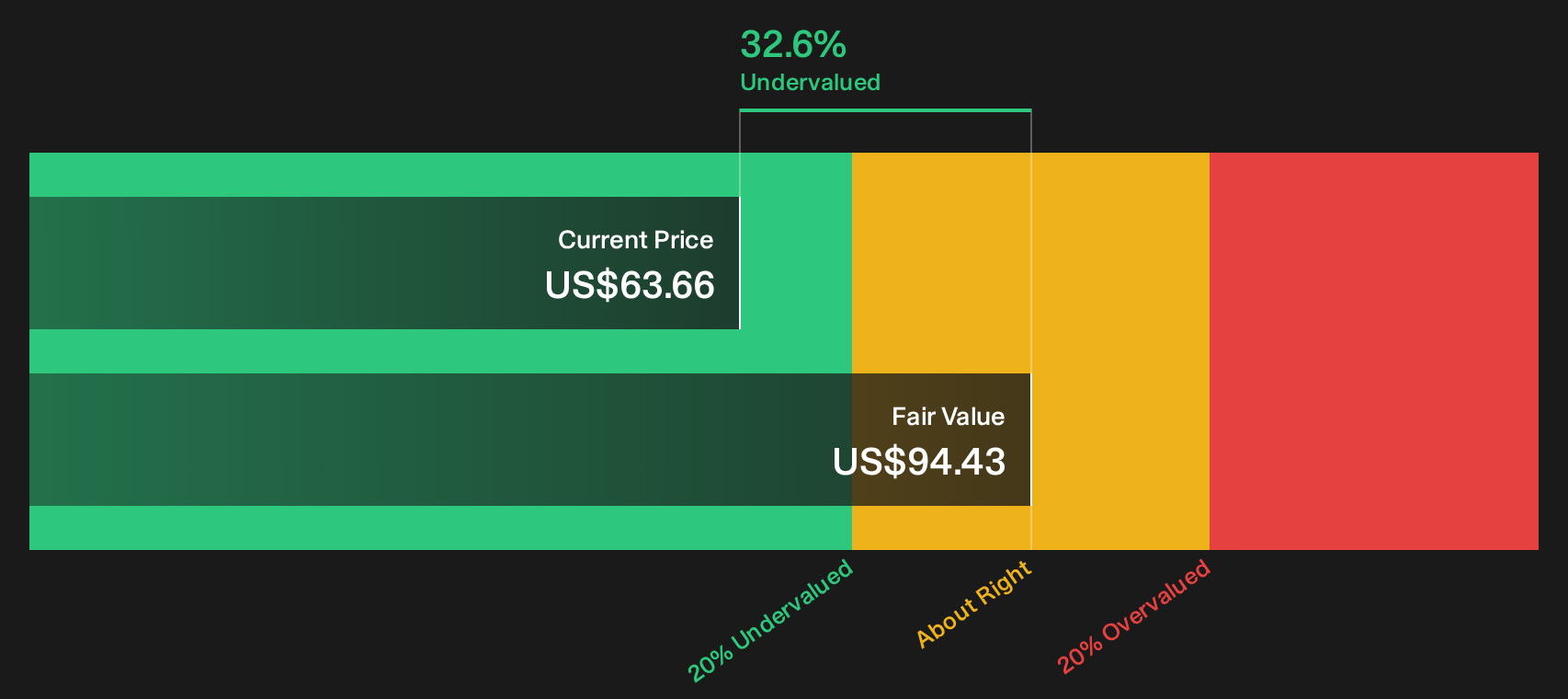
The Discounted Cash Flow (DCF) approach here values Equity Residential by projecting its future cash generation and discounting it back to today. On the latest twelve month numbers, the model uses free cash flow of about $1.54b and assumes cash flows continue growing from this base rather than swinging sharply higher or lower. On that basis, the DCF suggests an intrinsic value of about $93.75 per share.
That compares to a current share price that sits roughly 26.8% below the modeled value, so Equity Residential screens as undervalued on this cash flow view. The investigation of the proposed AvalonBay merger helps explain why the market may be applying a discount despite the cash flows supporting this valuation. On the numbers alone, Equity Residential currently appears undervalued relative to what its projected cash flows imply.
Our Discounted Cash Flow (DCF) analysis suggests Equity Residential is undervalued by 26.8%. Track this in your watchlist or portfolio, or discover 41 more high quality undervalued stocks.
Is Equity Residential Fairly Priced on Earnings?
The P/E ratio is a useful yardstick for Equity Residential because earnings are a key driver for how investors value established REITs. On this metric, the stock trades at about 27.0x earnings, which is below the Residential REITs industry average of roughly 24.4x and also below the peer average of 31.6x for closer comparables.
Simply Wall St’s model points to a fair P/E of about 28.2x for Equity Residential, based on its sector, size and risk profile. That puts the current multiple slightly under this tailored fair value, suggesting the stock is neither clearly cheap nor clearly expensive on earnings. The gap between the current and fair P/E is modest, so most of the earnings outlook already appears reflected in the price.
On balance, Equity Residential looks priced roughly in line with what its earnings profile would suggest on a P/E basis.

The Equity Residential Narrative: What Would Justify Today's Price?
Simply Wall St Narratives for Equity Residential pick up where the valuation puzzle leaves off by spelling out which assumptions about Equity Residential's future growth, margins and earnings would need to hold for the stock to be worth significantly more or less than today's price, and they sit on Simply Wall St's Community page. Rather than relying on a single multiple or model result, each Narrative lays out the key drivers behind its view of fair value so you can compare those assumptions with actual results as they are reported.
If you have a number driven view on whether Equity Residential's proposed merger with AvalonBay Communities ultimately delivers for shareholders, share a Narrative in the Simply Wall St community so others can see how your thesis holds up as new information emerges.
Adding your take now can help shape how investors interpret the merger investigation, shifting analyst views and Equity Residential's valuation as fresh data comes through.
Do you think there's more to the story for Equity Residential? Head over to our Community to see what others are saying!
The Bottom Line
For Equity Residential, the Discounted Cash Flow (DCF) work points to meaningful intrinsic value upside, while the P/E view suggests the stock is priced about right on current earnings. That split reflects a market that appears cautious about how cash flows and integration risk around the proposed AvalonBay Communities merger will actually play out. With broader valuation checks sitting in a mixed zone, the crucial question is whether the merger and future cash generation ultimately justify closing that modeled discount, or whether it proves to be a value trap that the market is already discounting for good reason.
This article by Simply Wall St is general in nature. We provide commentary based on historical data and analyst forecasts only using an unbiased methodology and our articles are not intended to be financial advice. It does not constitute a recommendation to buy or sell any stock, and does not take account of your objectives, or your financial situation. We aim to bring you long-term focused analysis driven by fundamental data. Note that our analysis may not factor in the latest price-sensitive company announcements or qualitative material. Simply Wall St has no position in any stocks mentioned.