

Erie Indemnity (ERIE) Stock Looks Discounted As Shares Fell 36%
Erie Indemnity Company Class A ERIE | 0.00 |
Erie Indemnity stock has fallen 35.8% over the past year, yet the Excess Returns intrinsic value estimate still points to meaningful upside while traditional earnings multiples suggest the shares trade at a premium, leaving investors with a clear split in valuation signals.
- Over the last 12 months, Erie Indemnity shares declined 35.8%, which puts recent sentiment and expectations under pressure even as longer term returns remain positive.
- The key support for any valuation case is whether Erie Indemnity can keep converting its fee based insurance operations into reliable cash flows. A material risk is that slower policy growth or margin compression would limit the value that current earnings can justify.
- On Simply Wall St's broader checks, Erie Indemnity scores 1 out of 6, which leans toward the stock not looking like an obvious bargain on most standard valuation metrics.
The issue now is whether the intrinsic value signal or the richer market multiple will prove the better guide to where Erie Indemnity stock should trade.
Does Erie Indemnity Look Undervalued on Excess Returns?
The Excess Returns model looks at how much value Erie Indemnity creates above the return investors require on its equity. For this stock, the inputs point to a business earning a healthy spread over its funding cost.
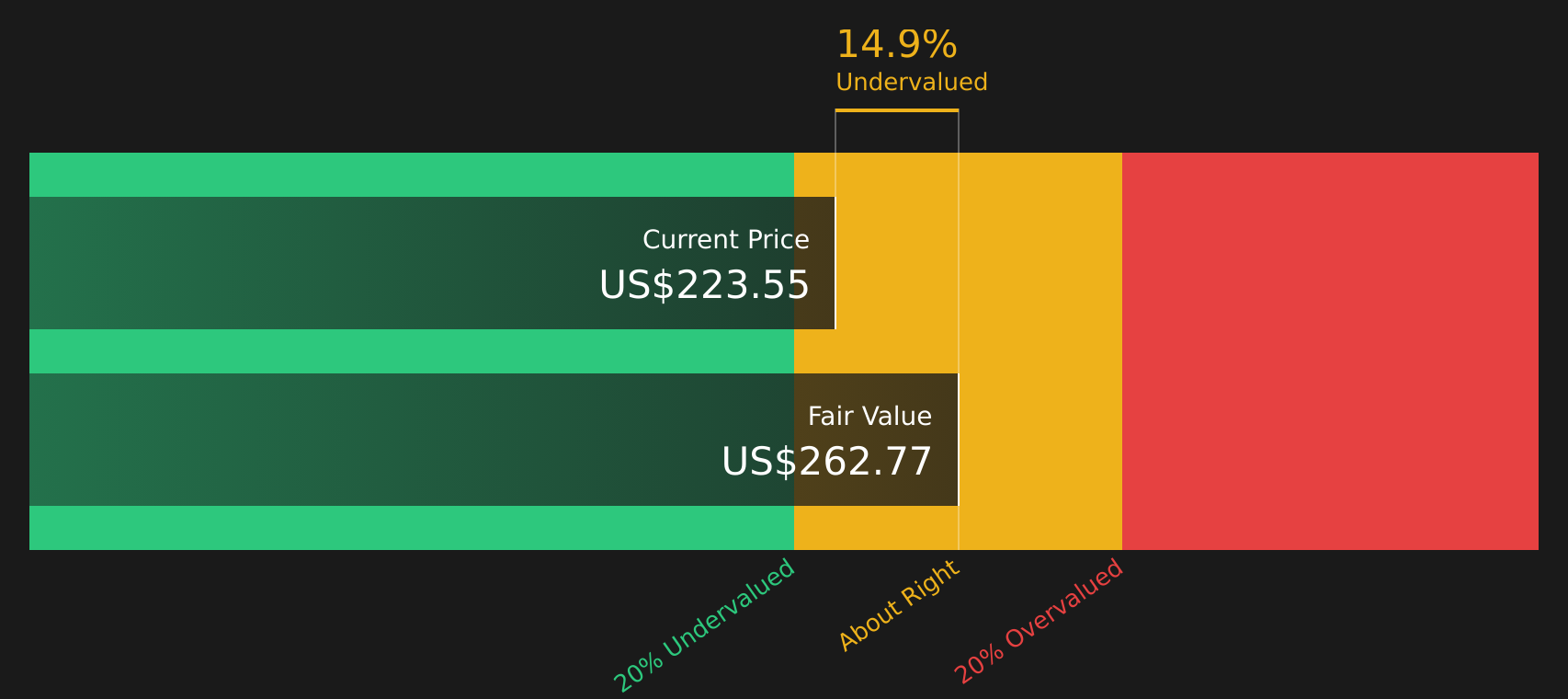
Erie Indemnity is modeled with a Book Value of $45.01 per share and Stable EPS of $10.69 per share, based on the median return on equity from the past 5 years. Against a Cost of Equity of $2.65 per share, that implies an Excess Return of $8.05 per share and an Average Return on Equity of 28.71%, applied to a Stable Book Value of $37.25 per share. On these assumptions, the Excess Returns framework arrives at an intrinsic value of about $262.77 per share, implying the stock is 14.9% undervalued versus the current market price.
On this Excess Returns view, Erie Indemnity stock currently screens as undervalued relative to the cash returns its equity base is assumed to generate.
Our Excess Returns analysis suggests Erie Indemnity is undervalued by 14.9%. Track this in your watchlist or portfolio, or discover 49 more high quality undervalued stocks.
Does Erie Indemnity Look Pricey on Earnings?
The P/E ratio is a useful way to compare what the market is paying for each dollar of Erie Indemnity earnings with other insurance stocks. Erie Indemnity currently trades on a P/E of about 20.5x, which sits well above the Insurance industry average of roughly 12.4x and also above the broader peer group average of around 13.6x.
This gap suggests investors are paying a clear premium for Erie Indemnity relative to typical insurers, based on these valuation metrics. Without a tailored fair P/E ratio provided, a straightforward interpretation is that the current market price reflects stronger expectations than those implied for the sector as a whole.
On the P/E multiple alone, Erie Indemnity stock currently screens as more expensive compared with its industry and peer benchmarks.

The Erie Indemnity Narrative: What Would Justify Today's Price?
Simply Wall St Narratives pick up where Erie Indemnity's mixed valuation signals leave off by spelling out which combinations of future growth, margins and earnings would need to hold for the stock to be worth substantially more or less than its current price. Each narrative links its number to a clear view on how Erie Indemnity's growth, profitability and risks might evolve, giving you a reference point you can revisit as fresh information appears.
Share a narrative on Erie Indemnity to put your own number-driven view on where its growth, margins and execution go from here, and see how that thesis holds up as fresh results and news arrive.
Do you think there's more to the story for Erie Indemnity? Head over to our Community to see what others are saying!
The Bottom Line
For Erie Indemnity, the Excess Returns intrinsic value estimate suggests the stock screens as undervalued, while the market multiple view points to it being overvalued relative to peers. That split largely reflects different weightings on cash generation versus the higher expectations baked into the P/E ratio. Broader checks lean weak despite the intrinsic value support, so the key question is whether Erie Indemnity can keep converting its fee based insurance operations into resilient cash flows without a meaningful squeeze on growth or margins. How that plays out is likely to decide whether today’s discount is an opportunity or a sign of justified caution.
This article by Simply Wall St is general in nature. We provide commentary based on historical data and analyst forecasts only using an unbiased methodology and our articles are not intended to be financial advice. It does not constitute a recommendation to buy or sell any stock, and does not take account of your objectives, or your financial situation. We aim to bring you long-term focused analysis driven by fundamental data. Note that our analysis may not factor in the latest price-sensitive company announcements or qualitative material. Simply Wall St has no position in any stocks mentioned.