

Eurozone Business Activity Remains 'Sluggish' Despite 16-Month High
Eurozone business remained sluggish despite edging higher in September, a sign that the region has struggled to regain momentum as geopolitical uncertainty and tariffs have slowed growth and impacted business sentiment.
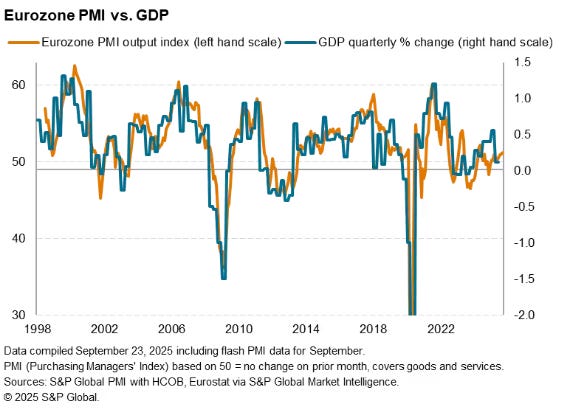
The HCOB Flash Eurozone Composite Purchasing Managers' Index, compiled by S&P Global, rose to 51.2 in September from 51.0 in August. The growth rate, which had reached a 16-month high, remained "disappointingly sluggish" at just 0.2% in September and for the third quarter.
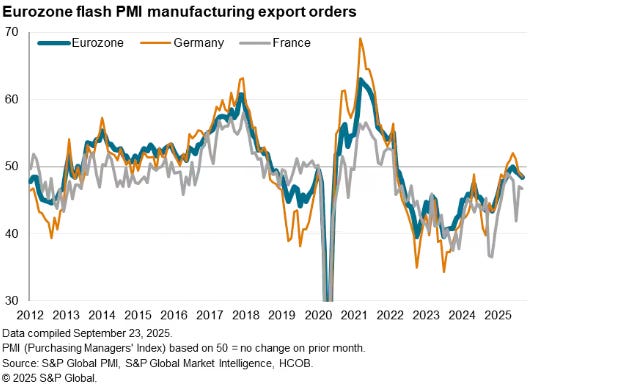
"Sluggish service sector growth was accompanied by a slowdown in manufacturing," S&P Global said on Tuesday. "Companies reported an increased loss of export sales thanks partly to the fading effect of tariff front-running. Business optimism also waned, led by reduced expectations of growth in the manufacturing sector."
Eurozone exports have fallen back into decline, a sign that the front-running effect is waning, after stabilizing in May for the first time in 40 months, according to the credit ratings agency. Germany reported an unexpected decline in exports in July, with goods shipped to the US falling to their lowest level since 2021.
Weak Demand Keeps Lid on Inflation
Weak demand has kept a lid on inflationary pressures, leaving the door open for further interest rate cuts from the European Central Bank (ECB), according to S&P Global. The ECB left interest rates unchanged on September 11, maintaining an upbeat view on growth and inflation.
Within the region, conditions contrasted between the eurozone's two largest economies, according to the credit ratings agency. Growth accelerated in Germany to a pace unbeaten since early 2023, it said, adding that France's downturn deepened amid intensifying political uncertainty.
France has experienced a wave of protest and a credit rating downgrade after a no-confidence vote forced President Emmanuel Macron to reshuffle his government for the second time in 12 months. The political and social instability has battered confidence in the country's credit rating and nudged business confidence lower.
"Within the eurozone, Germany was a key driver of growth in September, recording a solid increase in output that was unbeaten since May 2023," S&P Global said. "France saw activity decrease for the thirteenth consecutive month."
OECD Upgrades Its Global Economic Forecast
Meanwhile, the Organisation for Economic Co-operation and Development (OECD) upgraded its global economic growth forecast on Tuesday. Many economies have demonstrated more resilience than expected in the face of tariffs so far this year, it said.
The OECD now expects global growth of 3.2% this year, compared to the 2.9% expansion it had forecast in June. Expectations for 2026 remained unchanged at 2.9%, marking a slowdown from the 3.3% in 2024.

Eurozone GDP growth will expand by 1.2% in 2025 and 1.0% in 2026, according to the OECD. "Increased trade frictions and geopolitical uncertainty somewhat offset by easier credit conditions," the organisation said.
However, volatile growth in Ireland and US tariff shipments distorted official Eurozone GDP data, according to S&P Global. "These distortions have made it difficult to discern underlying trends," the credit ratings agency said, pointing to the first quarter GDP of 0.6% and meager 0.1% in the second quarter.
Fiscal Expansion to Boost German Economic Activity
Fiscal expansion should “boost economic activity in Germany, but expected consolidation in both France and Italy will dampen growth," the OECD said.
German Chancellor Friedrich Merz's government has tried to support an increase in domestic investment to boost the country's struggling economy. The government's policies helped stabilize investor confidence in September..
However, sentiment has remained subdued in the eurozone. Consumer confidence rose on Monday to -14.9 in September 2025, up from -15.5 in August, beating market expectations of -15.3, Trading Economics said.
The Eurozone service sector helped lift overall business activity in September.
"Although only sluggish, the increased service sector output, which was buoyed by one of the largest (though still fractional) influxes of new orders seen over the past year, adds to tentative signs of domestic demand picking up slowly in the region," S&P Global said.
Eurozone Manufacturing Rates of Expansion Taper
Eurozone manufacturing production also rose, but the rate of expansion slowed from the near three-and-a-half-year high registered in August, resulting in only a very modest gain. The front-running of US tariffs has distorted trends in manufacturing.
German industrial production rose 1.3% in July, compared with June, beating the forecast of 1.1%. However, the output remained weak by past standards."
Despite concerns, the OECD said that global economic growth proved more resilient than anticipated in the first half of 2025.
"The front-loading of goods production and trade ahead of the introduction of higher US tariff rates was an important source of support," the organization noted. Industrial production growth in the first half of the year exceeded "the average pace of 2024 in most G20 economies," it said.
Disclaimer:
Any opinions expressed in this article are not to be considered investment advice and are solely those of the authors. European Capital Insights is not responsible for any financial decisions made based on the contents of this article. Readers may use this article for information and educational purposes only.
Benzinga Disclaimer: This article is from an unpaid external contributor. It does not represent Benzinga’s reporting and has not been edited for content or accuracy.