

First Horizon (FHN) Stock May Be Undervalued Following Fresh Stress Test Results
First Horizon FHN | 0.00 |
First Horizon stock has more than doubled over the past three years, yet the latest intrinsic value work using the Excess Returns model suggests the market price may still be below what the underlying business justifies.
- First Horizon has returned 108.5% over the past three years, which puts extra focus on whether recent gains already reflect its fundamentals.
- The company run stress test results, which show capital ratios staying well above regulatory minimums in severe scenarios, can support confidence in the balance sheet. However, any shift in credit quality or risk appetite may still pressure how investors price that resilience.
- First Horizon screens as undervalued on 5 of 6 checks on the broader valuation framework, which signals that the stock currently looks cheap on several yardsticks even after its share price recovery 5/6.
The issue now is whether First Horizon's current share price already reflects this intrinsic value estimate, or if there is still a meaningful discount built into the stock.
Does First Horizon Look Undervalued on Excess Returns?
The Excess Returns model evaluates how much profit First Horizon earns on its equity compared with the cost of that equity, then derives an intrinsic value per share from those excess profits.
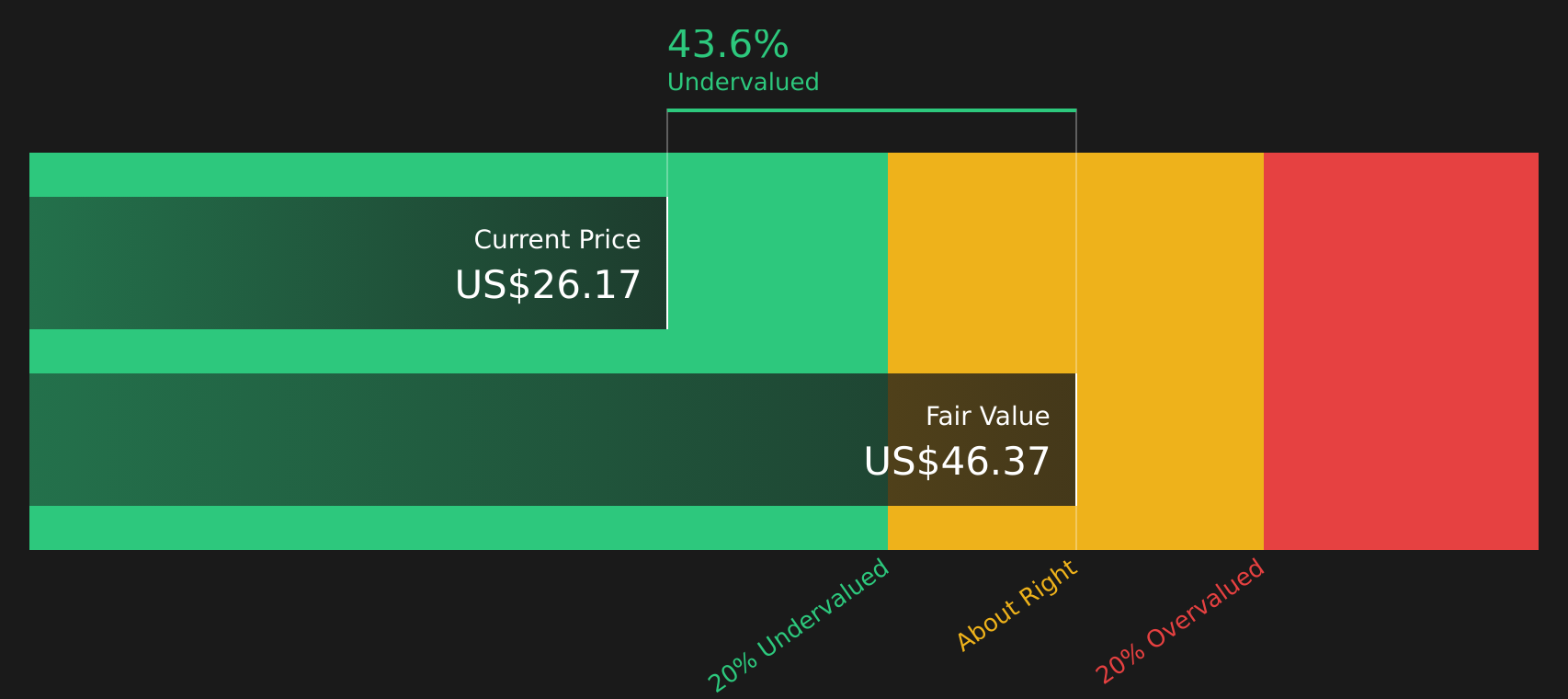
For First Horizon, the model uses a current Book Value of $17.90 per share and a Stable EPS estimate of $2.35 per share, based on weighted future Return on Equity estimates from 10 analysts. The implied Average Return on Equity is 11.90%. The Cost of Equity is $1.40 per share, which leaves an Excess Return of $0.95 per share. That stream of excess earnings on a Stable Book Value of $19.72 per share, sourced from 12 analysts, points to an intrinsic value of about $46.23 per share. Compared with the current share price, this output indicates the stock is 44.2% undervalued according to this model.
Because the 2026 company run stress test indicated capital ratios that remain well above regulatory minimums in severe scenarios, the current discount suggests the market is cautious despite that reported balance sheet resilience.
Overall, the Excess Returns analysis indicates that, under the assumptions used, First Horizon stock currently screens as undervalued relative to its intrinsic value estimate.
Our Excess Returns analysis suggests First Horizon is undervalued by 44.2%. Track this in your watchlist or portfolio, or discover 53 more high quality undervalued stocks.
Is First Horizon Fairly Priced on Earnings?
The P/E ratio is a useful measure for First Horizon because earnings are a key yardstick for banks. First Horizon currently trades on a P/E of 11.9x, which is very close to the broader Banks industry average of 11.9x and only slightly below the peer group average of 12.2x. On simple comparisons, the stock sits roughly in line with where many other listed banks trade.
A more tailored fair P/E ratio for First Horizon, which adjusts for its size, risk profile and analyst expectations, is 12.6x. That is only a small premium to the current 11.9x multiple, so the market price is not far from what this framework suggests might be reasonable for the stock. For investors, this indicates a market view that already reflects much of the current information on First Horizon without assigning a clear discount or premium.
On the P/E multiple, First Horizon stock appears roughly fairly valued at current levels.

The First Horizon Narrative: What Would Justify Today's Price?
Simply Wall St Narratives pick up where the valuation puzzle for First Horizon leaves off and explain which assumptions about growth, margins and earnings would need to hold for the stock to be worth materially more or less than today’s price, based on community and analyst views on the Community page. Rather than relying on a single multiple or model, each narrative sets out the assumptions behind its view of fair value so you can compare them with future results as they are reported.
Be one of the first voices in the Simply Wall St community to set out a clear, number driven narrative on First Horizon that weighs in on whether its reported stress test resilience really supports today's price. Share your view, track how it holds up as new results come through, and see how it stacks up against what other investors are expecting from First Horizon's earnings power.
Do you think there's more to the story for First Horizon? Head over to our Community to see what others are saying!
The Bottom Line
For First Horizon, the Excess Returns intrinsic value estimate points to meaningful upside compared with the current share price, while the P/E view suggests the stock now trades close to where many peers sit. That combination means the broader valuation checks still lean supportive, even though the market is no longer assigning a steep discount on earnings alone. The key question is whether the reported balance sheet resilience and projected returns on equity can hold up through future credit and funding cycles. That assumption will likely decide whether today’s apparent discount reflects opportunity or simply the market’s caution on bank risk.
This article by Simply Wall St is general in nature. We provide commentary based on historical data and analyst forecasts only using an unbiased methodology and our articles are not intended to be financial advice. It does not constitute a recommendation to buy or sell any stock, and does not take account of your objectives, or your financial situation. We aim to bring you long-term focused analysis driven by fundamental data. Note that our analysis may not factor in the latest price-sensitive company announcements or qualitative material. Simply Wall St has no position in any stocks mentioned.