

Harley Davidson (HOG) Stock Looks Undervalued On Earnings While Returns Stay Mixed
Harley-Davidson, Inc. HOG | 0.00 |
Harley-Davidson stock has logged a strong 34.6% gain year to date, yet its low overall value score and mixed long term return record raise questions about how much upside may already be reflected in the current US$27.78 share price.
- Year to date, Harley-Davidson is up 34.6%, which puts recent momentum firmly on the positive side for existing shareholders.
- The key support for the valuation can come from the market’s confidence in Harley-Davidson’s ability to convert its brand and product lineup into steady cash flows. The main risk is that any pressure on demand or margins would make the recent share price strength harder to justify.
- Harley-Davidson screens as undervalued on some earnings multiples, yet with a low value score of 2 out of 6 the broader checks suggest the stock is not a straightforward bargain.
The issue now is whether Harley-Davidson’s current valuation leaves enough room for attractive long term returns after this year’s strong run.
Does Harley-Davidson Look Undervalued on Earnings?
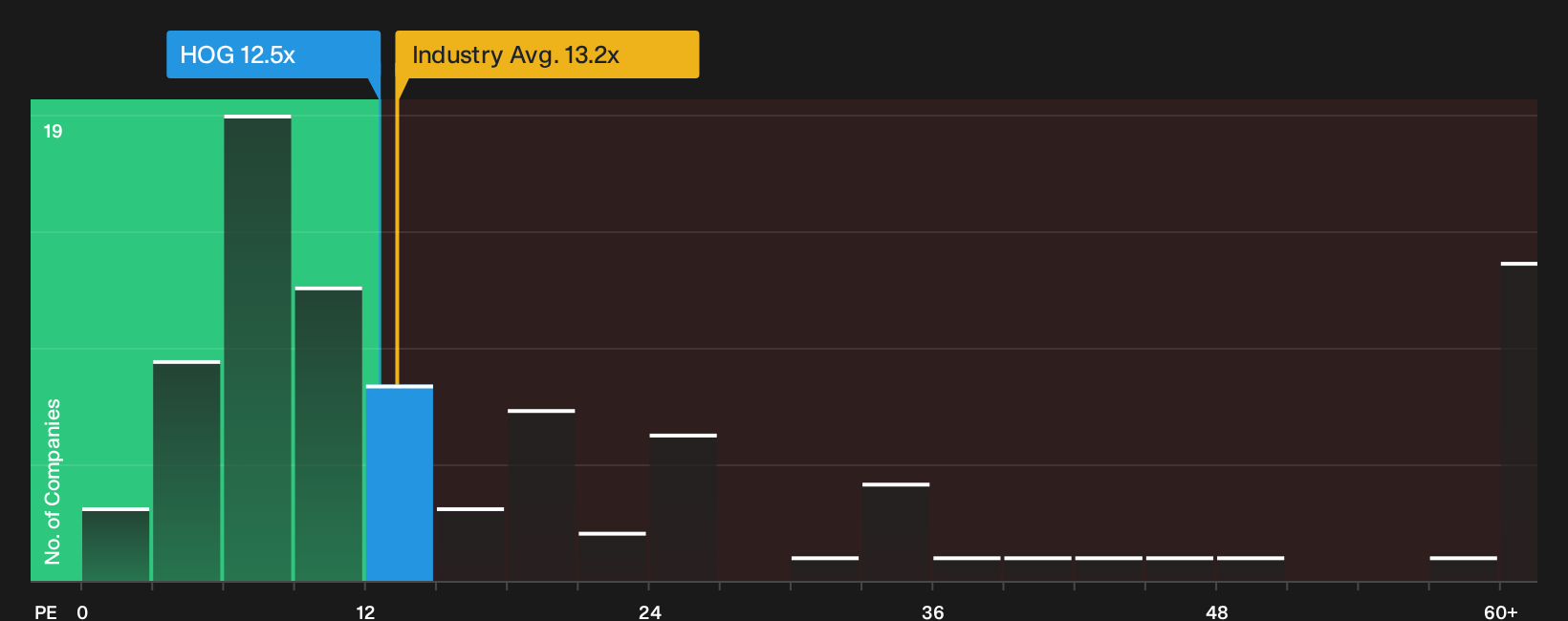
The P/E ratio suits Harley-Davidson because earnings are a key focus for an established manufacturer with a long trading history. On this measure, Harley-Davidson trades on a P/E of about 14.3x, which is close to the broader Auto industry average of 14.4x. That places the stock roughly in line with the sector on headline earnings, rather than at an obvious premium or discount.
The fair P/E ratio implied by the broader checks is 16.6x, which sits above both the current multiple and the peer group average of 18.3x. This indicates that the stock trades at a discount to what might be expected given its profile, even though it does not screen as an extreme outlier versus other Auto stocks. For investors who place most emphasis on earnings-based valuation, Harley-Davidson appears modestly cheap on this framework.
On the P/E multiple alone, Harley-Davidson stock currently screens as undervalued relative to the fair ratio suggested by the analysis.
The Harley-Davidson Narrative: What Would Justify Today's Price?
Simply Wall St Narratives for Harley-Davidson pick up where the valuation checks stop. They explain which paths for Harley-Davidson's growth, margins and earnings would need to occur for the stock to be worth meaningfully more or less than today's price, and they sit on the company’s Community page. Where a single ratio or model outputs one number, these narratives describe the future that number relies on so you can see whether it is unfolding as expected.
The Harley-Davidson community is split between one camp that sees room for upside and another that focuses on execution and reinvestment risks.
Bull case: 13% undervalued
"The transformation of HDFS into a capital-light business that emphasizes recurring origination and servicing fees, together with $1.2 billion of incremental cash, may create capacity for debt reduction and share repurchases, which could affect earnings per share and return on equity..."
Bear case: 53% overvalued
"Although the capital-light transformation of Harley-Davidson Financial Services unlocks over $1.2 billion in discretionary cash by early 2026 and should structurally lift returns on equity, reinvestment risk remains if organic initiatives in motorcycles and LiveWire fail to convert that cash into durable revenue and earnings growth..."
Do you think there's more to the story for Harley-Davidson? Head over to our Community to see what others are saying!
The Bottom Line
Harley-Davidson screens as modestly undervalued on its P/E multiple, which hints at some potential upside if sentiment and earnings hold together. However, the low overall value score suggests that many of the cross checks are less convincing and that this is not a simple value opportunity. The main question from here is whether Harley-Davidson can sustain solid demand and margins so that the apparent discount reflects mispricing rather than the market correctly pricing in execution and reinvestment risks.
This article by Simply Wall St is general in nature. We provide commentary based on historical data and analyst forecasts only using an unbiased methodology and our articles are not intended to be financial advice. It does not constitute a recommendation to buy or sell any stock, and does not take account of your objectives, or your financial situation. We aim to bring you long-term focused analysis driven by fundamental data. Note that our analysis may not factor in the latest price-sensitive company announcements or qualitative material. Simply Wall St has no position in any stocks mentioned.