

Hershey (HSY) Stock Looks Below Fair Value On Cash Flow
Hershey Company HSY | 0.00 |
Hershey stock has delivered a 21.9% total return over the past five years, yet its valuation signals are split, with the Discounted Cash Flow (DCF) intrinsic value estimate pointing to meaningful upside while market multiples indicate the shares are priced on the high side.
- Hershey's 21.9% five year return suggests the stock has rewarded patient investors over a medium term horizon.
- Future cash flow and margin expectations can support the DCF view of upside. However, any pressure on consumer demand or input costs may challenge that intrinsic value case.
- Hershey screens as undervalued on only 2 of 6 valuation checks, which leans closer to expensive than to an obvious bargain on the broader metrics.
The stock's next move may depend on whether the DCF upside or the richer earnings multiples provide the better guide to where Hershey should trade from here.
Is Hershey a Bargain on Cash Flow?
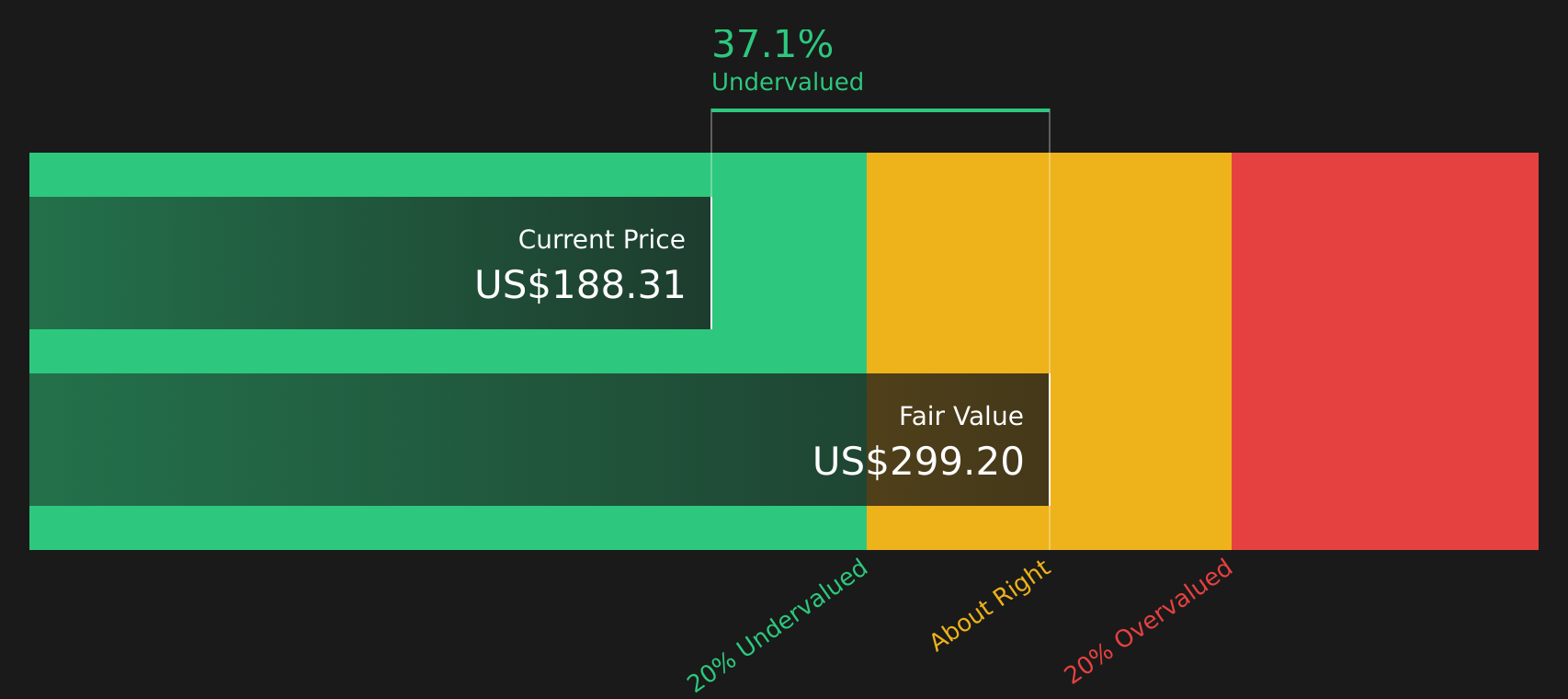
The Discounted Cash Flow (DCF) approach looks at what Hershey might be worth based on the cash it can generate for shareholders over time. For Hershey, the model uses the latest twelve-month free cash flow of about $2.0b and assumes those cash flows continue to grow rather than shrink. Using that information, the two-stage free cash flow to equity model points to an intrinsic value of about $299 per share.
Compared with the current share price, this DCF output implies Hershey stock trades at a 36.9% discount to that intrinsic estimate. The gap suggests the market is valuing Hershey more cautiously than the cash flow projections indicate, even with relatively steady growth assumptions built in rather than aggressive ones.
On this cash flow view, Hershey stock appears undervalued relative to its estimated intrinsic value.
Our Discounted Cash Flow (DCF) analysis suggests Hershey is undervalued by 36.9%. Track this in your watchlist or portfolio, or discover 52 more high quality undervalued stocks.
Does Hershey Look Pricey on Earnings?
The P/E ratio is a useful cross check for Hershey because it ties the share price directly to the earnings the business is already generating.
Hershey trades on a P/E of about 25.5x, which is higher than both the Food industry average of 17.8x and the peer group average of 20.4x. The company specific fair P/E, which reflects its margins, scale and risk profile, is estimated at 21.9x. That is several turns below where the stock changes hands today.
This gap suggests investors are paying a premium for each dollar of Hershey earnings compared with similar Food companies and with the level implied by the fair P/E estimate. Anyone looking at Hershey stock through this lens is therefore relying on the company to justify that richer multiple over time.
On the P/E yardstick, Hershey stock currently looks overvalued relative to both its tailored fair multiple and its sector benchmarks.

The Hershey Narrative: What Would Justify Today's Price?
Simply Wall St Narratives for Hershey pick up where this valuation puzzle leaves off. They explain which assumptions on Hershey's growth, margins and earnings would need to hold for the stock to be worth materially more or less than its current market price. Each Narrative links a fair value to a specific storyline about Hershey's potential catalysts and risks so you can track over time which version is closest to reality.
The community is sharply split on Hershey, with one camp seeing solid brand strength and margin potential while the other questions whether the slower growth profile justifies the current valuation.
Bull case: 24% undervalued
"Ongoing supply chain optimization, recent capacity expansions, especially the new vertically integrated chocolate processing plant, and investments in automation equip Hershey with improved agility, cost competitiveness, and the ability to rapidly scale innovation, which together are expected to enhance operating leverage and support sustainable gains in gross margins and earnings…"
Bear case: 138% overvalued
"The binding constraint is growth, not quality: this business protects the downside far better than it compounds the upside…"
Do you think there's more to the story for Hershey? Head over to our Community to see what others are saying!
The Bottom Line
Hershey sits between two conflicting signals. The Discounted Cash Flow (DCF) intrinsic value estimate points to a clear discount to where the stock trades today, while the earnings multiple view still flags Hershey as overvalued compared with peers and its own fair P/E.
The broader valuation checks lean weak, so the intrinsic value signal on its own is not conclusive. The key question now is whether Hershey can sustain the cash flows and margins that underpin the DCF case, or whether the market is correctly pricing in a slower growth profile through a richer but fragile multiple.
This article by Simply Wall St is general in nature. We provide commentary based on historical data and analyst forecasts only using an unbiased methodology and our articles are not intended to be financial advice. It does not constitute a recommendation to buy or sell any stock, and does not take account of your objectives, or your financial situation. We aim to bring you long-term focused analysis driven by fundamental data. Note that our analysis may not factor in the latest price-sensitive company announcements or qualitative material. Simply Wall St has no position in any stocks mentioned.