

How GIS’s Impairment-Driven Loss and Steady Payouts Have Changed Its Investment Story
General Mills, Inc. GIS | 0.00 |
- General Mills has reported fourth-quarter 2026 sales of US$4,609.6 million and a net loss of US$2,007.9 million, driven largely by about US$1,750.0 million in goodwill and intangible asset impairments, while for the full year sales were US$18,424.6 million and the company moved from prior-year profitability to a small net loss.
- Despite posting a rare annual loss and booking very large impairment charges, General Mills maintained its quarterly dividend at US$0.61 per share and continued its multi-year share repurchase program, signaling an ongoing commitment to returning capital to shareholders.
- Now we’ll examine how this impairment-driven swing to a quarterly loss may influence General Mills’ existing investment narrative and outlook.
The best AI stocks today may lie beyond giants like Nvidia and Microsoft. Find the next big opportunity with these 15 smaller AI-focused companies with strong growth potential through early-stage innovation in machine learning, automation, and data intelligence that could fund your retirement.
General Mills Investment Narrative Recap
To own General Mills, you have to believe its brands, marketing and innovation can support steady cash generation, even when reported earnings are hit by accounting charges. The latest US$1,750.0 million impairment and swing to a full year net loss highlight the main near term risk around profitability pressure, but they do not appear to change the key short term catalyst, which is whether management can stabilize volumes after a year of lower sales.
Against that backdrop, the company’s decision to keep its US$0.61 quarterly dividend and complete a US$500 million buyback tranche stands out. Continuing to return cash while reporting a rare annual loss connects directly to the core investment case, but also sharpens the existing risk around leverage and cash flow strength if operating performance weakens further.
Yet behind the stable dividend, there is a separate risk around how much pressure future earnings could face if...
General Mills’ narrative projects $18.3 billion revenue and $1.8 billion earnings by 2029. This implies fairly flat yearly revenue growth and a $0.4 billion earnings decrease from $2.2 billion today.
Uncover how General Mills' forecasts yield a $37.00 fair value, a 6% upside to its current price.
Exploring Other Perspectives
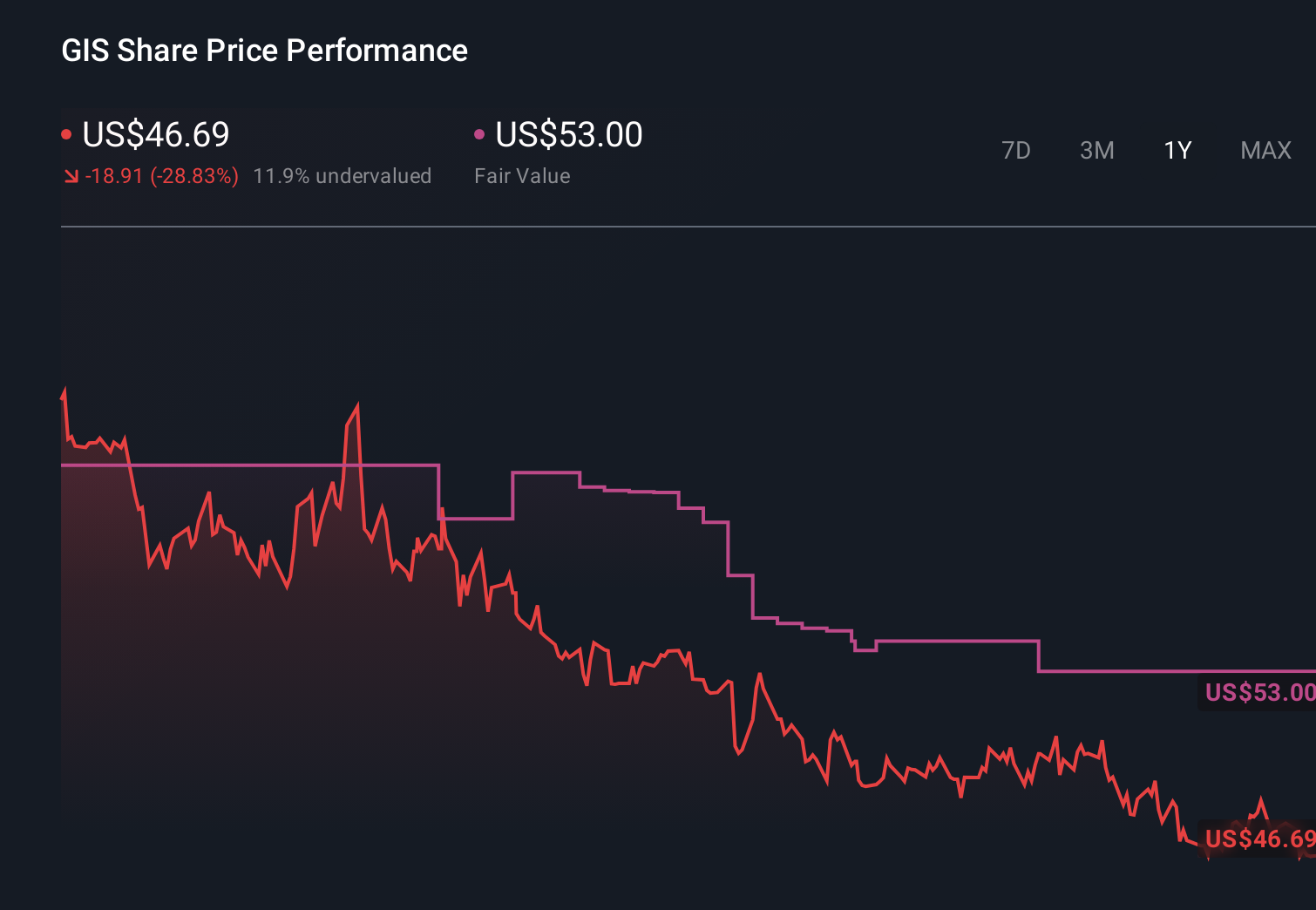
Some of the lowest analysts were already assuming revenue could fall toward about US$17.7 billion and earnings toward US$1.6 billion, so this impairment driven loss may push that more pessimistic view further, especially if you worry, as they do, about rising promotional sensitivity and its impact on margins.
Explore 8 other fair value estimates on General Mills - why the stock might be worth 8% less than the current price!
The Verdict Is Yours
Disagree with existing narratives? Extraordinary investment returns rarely come from following the herd, so go with your instincts.
- A great starting point for your General Mills research is our analysis highlighting 3 key rewards and 4 important warning signs that could impact your investment decision.
- Our free General Mills research report provides a comprehensive fundamental analysis summarized in a single visual - the Snowflake - making it easy to evaluate General Mills' overall financial health at a glance.
Looking For Alternative Opportunities?
Early movers are already taking notice. See the stocks they're targeting before they've flown the coop:
- We've uncovered the 10 dividend fortresses yielding 5%+ that don't just survive market storms, but thrive in them.
- AI is about to change healthcare. These 40 stocks are working on everything from early diagnostics to drug discovery. The best part - they are all under $10b in market cap - there's still time to get in early.
- Capitalize on the AI infrastructure supercycle with our selection of the 51 best 'picks and shovels' of the AI gold rush converting record-breaking demand into massive cash flow.
This article by Simply Wall St is general in nature. We provide commentary based on historical data and analyst forecasts only using an unbiased methodology and our articles are not intended to be financial advice. It does not constitute a recommendation to buy or sell any stock, and does not take account of your objectives, or your financial situation. We aim to bring you long-term focused analysis driven by fundamental data. Note that our analysis may not factor in the latest price-sensitive company announcements or qualitative material. Simply Wall St has no position in any stocks mentioned.