

How Investors Are Reacting To Allstate (ALL) Halting Monthly Auto Policy Updates Amid Digital Shift
Allstate Corporation ALL | 0.00 |
- Earlier this week, Keefe Bruyette downgraded The Allstate Corporation to “Market Perform,” pointing to evidence that previously accelerating growth in personal auto policies in force likely peaked in February and highlighting the company’s move to halt monthly reporting of these metrics after May in favor of quarterly disclosure.
- This shift away from monthly policy reporting reduces near‑term visibility into Allstate’s core auto franchise, potentially sharpening investor focus on how the insurer’s underlying growth and profitability align with its longer-term technology and product initiatives.
- We’ll now examine how Allstate’s decision to stop monthly policy disclosures could influence the existing investment narrative built around digital transformation.
Invest in the nuclear renaissance through our list of 88 elite nuclear energy infrastructure plays powering the global AI revolution.
Allstate Investment Narrative Recap
To own Allstate today, you generally need to believe its core auto and homeowner businesses can translate ongoing product and technology investments into durable underwriting profits, even as competition and regulatory oversight remain intense. Keefe Bruyette’s downgrade and Allstate’s move to stop monthly auto policy disclosures may affect how closely the market can track the key near term catalyst of personal auto policy momentum, but they do not alter the fundamental exposure to climate, regulatory, and retention risks.
Against this backdrop, Allstate’s recent approval of a US$1.08 quarterly dividend in May 2026 stands out as an important signal about capital priorities in the middle of shifting disclosure practices. For investors focused on catalysts, that ongoing cash return sits alongside the company’s tech and product rollouts, and will likely be assessed against any perceived slowdown or opacity in personal auto growth and the potential impact of more volatile catastrophe experience.
Yet beneath the headline growth story, investors should also be aware of the risk that climate driven catastrophe losses could...
Allstate’s narrative projects $77.0 billion in revenue and $5.0 billion in earnings by 2029. This implies 4.2% yearly revenue growth but a $7.0 billion earnings decline from $12.0 billion today.
Uncover how Allstate's forecasts yield a $241.86 fair value, a 9% upside to its current price.
Exploring Other Perspectives
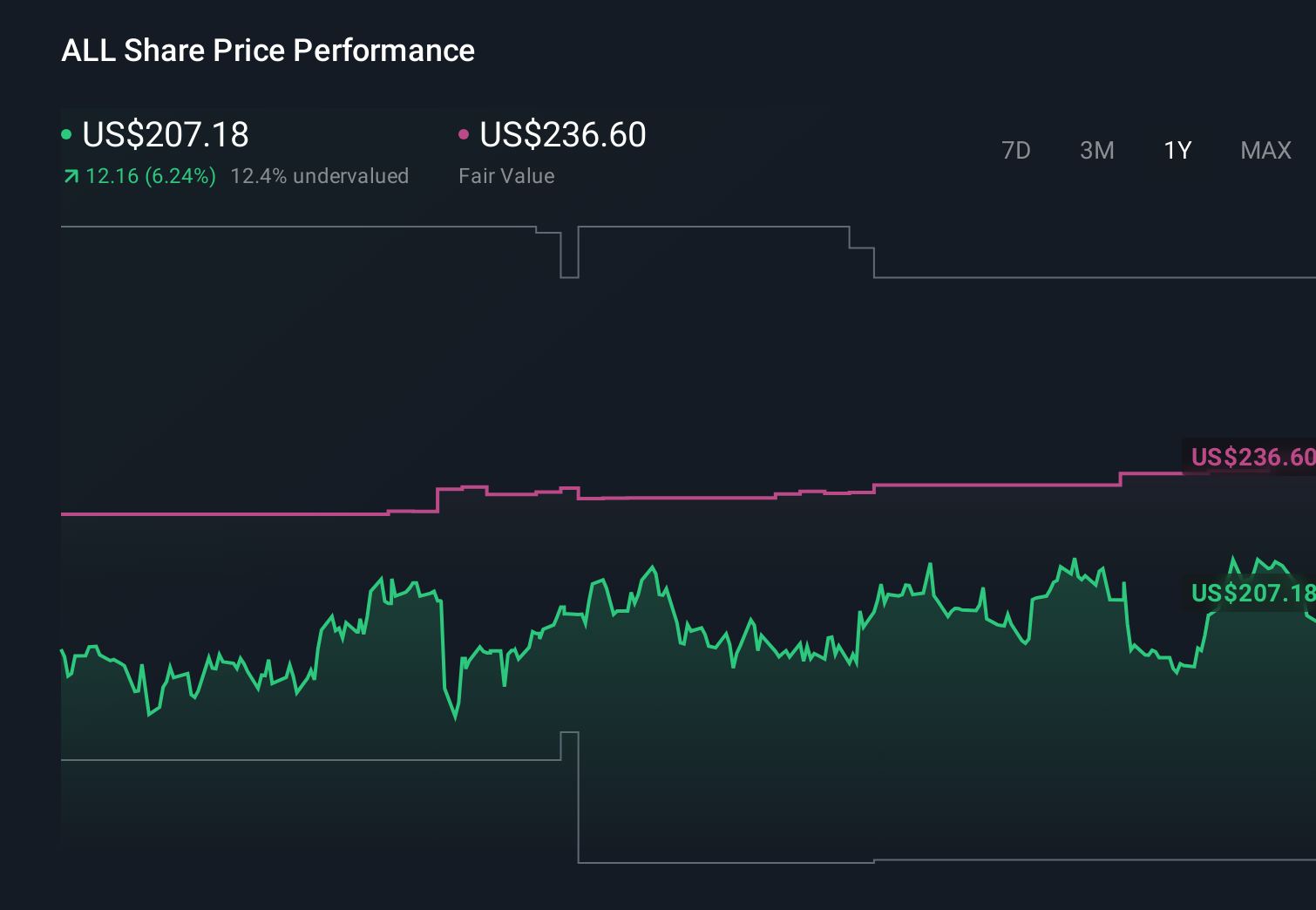
While consensus leans on policy growth and tech gains, the most pessimistic analysts, who see earnings falling toward about US$4.5 billion, remind you that heavy auto reliance and climate risks could matter more than the market currently assumes, and that both bullish and bearish narratives may shift as the impact of Allstate’s reduced disclosure becomes clearer.
Explore 7 other fair value estimates on Allstate - why the stock might be worth 13% less than the current price!
Form Your Own Verdict
Don't just follow the ticker - dig into the data and build a conviction that's truly your own.
- A great starting point for your Allstate research is our analysis highlighting 4 key rewards and 1 important warning sign that could impact your investment decision.
- Our free Allstate research report provides a comprehensive fundamental analysis summarized in a single visual - the Snowflake - making it easy to evaluate Allstate's overall financial health at a glance.
Seeking Other Investments?
Every day counts. These free picks are already gaining attention. See them before the crowd does:
- AI is about to change healthcare. These 40 stocks are working on everything from early diagnostics to drug discovery. The best part - they are all under $10b in market cap - there's still time to get in early.
- Explore 29 top quantum computing companies leading the revolution in next-gen technology and shaping the future with breakthroughs in quantum algorithms, superconducting qubits, and cutting-edge research.
- Find 48 companies with promising cash flow potential yet trading below their fair value.
This article by Simply Wall St is general in nature. We provide commentary based on historical data and analyst forecasts only using an unbiased methodology and our articles are not intended to be financial advice. It does not constitute a recommendation to buy or sell any stock, and does not take account of your objectives, or your financial situation. We aim to bring you long-term focused analysis driven by fundamental data. Note that our analysis may not factor in the latest price-sensitive company announcements or qualitative material. Simply Wall St has no position in any stocks mentioned.