

How Investors Are Reacting To Johnson & Johnson (JNJ) Oncology And Rare-Disease Trial Wins
Johnson & Johnson JNJ | 0.00 |
- In mid-June 2026, Johnson & Johnson reported strong Phase 3 MonumenTAL-3 data for TALVEY in relapsed/refractory multiple myeloma and positive Phase 2/3 ENERGY results for IMAAVY in warm autoimmune hemolytic anemia, supporting an FDA Priority Review for a new indication.
- These late-stage successes highlight Johnson & Johnson’s ability to advance first-in-class mechanisms like GPRC5D bispecifics and FcRn inhibition into areas of high unmet medical need, potentially broadening its Innovative Medicine franchise.
- We’ll now explore how this late-stage oncology and rare-disease progress, especially TALVEY’s superior progression-free survival, could influence Johnson & Johnson’s investment narrative.
We've uncovered the 7 dividend fortresses yielding 5%+ that don't just survive market storms, but thrive in them.
Johnson & Johnson Investment Narrative Recap
To own Johnson & Johnson, you have to believe its broad pharma and MedTech portfolio, plus consistent dividends, can offset headwinds like STELARA’s loss of exclusivity and ongoing talc litigation. The strong TALVEY and IMAAVY data reinforce oncology and rare disease as key near term growth drivers, but they do not remove the risk that biosimilars, tariffs and legal outcomes could still weigh on earnings and sentiment over the next few years.
Among recent updates, the US$55 billion U.S. manufacturing and R&D buildout, including more than US$1 billion into Vision capacity in Florida, matters most alongside these trial wins. If assets like TALVEY and IMAAVY move through approval and uptake as expected, having scaled, modern manufacturing and MedTech distribution could be important in turning today’s clinical momentum into durable, company wide revenue and margin support.
Yet while the pipeline looks encouraging, investors should be aware that talc litigation and biosimilar pressure could still materially affect cash flow and valuation...
Johnson & Johnson's narrative projects $116.6 billion revenue and $26.9 billion earnings by 2029. This requires 6.6% yearly revenue growth and about a $5.9 billion earnings increase from $21.0 billion today.
Uncover how Johnson & Johnson's forecasts yield a $252.87 fair value, a 9% upside to its current price.
Exploring Other Perspectives
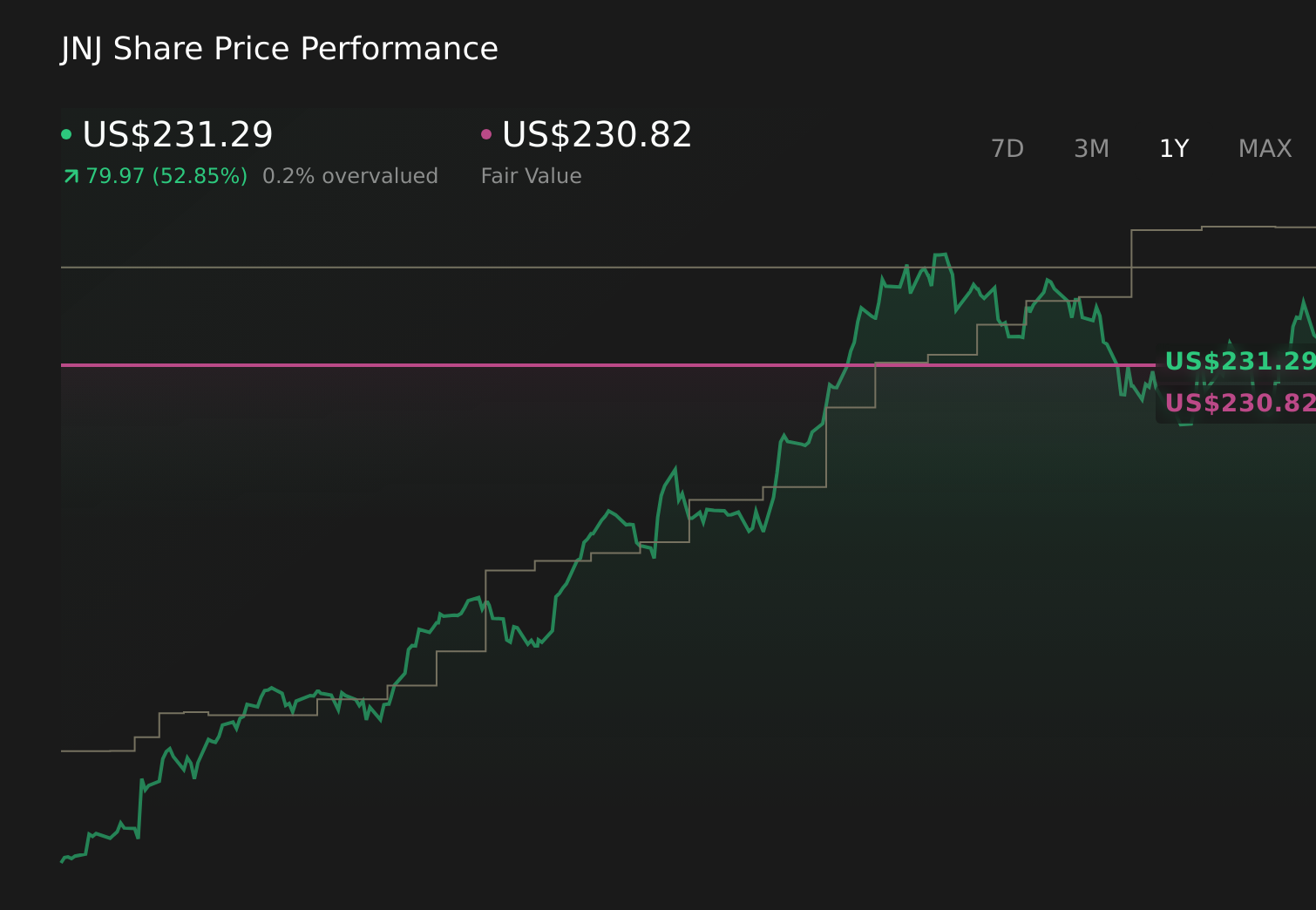
Some of the lowest estimate analysts were already assuming revenue of about US$109.9 billion and earnings of US$21.9 billion by 2029 if oncology regimens underperform, so this kind of pessimistic view could be tested as results like TALVEY’s MonumenTAL 3 data are absorbed into new forecasts.
Explore 7 other fair value estimates on Johnson & Johnson - why the stock might be worth 8% less than the current price!
Form Your Own Verdict
Disagree with existing narratives? Extraordinary investment returns rarely come from following the herd, so go with your instincts.
- A great starting point for your Johnson & Johnson research is our analysis highlighting 3 key rewards and 1 important warning sign that could impact your investment decision.
- Our free Johnson & Johnson research report provides a comprehensive fundamental analysis summarized in a single visual - the Snowflake - making it easy to evaluate Johnson & Johnson's overall financial health at a glance.
Interested In Other Possibilities?
These stocks are moving-our analysis flagged them today. Act fast before the price catches up:
- Find 44 companies with promising cash flow potential yet trading below their fair value.
- The latest GPUs need a type of rare earth metal called Terbium and there are only 30 companies in the world exploring or producing it. Find the list for free.
- AI is about to change healthcare. These 38 stocks are working on everything from early diagnostics to drug discovery. The best part - they are all under $10b in market cap - there's still time to get in early.
This article by Simply Wall St is general in nature. We provide commentary based on historical data and analyst forecasts only using an unbiased methodology and our articles are not intended to be financial advice. It does not constitute a recommendation to buy or sell any stock, and does not take account of your objectives, or your financial situation. We aim to bring you long-term focused analysis driven by fundamental data. Note that our analysis may not factor in the latest price-sensitive company announcements or qualitative material. Simply Wall St has no position in any stocks mentioned.