

How Investors May Respond To PACCAR (PCAR) Revenue And EPS Declines Questioning Profit Durability
PACCAR Inc PCAR | 0.00 |
- PACCAR has recently faced pressure as analysis highlighted an annual revenue decline of 11.4% and a 30.2% annual drop in earnings per share over the past two years, pointing to weaker demand as customers delayed truck purchases.
- Waning returns on capital suggest that PACCAR's earlier profit drivers are slowing, prompting fresh questions about the durability of its long-term business model.
- Next, we’ll examine how concerns about PACCAR’s shrinking earnings base may influence the company’s investment narrative and future expectations.
The latest GPUs need a type of rare earth metal called Terbium and there are only 32 companies in the world exploring or producing it. Find the list for free.
PACCAR Investment Narrative Recap
To own PACCAR, you really have to believe that its core truck and parts franchises can remain resilient even when customers pull back on new vehicle orders. The recent 11.4% annual revenue decline and 30.2% annual EPS drop highlight how sensitive results can be to delayed fleet purchases, making the timing and strength of any pre‑2027 emissions pre‑buy a key near term catalyst, and exposing the company to the risk that weaker truck demand lasts longer than expected.
Against that backdrop, PACCAR’s decision in April 2026 to raise its regular quarterly dividend to US$0.35 per share stands out. It sits uncomfortably beside shrinking earnings, because dividend growth depends on future cash generation that is now under more scrutiny. For investors watching both the emissions related demand catalyst and the risk of prolonged earnings pressure, this combination of softer fundamentals and a higher payout raises fresh questions about how the board views the company’s earnings power over the next few years.
Yet behind the headlines, one risk tied to how quickly freight markets absorb today’s truck overcapacity is something investors should really understand before they decide whether...
PACCAR's narrative projects $32.5 billion in revenue and $4.0 billion in earnings by 2029.
Uncover how PACCAR's forecasts yield a $127.96 fair value, a 13% upside to its current price.
Exploring Other Perspectives
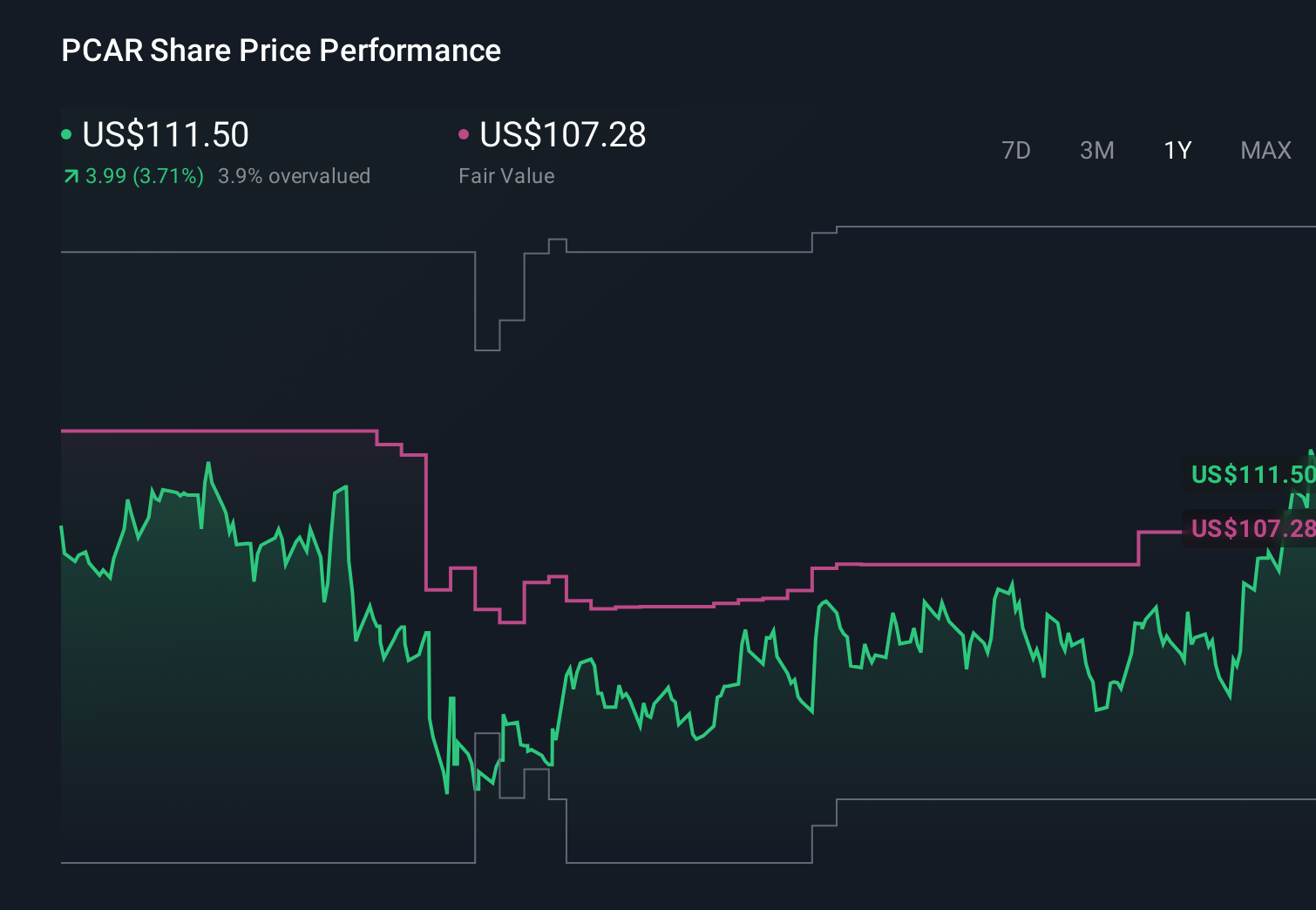
Some of the most optimistic analysts once projected PACCAR’s revenue reaching about US$36,000,000,000 and earnings of roughly US$5,400,000,000 by 2028, which contrasts sharply with today’s earnings pressure and highlights how views on regulatory costs and competitive threats like faster electrification can diverge, so it is worth comparing these upbeat scenarios with more cautious takes that may look very different after this weak demand news.
Explore 4 other fair value estimates on PACCAR - why the stock might be worth just $109.00!
The Verdict Is Yours
Disagree with existing narratives? Extraordinary investment returns rarely come from following the herd, so go with your instincts.
- A great starting point for your PACCAR research is our analysis highlighting 3 key rewards and 1 important warning sign that could impact your investment decision.
- Our free PACCAR research report provides a comprehensive fundamental analysis summarized in a single visual - the Snowflake - making it easy to evaluate PACCAR's overall financial health at a glance.
No Opportunity In PACCAR?
Don't miss your shot at the next 10-bagger. Our latest stock picks just dropped:
- Outshine the giants: these 14 early-stage AI stocks could fund your retirement.
- Invest in the nuclear renaissance through our list of 88 elite nuclear energy infrastructure plays powering the global AI revolution.
- Explore 29 top quantum computing companies leading the revolution in next-gen technology and shaping the future with breakthroughs in quantum algorithms, superconducting qubits, and cutting-edge research.
This article by Simply Wall St is general in nature. We provide commentary based on historical data and analyst forecasts only using an unbiased methodology and our articles are not intended to be financial advice. It does not constitute a recommendation to buy or sell any stock, and does not take account of your objectives, or your financial situation. We aim to bring you long-term focused analysis driven by fundamental data. Note that our analysis may not factor in the latest price-sensitive company announcements or qualitative material. Simply Wall St has no position in any stocks mentioned.