

How Investors May Respond To Vulcan Materials (VMC) Completing Its Long-Term US$2 Billion Buyback Program
Vulcan Materials Company VMC | 0.00 |
- In the second quarter of 2026, Vulcan Materials Company reported higher sales of US$2,155.8 million and net income of US$323.4 million, while also completing a long-running US$2,025.24 million share repurchase program that retired 14,379,186 shares since its launch in 2006.
- The combination of steady year-over-year gains in earnings per share and a substantial reduction in share count underlines Vulcan’s focus on profitability per share and capital return discipline.
- We’ll now examine how Vulcan’s completion of a large, long-term buyback program may reshape its existing investment narrative and risk-reward profile.
Invest in the nuclear renaissance through our list of 89 elite nuclear energy infrastructure plays powering the global AI revolution.
Vulcan Materials Investment Narrative Recap
To own Vulcan Materials, you need to believe in a long runway for US infrastructure and construction aggregates, supported by disciplined capital returns. The completed US$2,025.24 million buyback, alongside modest EPS growth in Q2 2026, reinforces the near term focus on per share profitability rather than changing the core catalyst, which still hinges on infrastructure spending. The biggest current risk remains project delays and funding or permitting setbacks that could slow expected volume growth.
The Q2 2026 earnings release is the most relevant backdrop for this buyback milestone. Sales and net income were slightly higher year over year, and six month earnings also improved, suggesting Vulcan is using repurchases from a position of ongoing profitability. That matters for investors watching how capital allocation decisions interact with the key catalyst of expanding public infrastructure work and the risk of weather or regulatory disruptions to volumes and margins.
Yet despite this progress, investors should be aware that Vulcan’s heavy exposure to Southeast markets could still leave results vulnerable to...
Vulcan Materials' narrative projects $9.6 billion revenue and $1.7 billion earnings by 2029. This requires 6.0% yearly revenue growth and about a $0.6 billion earnings increase from $1.1 billion today.
Uncover how Vulcan Materials' forecasts yield a $328.81 fair value, a 15% upside to its current price.
Exploring Other Perspectives
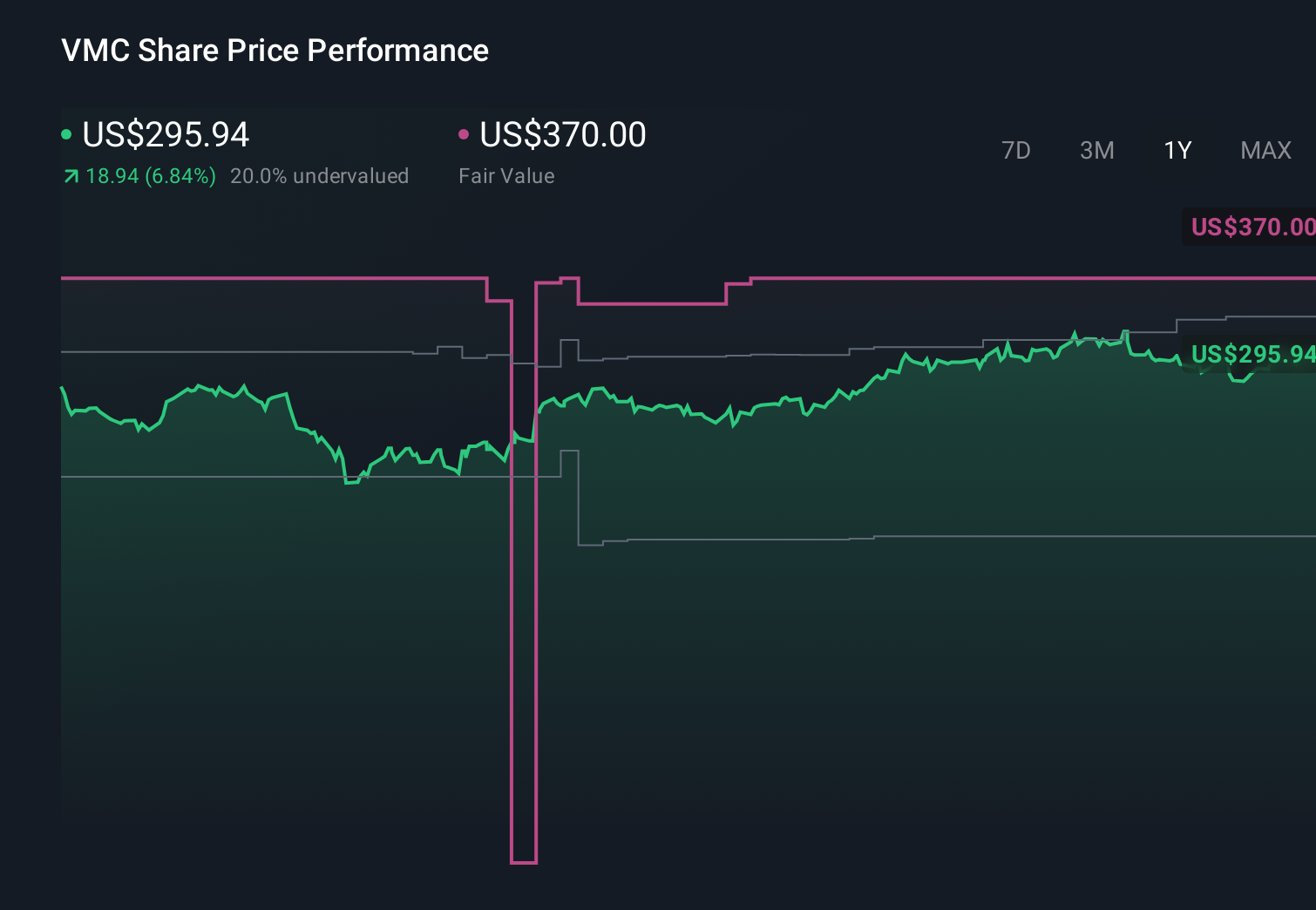
Some of the most optimistic analysts were already modeling revenue of about US$9.6 billion and earnings near US$1.9 billion by 2029, so this buyback and earnings update may either reinforce or challenge those expectations depending on how you view the long term impact of geographic concentration risk in Vulcan’s core regions.
Explore 5 other fair value estimates on Vulcan Materials - why the stock might be worth 22% less than the current price!
The Verdict Is Yours
Don't just follow the ticker - dig into the data and build a conviction that's truly your own.
- A great starting point for your Vulcan Materials research is our analysis highlighting 2 key rewards and 1 important warning sign that could impact your investment decision.
- Our free Vulcan Materials research report provides a comprehensive fundamental analysis summarized in a single visual - the Snowflake - making it easy to evaluate Vulcan Materials' overall financial health at a glance.
Searching For A Fresh Perspective?
Right now could be the best entry point. These picks are fresh from our daily scans. Don't delay:
- AI is about to change healthcare. These 43 stocks are working on everything from early diagnostics to drug discovery. The best part - they are all under $10b in market cap - there's still time to get in early.
- This technology could replace computers: discover 26 stocks that are working to make quantum computing a reality.
- Find 51 companies with promising cash flow potential yet trading below their fair value.
This article by Simply Wall St is general in nature. We provide commentary based on historical data and analyst forecasts only using an unbiased methodology and our articles are not intended to be financial advice. It does not constitute a recommendation to buy or sell any stock, and does not take account of your objectives, or your financial situation. We aim to bring you long-term focused analysis driven by fundamental data. Note that our analysis may not factor in the latest price-sensitive company announcements or qualitative material. Simply Wall St has no position in any stocks mentioned.