

How Removal From Key Russell Growth Indexes At National Health Investors (NHI) Has Changed Its Investment Story
National Health Investors, Inc. NHI | 0.00 |
- In late June 2026, National Health Investors, Inc. was removed from several Russell growth and small-cap indexes, including the Russell 2000 Growth and Russell 3000 Growth benchmarks.
- This broad index exclusion can influence how many institutional investors hold the stock and may alter liquidity patterns and portfolio positioning around the REIT.
- Next, we’ll examine how National Health Investors’ removal from multiple Russell growth indexes could reshape its previously growth-focused investment narrative.
Capitalize on the AI infrastructure supercycle with our selection of the 52 best 'picks and shovels' of the AI gold rush converting record-breaking demand into massive cash flow.
National Health Investors Investment Narrative Recap
To own National Health Investors, you need to believe in the long term demand for senior housing and the REIT’s ability to keep properties leased, tenants stable and cash flows resilient. Its removal from several Russell growth and small cap indexes may shift trading flows, but does not directly change the most important near term catalyst, which is stabilizing SHOP occupancy, or the key risk around tenant concentration and any knock on effects for rent coverage and earnings.
The recent update to full year 2026 earnings guidance, following Q1 2026 results, is particularly relevant here because it gives investors a reference point for assessing how index removal and any related liquidity changes may intersect with NHI’s execution on SHOP performance and tenant health. Against that backdrop, upcoming quarters will likely be scrutinized for how well management balances growth investments with the risk of relying on equity funding and concentrated operator relationships.
Yet behind this seemingly technical index change, one risk investors should be aware of is the combination of tenant concentration and...
National Health Investors' narrative projects $546.5 million revenue and $198.5 million earnings by 2029. This requires 10.5% yearly revenue growth and about a $50.6 million earnings increase from $147.9 million today.
Uncover how National Health Investors' forecasts yield a $85.75 fair value, a 11% upside to its current price.
Exploring Other Perspectives
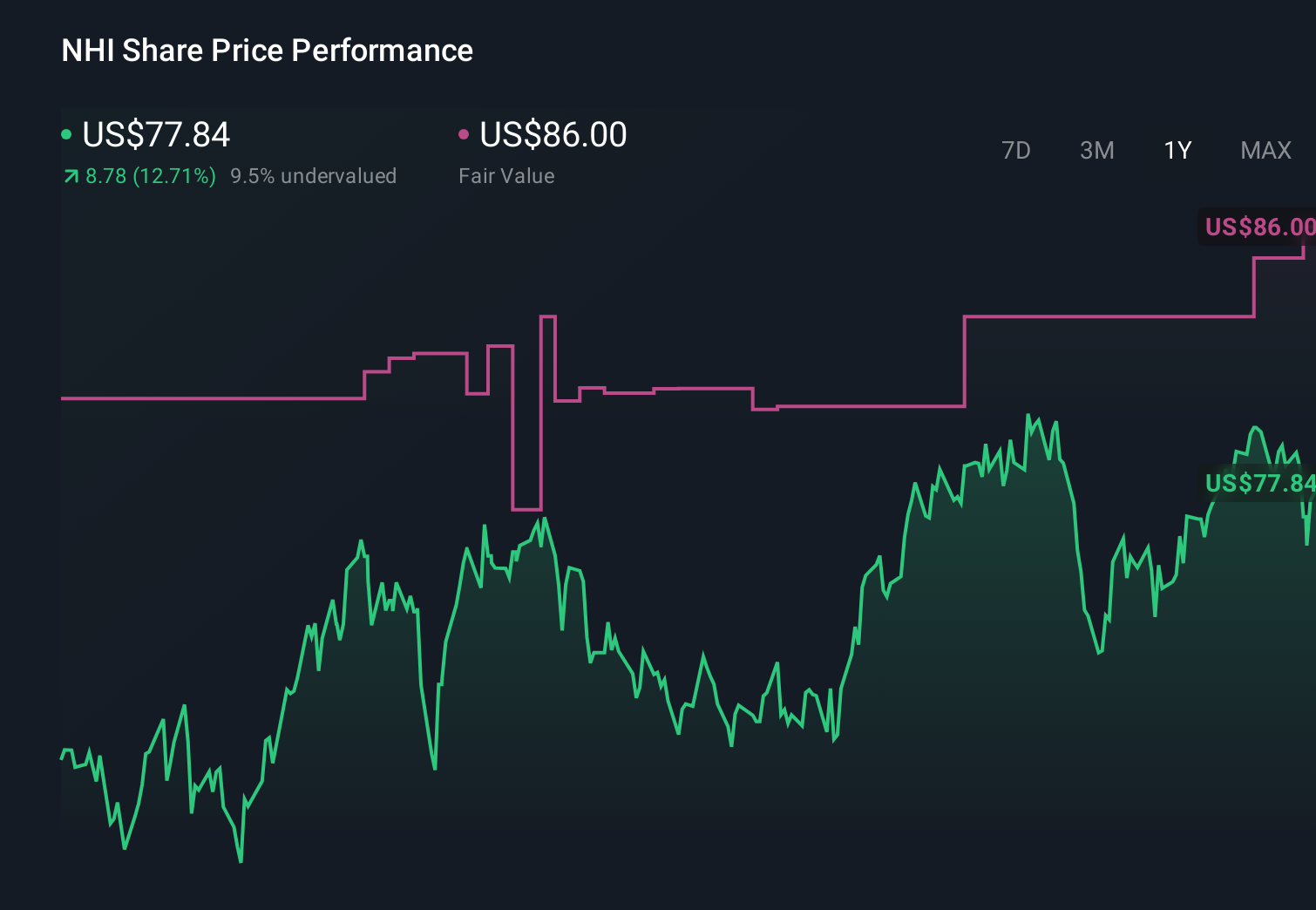
Simply Wall St Community members have published four fair value estimates for NHI, ranging from about US$66.50 to US$165.27 per share, showing how far apart individual views can be. Set against concerns about occupancy softness and concentrated tenant exposure, these differing opinions underline why it can help to weigh several perspectives before forming a view on the REIT’s longer term performance.
Explore 4 other fair value estimates on National Health Investors - why the stock might be worth over 2x more than the current price!
The Verdict Is Yours
Don't just follow the ticker - dig into the data and build a conviction that's truly your own.
- A great starting point for your National Health Investors research is our analysis highlighting 2 key rewards and 3 important warning signs that could impact your investment decision.
- Our free National Health Investors research report provides a comprehensive fundamental analysis summarized in a single visual - the Snowflake - making it easy to evaluate National Health Investors' overall financial health at a glance.
Want Some Alternatives?
Markets shift fast. These stocks won't stay hidden for long. Get the list while it matters:
- Find 45 companies with promising cash flow potential yet trading below their fair value.
- Outshine the giants: these 15 early-stage AI stocks could fund your retirement.
- Explore 26 top quantum computing companies leading the revolution in next-gen technology and shaping the future with breakthroughs in quantum algorithms, superconducting qubits, and cutting-edge research.
This article by Simply Wall St is general in nature. We provide commentary based on historical data and analyst forecasts only using an unbiased methodology and our articles are not intended to be financial advice. It does not constitute a recommendation to buy or sell any stock, and does not take account of your objectives, or your financial situation. We aim to bring you long-term focused analysis driven by fundamental data. Note that our analysis may not factor in the latest price-sensitive company announcements or qualitative material. Simply Wall St has no position in any stocks mentioned.