

How Slower Organic Growth And Flat Sales Forecasts At Church & Dwight (CHD) Have Changed Its Investment Story
Church & Dwight Co., Inc. CHD | 0.00 |
- In recent days, coverage of Church & Dwight highlighted that the Arm & Hammer owner has delivered slower organic revenue growth than many consumer staples peers, with analysts now projecting largely flat sales over the coming year.
- This combination of muted demand expectations and an already optimistic valuation has raised questions about how the company can justify its growth ambitions without clearer drivers.
- Now, we'll examine how concerns over stagnant near-term revenue expectations could reshape Church & Dwight's existing investment narrative and risk profile.
This technology could replace computers: discover 30 stocks that are working to make quantum computing a reality.
Church & Dwight Investment Narrative Recap
To own Church & Dwight today, you need to believe its core household and personal care brands can justify a premium valuation despite muted near term sales expectations. The recent commentary on flat projected revenue heightens focus on whether innovation, e‑commerce growth, and premium brands can offset slower category growth, while the biggest risk near term is that weak demand and rising promotional intensity further pressure already tight margins. At this stage, the news reinforces existing concerns rather than fundamentally changing the thesis.
The most relevant recent update is management’s 2026 outlook, which calls for a modest sales decline tied to portfolio exits but higher diluted EPS of US$3.57 to US$3.67. This highlights how Church & Dwight is leaning on margin improvement, cost control, and mix to support earnings, even as top line expectations cool. For investors focused on catalysts, this raises the bar on execution around innovation and premium brands if revenue growth remains subdued.
Yet behind the strong recent share price, one risk that investors should be aware of is how slower category growth and heavier promotion could interact with Church & Dwight's already high valuation...
Church & Dwight's narrative projects $6.7 billion revenue and $973.6 million earnings by 2029. This requires 2.4% yearly revenue growth and a $240.6 million earnings increase from $733.0 million today.
Uncover how Church & Dwight's forecasts yield a $102.16 fair value, a 4% upside to its current price.
Exploring Other Perspectives
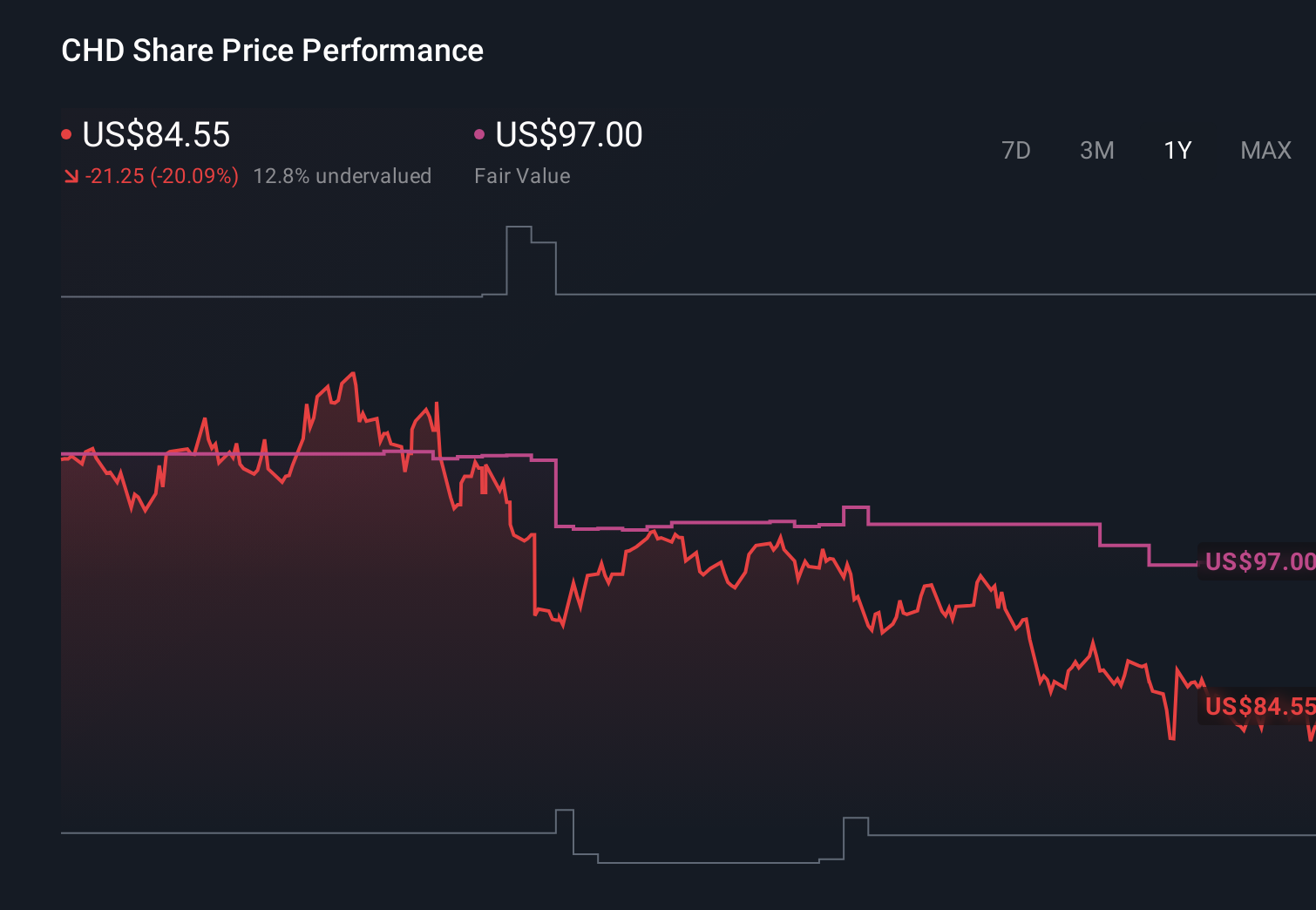
Before this news, the most optimistic analysts were assuming annual revenue growth of about 2.6% and earnings near US$994.5 million by 2029, which looks far more upbeat than today’s flat 12 month sales forecasts and shows how differently you and other investors might view brand concentration risks and Church & Dwight’s long term potential.
Explore 5 other fair value estimates on Church & Dwight - why the stock might be worth just $102.01!
Reach Your Own Conclusion
Disagree with existing narratives? Extraordinary investment returns rarely come from following the herd, so go with your instincts.
- A great starting point for your Church & Dwight research is our analysis highlighting 3 key rewards and 1 important warning sign that could impact your investment decision.
- Our free Church & Dwight research report provides a comprehensive fundamental analysis summarized in a single visual - the Snowflake - making it easy to evaluate Church & Dwight's overall financial health at a glance.
Curious About Other Options?
Don't miss your shot at the next 10-bagger. Our latest stock picks just dropped:
- The best AI stocks today may lie beyond giants like Nvidia and Microsoft. Find the next big opportunity with these 14 smaller AI-focused companies with strong growth potential through early-stage innovation in machine learning, automation, and data intelligence that could fund your retirement.
- Uncover the next big thing with 21 elite penny stocks that balance risk and reward.
- The future of work is here. Discover the 31 top robotics and automation stocks leading the charge in AI-driven automation and industrial transformation.
This article by Simply Wall St is general in nature. We provide commentary based on historical data and analyst forecasts only using an unbiased methodology and our articles are not intended to be financial advice. It does not constitute a recommendation to buy or sell any stock, and does not take account of your objectives, or your financial situation. We aim to bring you long-term focused analysis driven by fundamental data. Note that our analysis may not factor in the latest price-sensitive company announcements or qualitative material. Simply Wall St has no position in any stocks mentioned.