

How Steep Profit Declines and Strong Valuation Scores At Hancock Whitney (HWC) Have Changed Its Investment Story
Hancock Whitney Corporation HWC | 0.00 |
- Hancock Whitney recently reported a sharp year-over-year pullback in performance, with quarterly revenue down 24.16% and net profit down 60.28%, alongside assessments of stable financial health but weak operating efficiency.
- At the same time, the bank’s valuation and price momentum scores remain relatively strong, and institutional ownership exceeds 100%, highlighting a contrast between softer fundamentals and sustained professional investor interest.
- We’ll now explore how this steep profit decline interacts with earlier expectations around acquisitions and capital returns in Hancock Whitney’s investment narrative.
The future of work is here. Discover the 31 top robotics and automation stocks leading the charge in AI-driven automation and industrial transformation.
Hancock Whitney Investment Narrative Recap
To own Hancock Whitney, you need to be comfortable with a regional bank story that mixes capital returns, acquisitions and traditional lending with some volatility in quarterly results. The sharp 60% drop in net profit and weaker efficiency metrics directly test confidence in near term earnings stability, while the strongest short term catalyst and risk now both sit around how effectively management can turn recent investments into durable profitability.
The most relevant recent announcement here is the completion of the latest share repurchase program, with 1,400,000 shares bought back for US$94,570,000 in Q1 2026. That capital return sits uncomfortably beside a 24.16% year over year revenue decline and raises fresh questions about how much room Hancock Whitney has to keep balancing buybacks with funding loan growth, absorbing higher Sabal Trust related expenses and managing any credit costs from a softer small business backdrop.
Yet beneath the solid institutional ownership and strong price momentum, investors should still be aware of how rising expenses from the Sabal Trust deal could...
Hancock Whitney's narrative projects $2.1 billion revenue and $644.9 million earnings by 2029. This requires 15.5% yearly revenue growth and about a $232.6 million earnings increase from $412.3 million today.
Uncover how Hancock Whitney's forecasts yield a $78.22 fair value, a 11% upside to its current price.
Exploring Other Perspectives
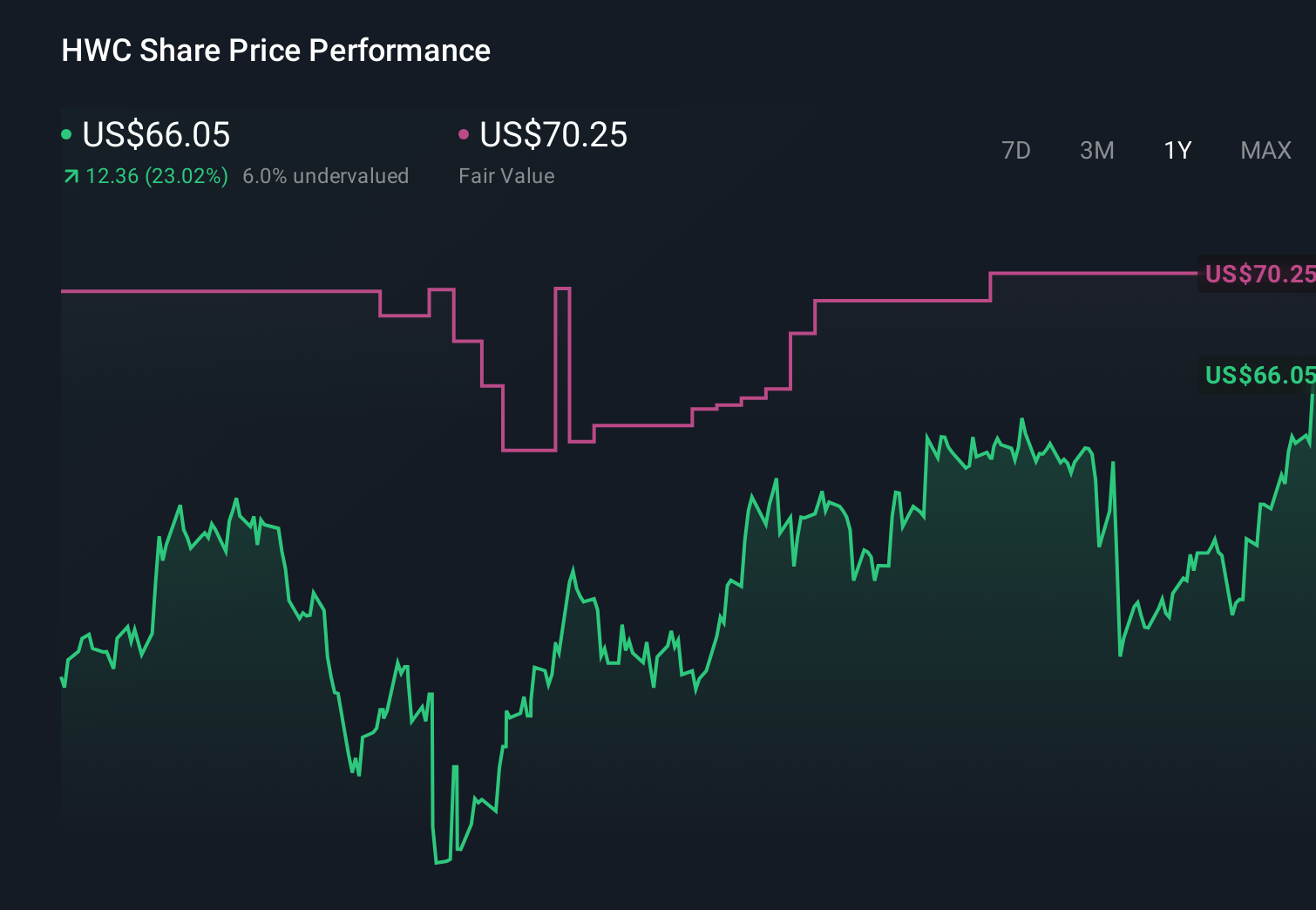
Two fair value estimates from the Simply Wall St Community span roughly US$78 to US$133 per share, showing wide gaps in expectations. Against that backdrop, the recent 60% net profit decline and weaker operating efficiency give you a concrete reason to compare several of those community views before deciding how Hancock Whitney might fit into your own portfolio.
Explore 2 other fair value estimates on Hancock Whitney - why the stock might be worth just $78.22!
Form Your Own Verdict
Don't just follow the ticker - dig into the data and build a conviction that's truly your own.
- A great starting point for your Hancock Whitney research is our analysis highlighting 3 key rewards that could impact your investment decision.
- Our free Hancock Whitney research report provides a comprehensive fundamental analysis summarized in a single visual - the Snowflake - making it easy to evaluate Hancock Whitney's overall financial health at a glance.
Looking For Alternative Opportunities?
Every day counts. These free picks are already gaining attention. See them before the crowd does:
- AI is about to change healthcare. These 40 stocks are working on everything from early diagnostics to drug discovery. The best part - they are all under $10b in market cap - there's still time to get in early.
- Invest in the nuclear renaissance through our list of 89 elite nuclear energy infrastructure plays powering the global AI revolution.
- Uncover the next big thing with 24 elite penny stocks that balance risk and reward.
This article by Simply Wall St is general in nature. We provide commentary based on historical data and analyst forecasts only using an unbiased methodology and our articles are not intended to be financial advice. It does not constitute a recommendation to buy or sell any stock, and does not take account of your objectives, or your financial situation. We aim to bring you long-term focused analysis driven by fundamental data. Note that our analysis may not factor in the latest price-sensitive company announcements or qualitative material. Simply Wall St has no position in any stocks mentioned.