

How Whirlpool’s Upsized Secured Debt Deal At Whirlpool (WHR) Has Changed Its Investment Story
Whirlpool Corporation WHR | 0.00 |
- In early June 2026, Whirlpool Corporation priced an upsized US$2.00 billion offering of senior secured second-lien notes, carrying coupons of 7.500% due 2031 and 7.875% due 2034, to refinance near-term notes, repay its unsecured revolver, and fund related fees alongside a new asset-based revolving credit facility.
- This move replaces lower‑coupon debt with higher‑cost, asset‑backed borrowings, highlighting Whirlpool’s reliance on secured financing and the increased priority given to creditors over equity holders in its capital structure.
- We’ll now examine how Whirlpool’s larger, higher‑coupon secured debt package reshapes its investment narrative and longer‑term balance sheet flexibility.
Find 46 companies with promising cash flow potential yet trading below their fair value.
Whirlpool Investment Narrative Recap
To own Whirlpool today, you need to believe it can turn a low margin, debt heavy appliance business into a steadier cash generator, helped by product refreshes and a slow repair in demand. The upsized US$2.00 billion second lien debt deal raises interest costs and leans harder on secured financing, which tightens near term balance sheet flexibility and heightens the key risk around already thin margins and pressured free cash flow, but does not directly change the main product and demand catalysts.
The most relevant recent move alongside this refinancing is Whirlpool’s suspension of its common dividend in May 2026, after earlier affirming a US$0.90 quarterly payout in February. Together with the higher coupon, secured notes, this signals that balance sheet repair and debt service now sit ahead of cash returns to shareholders, which could influence how quickly any benefits from cost programs, new products and U.S. manufacturing investments translate into visible upside for equity holders.
Yet investors should also be aware that Whirlpool’s increased reliance on secured, higher cost borrowing could interact uncomfortably with already weak interest coverage and...
Whirlpool’s narrative projects $16.3 billion revenue and $315.6 million earnings by 2029.
Uncover how Whirlpool's forecasts yield a $56.55 fair value, a 36% upside to its current price.
Exploring Other Perspectives
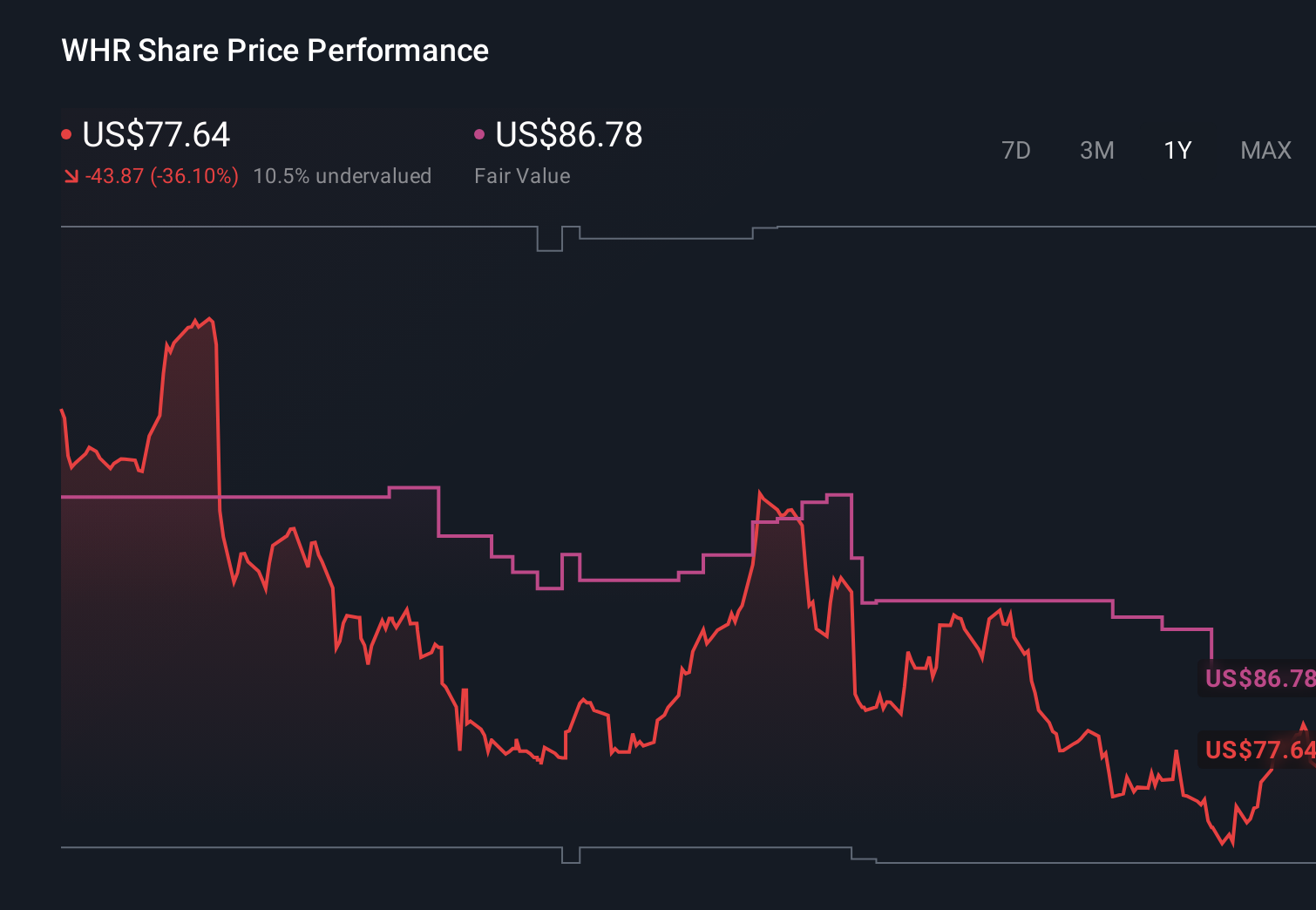
Compared with the baseline, the lowest analysts were already assuming flat revenue near US$15.7 billion and earnings of about US$613.9 million, so this higher cost secured refinancing may reinforce their more pessimistic view that debt service and margin pressure could remain the real swing factors for Whirlpool’s equity story.
Explore 3 other fair value estimates on Whirlpool - why the stock might be worth just $56.55!
Reach Your Own Conclusion
Disagree with existing narratives? Extraordinary investment returns rarely come from following the herd, so go with your instincts.
- A great starting point for your Whirlpool research is our analysis highlighting 3 key rewards and 3 important warning signs that could impact your investment decision.
- Our free Whirlpool research report provides a comprehensive fundamental analysis summarized in a single visual - the Snowflake - making it easy to evaluate Whirlpool's overall financial health at a glance.
Seeking Other Investments?
Markets shift fast. These stocks won't stay hidden for long. Get the list while it matters:
- The future of work is here. Discover the 33 top robotics and automation stocks leading the charge in AI-driven automation and industrial transformation.
- Uncover the next big thing with 24 elite penny stocks that balance risk and reward.
- Capitalize on the AI infrastructure supercycle with our selection of the 48 best 'picks and shovels' of the AI gold rush converting record-breaking demand into massive cash flow.
This article by Simply Wall St is general in nature. We provide commentary based on historical data and analyst forecasts only using an unbiased methodology and our articles are not intended to be financial advice. It does not constitute a recommendation to buy or sell any stock, and does not take account of your objectives, or your financial situation. We aim to bring you long-term focused analysis driven by fundamental data. Note that our analysis may not factor in the latest price-sensitive company announcements or qualitative material. Simply Wall St has no position in any stocks mentioned.