

Howard Hughes Holdings (HHH) Stock May Be 35% Undervalued On Cash Flow
Howard Hughes Holdings Inc. HHH | 0.00 |
Howard Hughes Holdings stock has fallen about 21.3% over the past five years, yet the current valuation work suggests the market may be pricing it too cautiously. Both the Discounted Cash Flow (DCF) intrinsic value estimate and the earnings based multiples point to the shares trading at a discount to what the underlying cash flows may justify.
- Over five years the share price decline of roughly 21.3% means long term holders have experienced a material capital loss.
- Future cash flow from Howard Hughes Holdings' development projects can support the intrinsic value case, while the execution risk and capital intensity of large scale real estate developments may weigh on what investors are willing to pay today.
- The company screens as undervalued on 6 of 6 valuation checks, which leans toward the shares being cheap rather than fairly priced or expensive.
For investors, the debate is whether Howard Hughes Holdings' discounted valuation offers an attractive entry point relative to the risks tied to its long dated real estate cash flows.
Is Howard Hughes Holdings a Bargain on Cash Flow?
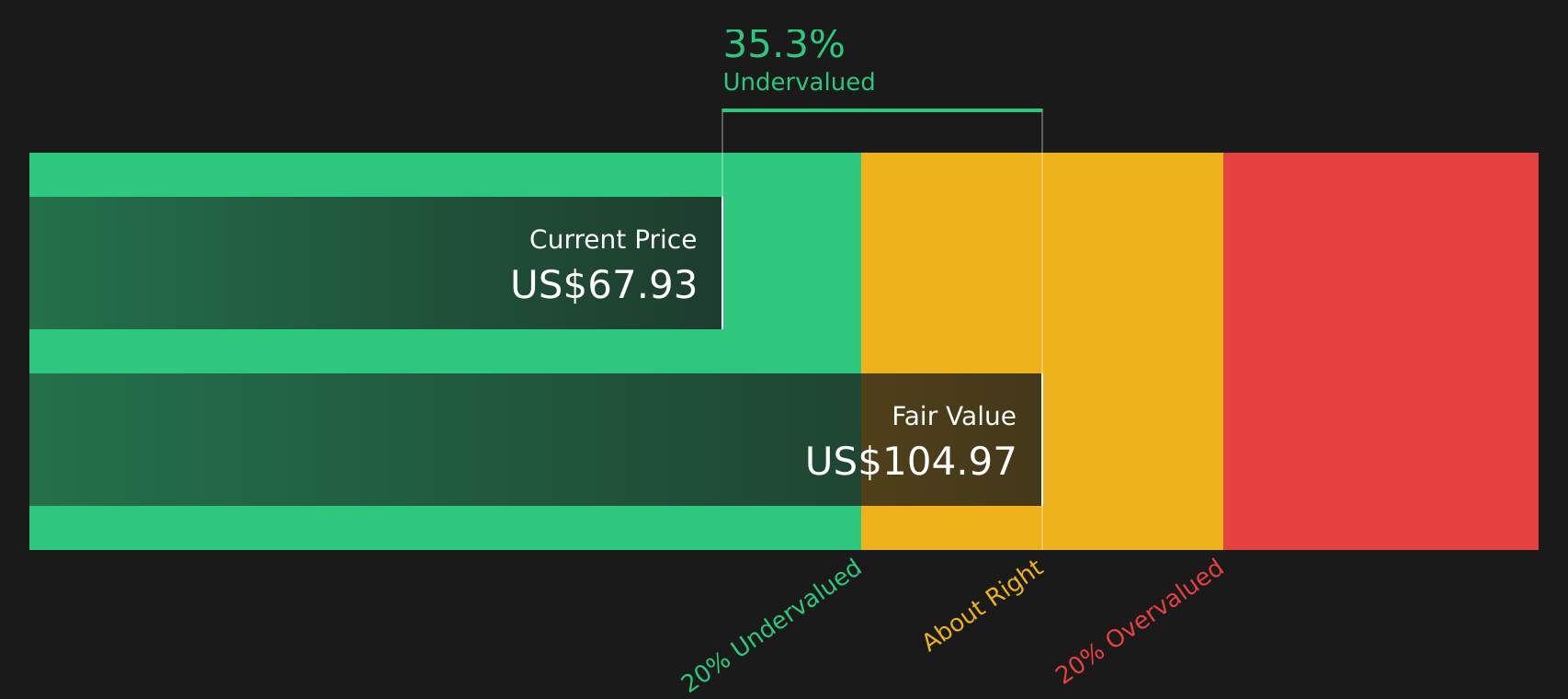
The Discounted Cash Flow (DCF) model values Howard Hughes Holdings by projecting future free cash flows and discounting them back to today. On this view, the company generated last twelve month free cash flow of about $763.4 million, with the model assuming that cash generation trends lower over time rather than expanding aggressively.
Based on these projections, the DCF model points to an estimated intrinsic value of about $104 per share. Compared with the current share price, this implies the stock trades at roughly a 34.6% discount. That gap suggests the market is treating Howard Hughes Holdings' cash flows cautiously relative to what the model indicates.
On these cash flow assumptions, the DCF-based intrinsic value estimate is higher than the current share price.
Our Discounted Cash Flow (DCF) analysis suggests Howard Hughes Holdings is undervalued by 34.6%. Track this in your watchlist or portfolio, or discover 52 more high quality undervalued stocks.
Is Howard Hughes Holdings a Bargain on Earnings?
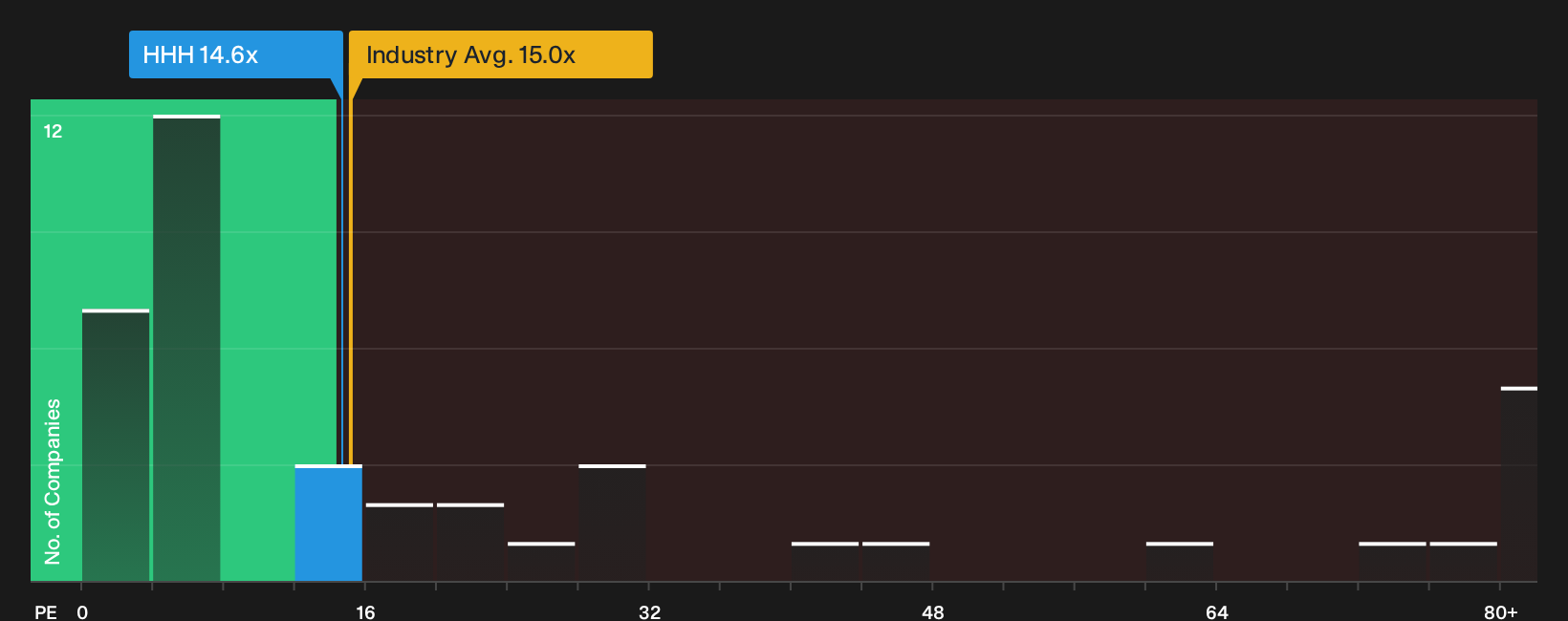
P/E works well for Howard Hughes Holdings because earnings are a core yardstick for real estate businesses that are already producing profit. On this measure, the stock trades at about 13.8x earnings, which is below both the Real Estate industry average of roughly 17.8x and a peer group average near 17.1x.
The valuation model suggests that, given Howard Hughes Holdings' profile, a P/E closer to 21.8x would be in line with what investors might usually pay. That is materially higher than the current 13.8x, which points to the market applying a sizeable discount to the stock relative to this tailored benchmark and to sector peers.
Taken together, the P/E comparison indicates Howard Hughes Holdings stock appears undervalued on an earnings multiple basis.
The Howard Hughes Holdings Narrative: What Would Justify Today's Price?
Howard Hughes Holdings' valuation gap raises an obvious question about what would need to change in the company’s future for the current price to look high or low. Simply Wall St Narratives on the Community page spell out those assumptions in plain terms, linking each number to a clear view on how Howard Hughes Holdings' growth, margins and risks might evolve, so you can return to the same story as fresh information appears.
You can add your own narrative on Howard Hughes Holdings' stock to set out a clear, number-driven case on where its growth, margins and execution go from here. Share your view and see how it stacks up as new results and information come through.
Do you think there's more to the story for Howard Hughes Holdings? Head over to our Community to see what others are saying!
The Bottom Line
For Howard Hughes Holdings, both the Discounted Cash Flow (DCF) intrinsic value estimate and the earnings multiple work point in the same direction, with each suggesting the stock screens as undervalued rather than stretched. The key question is whether the discount is compensation for the execution and capital intensity risks tied to its long dated real estate projects, or whether it is an opportunity if those projects deliver the cash flows implied. What matters most from here is whether the market gains confidence in the timing and durability of those cash flows enough for the current discount to narrow.
This article by Simply Wall St is general in nature. We provide commentary based on historical data and analyst forecasts only using an unbiased methodology and our articles are not intended to be financial advice. It does not constitute a recommendation to buy or sell any stock, and does not take account of your objectives, or your financial situation. We aim to bring you long-term focused analysis driven by fundamental data. Note that our analysis may not factor in the latest price-sensitive company announcements or qualitative material. Simply Wall St has no position in any stocks mentioned.