

Is Best Buy’s (BBY) ESG Pay Dispute Quietly Reframing Its Capital Allocation Story?
Best Buy Co.,Inc. BBY | 0.00 |
- On April 30, 2026, Best Buy disclosed that two shareholder groups filed proposals asking for detailed reporting on risks tied to ESG and DEI-linked executive pay and on the financial rationale for investments highlighted in its 2025 Corporate Responsibility & Sustainability Report, while the company urged investors to vote against both at its upcoming June 12, 2026 meeting.
- This clash over ESG oversight and investment transparency highlights growing tension between activist shareholders seeking more rigorous financial accountability and Best Buy’s current governance approach.
- We’ll now examine how this pushback against ESG-linked incentives and investment transparency could influence Best Buy’s existing investment narrative.
Explore 26 top quantum computing companies leading the revolution in next-gen technology and shaping the future with breakthroughs in quantum algorithms, superconducting qubits, and cutting-edge research.
Best Buy Investment Narrative Recap
To own Best Buy, you need to believe its omnichannel model, vendor relationships and services like Geek Squad can support earnings even as electronics demand and margins stay pressured. The latest ESG-related shareholder proposals mainly touch governance and disclosure, so they do not meaningfully change the near term focus on stabilizing gross margins and managing competition from online and direct to consumer channels.
The most relevant recent announcement here is Best Buy’s April 30, 2026 proxy filing, where it urged shareholders to vote against additional ESG and ROI reporting proposals. For investors, this sits alongside existing catalysts such as the Windows 10 replacement cycle and marketplace expansion, but it also puts a fresh spotlight on governance, capital allocation discipline and how clearly Best Buy ties non financial goals to shareholder returns.
Yet behind the upgrade story, investors should also be aware of how ESG linked incentives could interact with already thin margins and rising SG&A...
Best Buy's narrative projects $43.1 billion revenue and $1.5 billion earnings by 2029. This requires 1.1% yearly revenue growth and an earnings increase of about $0.4 billion from $1.1 billion today.
Uncover how Best Buy's forecasts yield a $72.50 fair value, a 31% upside to its current price.
Exploring Other Perspectives
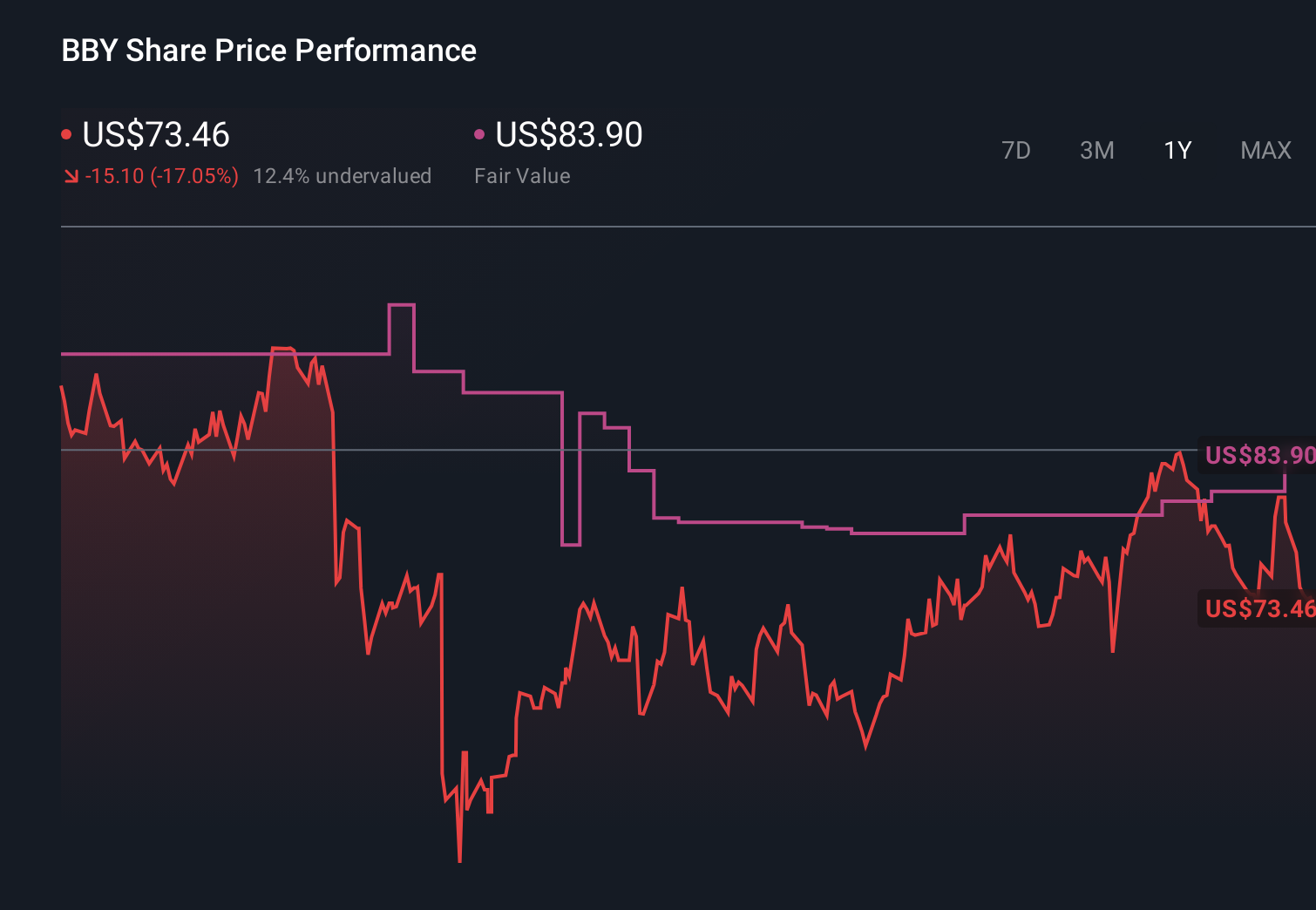
Some of the most optimistic analysts were expecting revenue to reach about US$44.3 billion and earnings US$1.7 billion by 2029, yet this new ESG focused push for cost and risk clarity, especially around tariffs and a softer sales backdrop, could prompt you to rethink how confident you are in those assumptions.
Explore 5 other fair value estimates on Best Buy - why the stock might be worth over 2x more than the current price!
Decide For Yourself
Disagree with existing narratives? Extraordinary investment returns rarely come from following the herd, so go with your instincts.
- A great starting point for your Best Buy research is our analysis highlighting 6 key rewards and 2 important warning signs that could impact your investment decision.
- Our free Best Buy research report provides a comprehensive fundamental analysis summarized in a single visual - the Snowflake - making it easy to evaluate Best Buy's overall financial health at a glance.
Contemplating Other Strategies?
Our top stock finds are flying under the radar-for now. Get in early:
- The latest GPUs need a type of rare earth metal called Dysprosium and there are only 33 companies in the world exploring or producing it. Find the list for free.
- We've uncovered the 14 dividend fortresses yielding 5%+ that don't just survive market storms, but thrive in them.
- Capitalize on the AI infrastructure supercycle with our selection of the 39 best 'picks and shovels' of the AI gold rush converting record-breaking demand into massive cash flow.
This article by Simply Wall St is general in nature. We provide commentary based on historical data and analyst forecasts only using an unbiased methodology and our articles are not intended to be financial advice. It does not constitute a recommendation to buy or sell any stock, and does not take account of your objectives, or your financial situation. We aim to bring you long-term focused analysis driven by fundamental data. Note that our analysis may not factor in the latest price-sensitive company announcements or qualitative material. Simply Wall St has no position in any stocks mentioned.