

Is Celanese (CE) Quietly Recasting Its Materials Portfolio Around Carbon Capture With SharpCell Deal?
Celanese Corporation CE | 0.00 |
- In early May 2026, Celanese Corporation and SharpCell Oy announced a collaboration to use carbon capture and utilization technology in Celanese vinyl acetate ethylene binders for airlaid nonwovens, aiming to lower the product carbon footprint of everyday items like wipes and hygiene products.
- A key feature of this cooperation is the projected annual use of over 400 metric tons of captured CO2, accounted for via mass-balance methods, to produce lower-emission nonwoven materials without altering product performance.
- Next, we’ll explore how integrating carbon capture-based binders into everyday nonwovens could reinforce Celanese’s sustainability-focused investment narrative.
The future of work is here. Discover the 35 top robotics and automation stocks leading the charge in AI-driven automation and industrial transformation.
Celanese Investment Narrative Recap
To own Celanese today, you need to believe its portfolio of engineered materials and acetyl products can return to healthier profitability while it manages high debt and cyclical demand. The SharpCell CCU announcement strengthens the sustainability angle that many investors already watch, but it does not materially change the near term catalyst of volume and margin recovery or the key risk of prolonged overcapacity and weak demand depressing earnings and cash flow.
Against that backdrop, the recent expansion of the Michigan Technology Center in February 2026 is worth watching. It supports Celanese’s push into higher value engineered materials and application development, which ties directly into the same sustainability and innovation themes highlighted by the SharpCell agreement and could matter for how effectively the company converts any eventual demand recovery into stronger margins.
Yet, while Celanese leans into greener binders and innovation hubs, investors should also be aware that prolonged margin pressure in key regions could...
Celanese's narrative projects $10.2 billion revenue and $799.9 million earnings by 2028. This implies revenue shrinking by 1.0% per year and an earnings increase of roughly $2.4 billion from about -$1.6 billion today.
Uncover how Celanese's forecasts yield a $51.50 fair value, a 25% downside to its current price.
Exploring Other Perspectives
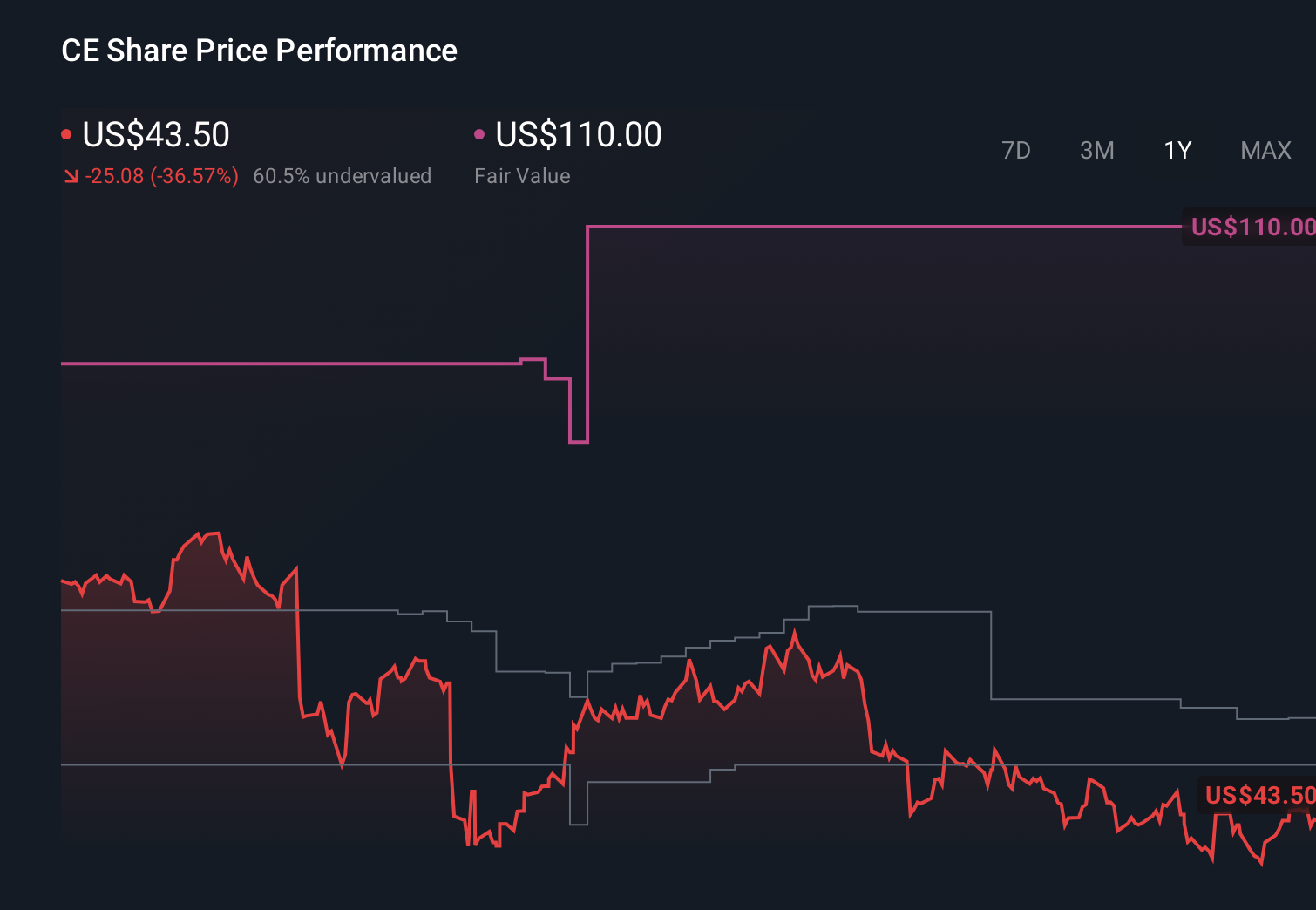
Some of the most optimistic analysts were already modeling revenue around US$11.4 billion and earnings near US$902.5 million by 2029, so if you are weighing that upbeat view against concerns about high debt and raw material cost risk, this new CCU collaboration is exactly the kind of development that could shift those narratives in different ways.
Explore 5 other fair value estimates on Celanese - why the stock might be worth 25% less than the current price!
Decide For Yourself
Disagree with existing narratives? Extraordinary investment returns rarely come from following the herd, so go with your instincts.
- A great starting point for your Celanese research is our analysis highlighting 3 key rewards and 1 important warning sign that could impact your investment decision.
- Our free Celanese research report provides a comprehensive fundamental analysis summarized in a single visual - the Snowflake - making it easy to evaluate Celanese's overall financial health at a glance.
No Opportunity In Celanese?
Our top stock finds are flying under the radar-for now. Get in early:
- Uncover the next big thing with 22 elite penny stocks that balance risk and reward.
- The best AI stocks today may lie beyond giants like Nvidia and Microsoft. Find the next big opportunity with these 19 smaller AI-focused companies with strong growth potential through early-stage innovation in machine learning, automation, and data intelligence that could fund your retirement.
- Capitalize on the AI infrastructure supercycle with our selection of the 38 best 'picks and shovels' of the AI gold rush converting record-breaking demand into massive cash flow.
This article by Simply Wall St is general in nature. We provide commentary based on historical data and analyst forecasts only using an unbiased methodology and our articles are not intended to be financial advice. It does not constitute a recommendation to buy or sell any stock, and does not take account of your objectives, or your financial situation. We aim to bring you long-term focused analysis driven by fundamental data. Note that our analysis may not factor in the latest price-sensitive company announcements or qualitative material. Simply Wall St has no position in any stocks mentioned.