

Is Duolingo’s (DUOL) AI-Boosted Youth Engagement Quietly Reshaping Its Long-Term Growth Narrative?
Duolingo, Inc. DUOL | 0.00 |
- In July 2026, app analytics firm Apptopia reported that Duolingo’s average time spent per daily active user among 17-to-25-year-olds reached its highest level since January 2025, with heavy AI chatbot users also increasing their engagement.
- This suggests that rather than replacing language learning apps, AI chatbots may be reinforcing Duolingo’s appeal for younger, highly engaged learners.
- We’ll now examine how this surge in AI-driven engagement among young users might influence Duolingo’s investment narrative and growth assumptions.
The best AI stocks today may lie beyond giants like Nvidia and Microsoft. Find the next big opportunity with these 16 smaller AI-focused companies with strong growth potential through early-stage innovation in machine learning, automation, and data intelligence that could fund your retirement.
Duolingo Investment Narrative Recap
To own Duolingo, you need to believe it can keep growing a highly engaged global user base and convert that attention into recurring, profitable revenue, even as AI reshapes language learning. The Apptopia data on rising time spent among 17-to-25-year-olds suggests that AI chatbots are, for now, complementing rather than displacing Duolingo, which is helpful for the key near term catalyst of sustaining DAU growth. The biggest current risk remains that user growth in mature markets slows as competition and digital fatigue increase.
The most relevant recent development here is Duolingo’s expanding AI-powered feature set, particularly within Duolingo Max and adjacent experiments unveiled around Duocon 2025. Those initiatives were already framed as a way to deepen engagement and justify premium tiers; Apptopia’s findings now give fresh, user-level evidence that heavier AI feature use aligns with more time in the app. How effectively Duolingo translates that engagement into higher ARPU and stable margins is central to the upcoming earnings updates and to the broader investment narrative.
Yet even with stronger AI engagement, investors should be aware that rising competition from large tech firms offering free or cheap AI translation tools could still...
Duolingo's narrative projects $1.6 billion revenue and $129.9 million earnings by 2029. This requires 13.1% yearly revenue growth and a $292.5 million earnings decrease from $422.4 million today.
Uncover how Duolingo's forecasts yield a $108.14 fair value, a 12% downside to its current price.
Exploring Other Perspectives
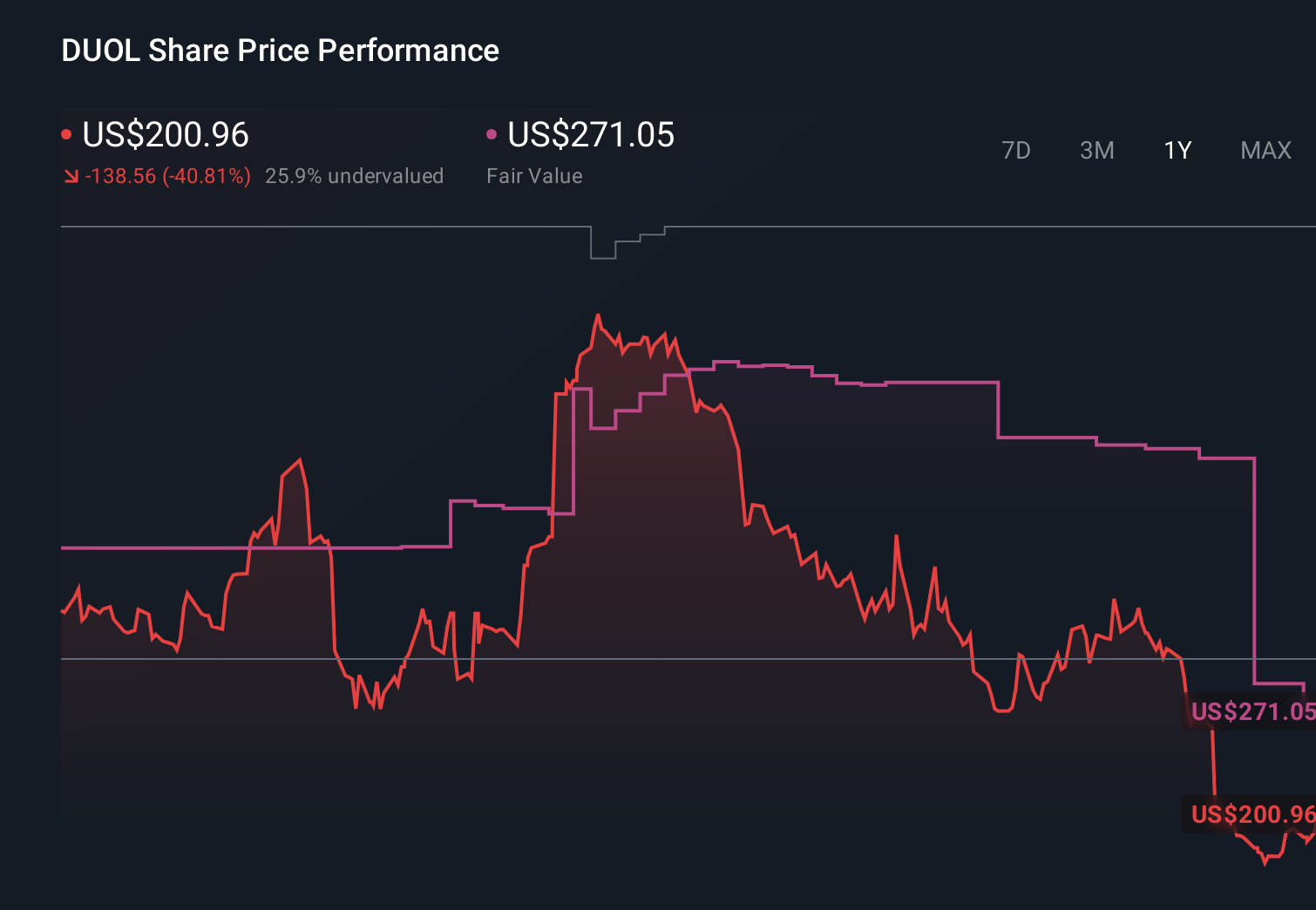
Some of the most optimistic analysts were already expecting about US$1.7 billion of revenue and US$239.4 million of earnings by 2029, so if AI keeps lifting engagement, their far more upbeat view on Duolingo’s upside and on the risk of AI replacing paid learning could look closer to reality or prove too bold, depending on how these user trends evolve from here.
Explore 24 other fair value estimates on Duolingo - why the stock might be worth 34% less than the current price!
The Verdict Is Yours
Don't just follow the ticker - dig into the data and build a conviction that's truly your own.
- A great starting point for your Duolingo research is our analysis highlighting 2 key rewards and 2 important warning signs that could impact your investment decision.
- Our free Duolingo research report provides a comprehensive fundamental analysis summarized in a single visual - the Snowflake - making it easy to evaluate Duolingo's overall financial health at a glance.
Seeking Other Investments?
Every day counts. These free picks are already gaining attention. See them before the crowd does:
- The future of work is here. Discover the 34 top robotics and automation stocks leading the charge in AI-driven automation and industrial transformation.
- Uncover the next big thing with 21 elite penny stocks that balance risk and reward.
- Capitalize on the AI infrastructure supercycle with our selection of the 55 best 'picks and shovels' of the AI gold rush converting record-breaking demand into massive cash flow.
This article by Simply Wall St is general in nature. We provide commentary based on historical data and analyst forecasts only using an unbiased methodology and our articles are not intended to be financial advice. It does not constitute a recommendation to buy or sell any stock, and does not take account of your objectives, or your financial situation. We aim to bring you long-term focused analysis driven by fundamental data. Note that our analysis may not factor in the latest price-sensitive company announcements or qualitative material. Simply Wall St has no position in any stocks mentioned.