

Is Easterly Government Properties (DEA) Using New Term Debt To Quietly Redefine Its Balance Sheet Strategy?
Easterly Government Properties Inc DEA | 0.00 |
- Easterly Government Properties recently closed a new five-year US$200,000,000 senior unsecured term loan facility, which includes an accordion feature allowing total commitments to rise to as much as US$250,000,000 and matures in June 2031.
- The company plans to use the proceeds to repay borrowings under its US$400,000,000 revolving credit facility and for general corporate purposes, effectively reshaping its mix of revolving and term debt while locking in pricing tied to its current leverage ratio.
- We will now examine how Easterly’s decision to refinance its revolving credit borrowings with a SOFR-linked term loan shapes its investment narrative.
Invest in the nuclear renaissance through our list of 89 elite nuclear energy infrastructure plays powering the global AI revolution.
What Is Easterly Government Properties' Investment Narrative?
To own Easterly Government Properties, you need to be comfortable with a slow‑growing, income‑oriented REIT that leans heavily on long federal and state leases and a relatively rich valuation. The new US$200,000,000 SOFR‑linked term loan, with potential expansion to US$250,000,000, mostly fine‑tunes the balance sheet rather than transforming the story, but it does slightly shift the near‑term catalysts and risks. On the positive side, refinancing part of the US$400,000,000 revolver with longer‑dated unsecured debt can ease near‑term refinancing uncertainty and reduce exposure to future swings in credit markets. On the risk side, it reinforces how important interest costs and leverage are at a time when earnings coverage of interest remains thin and net income growth has been modest. That mix of stable leases, high dividend payouts and tight interest cover is what investors are really underwriting here.
However, investors should not overlook how sensitive this model may still be to funding costs. Easterly Government Properties' shares have been on the rise but are still potentially undervalued by 46%. Find out what it's worth.Exploring Other Perspectives
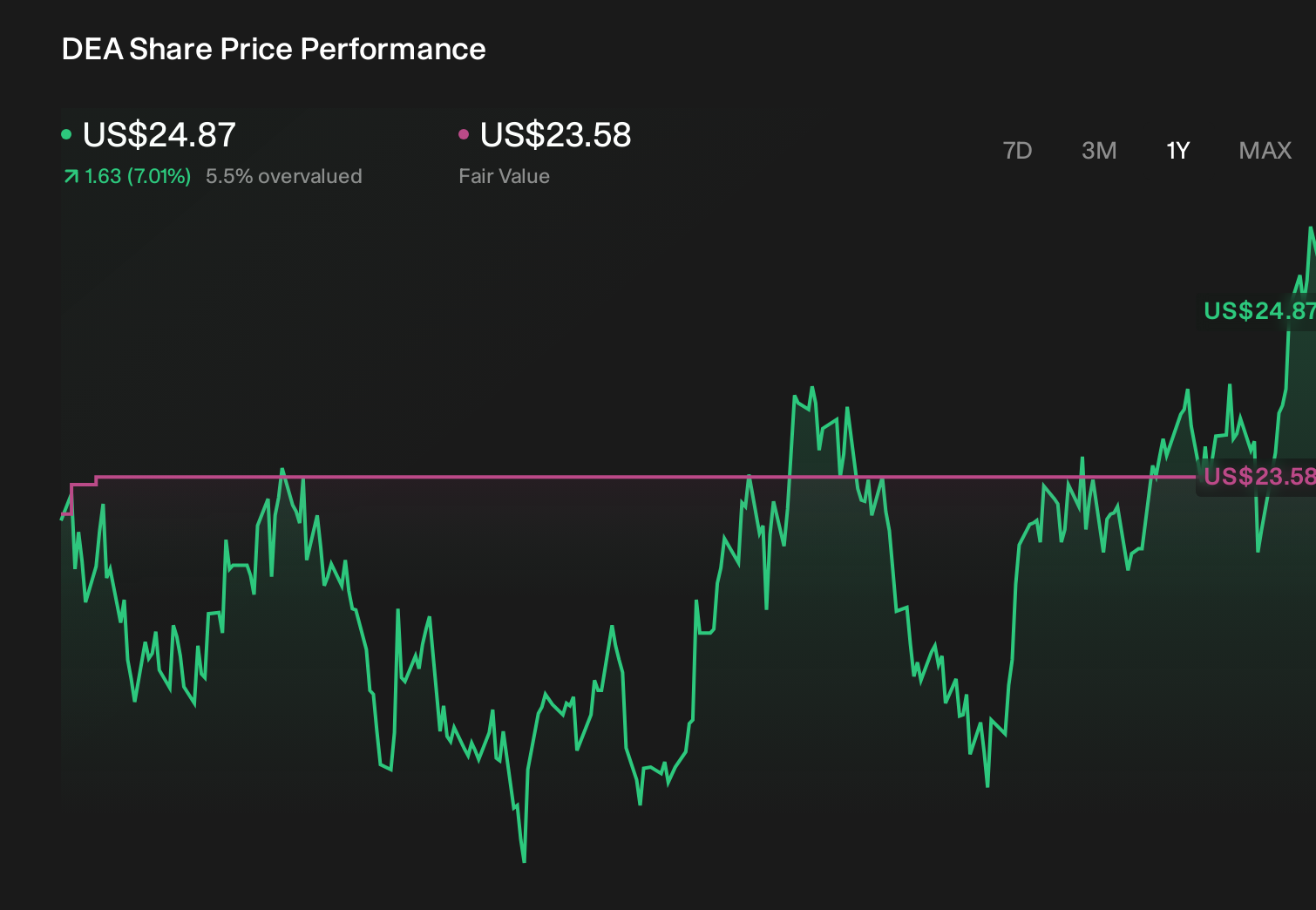
Explore 3 other fair value estimates on Easterly Government Properties - why the stock might be worth as much as 84% more than the current price!
The Verdict Is Yours
Don't just follow the ticker - dig into the data and build a conviction that's truly your own.
- A great starting point for your Easterly Government Properties research is our analysis highlighting 2 key rewards and 3 important warning signs that could impact your investment decision.
- Our free Easterly Government Properties research report provides a comprehensive fundamental analysis summarized in a single visual - the Snowflake - making it easy to evaluate Easterly Government Properties' overall financial health at a glance.
Want Some Alternatives?
Our top stock finds are flying under the radar-for now. Get in early:
- AI is about to change healthcare. These 41 stocks are working on everything from early diagnostics to drug discovery. The best part - they are all under $10b in market cap - there's still time to get in early.
- This technology could replace computers: discover 26 stocks that are working to make quantum computing a reality.
- We've uncovered the 9 dividend fortresses yielding 5%+ that don't just survive market storms, but thrive in them.
This article by Simply Wall St is general in nature. We provide commentary based on historical data and analyst forecasts only using an unbiased methodology and our articles are not intended to be financial advice. It does not constitute a recommendation to buy or sell any stock, and does not take account of your objectives, or your financial situation. We aim to bring you long-term focused analysis driven by fundamental data. Note that our analysis may not factor in the latest price-sensitive company announcements or qualitative material. Simply Wall St has no position in any stocks mentioned.