

Is Fannie Mae’s Rising Rate Sensitivity Quietly Rewriting the FNMA Investment Narrative?
FEDERAL NATIONAL MORTGAGE ASSOC FNMA | 0.00 |
- In recent weeks, Fannie Mae and Freddie Mac have expanded their retained investment portfolios, pushing their interest-rate risk exposure to levels reminiscent of the early 2000s as policymakers seek to lower mortgage rates by reducing mortgage-backed securities supply.
- This shift means the government-backed mortgage giants are now carrying materially higher sensitivity to sharp rate moves, even as they operate with larger capital buffers and smaller portfolios than before the 2008 financial crisis.
- We’ll now examine how this increased interest-rate risk in Fannie Mae’s growing retained portfolio may reshape its investment narrative.
We've uncovered the 9 dividend fortresses yielding 5%+ that don't just survive market storms, but thrive in them.
Federal National Mortgage Association Investment Narrative Recap
To own Fannie Mae, you need to believe its core guaranty business and vast mortgage footprint can keep generating sustainable fee and interest income, even as credit and housing conditions shift. Right now, the most important short term catalyst is how effectively it manages interest rate exposure while supporting mortgage liquidity. The latest expansion of its retained portfolio materially increases rate risk, sharpening the near term downside if yield curves move abruptly.
The recent fixed price cash tender offers for Connecticut Avenue Securities (CAS) notes are particularly relevant here, because they affect how credit risk is shared versus retained on Fannie Mae’s balance sheet. As retained mortgage assets grow and interest rate sensitivity rises, these CAS tenders interact directly with regulatory capital needs and earnings volatility, making them a key piece of the risk reward trade off investors are weighing today.
But beneath the story of lower mortgage rates, investors should be aware that growing retained portfolios also mean...
Federal National Mortgage Association's narrative projects $32.4 billion revenue and $764.3 thousand earnings by 2029. This requires 6.0% yearly revenue growth and a $67.2 million earnings decrease from $68.0 million today.
Uncover how Federal National Mortgage Association's forecasts yield a $12.08 fair value, a 66% upside to its current price.
Exploring Other Perspectives
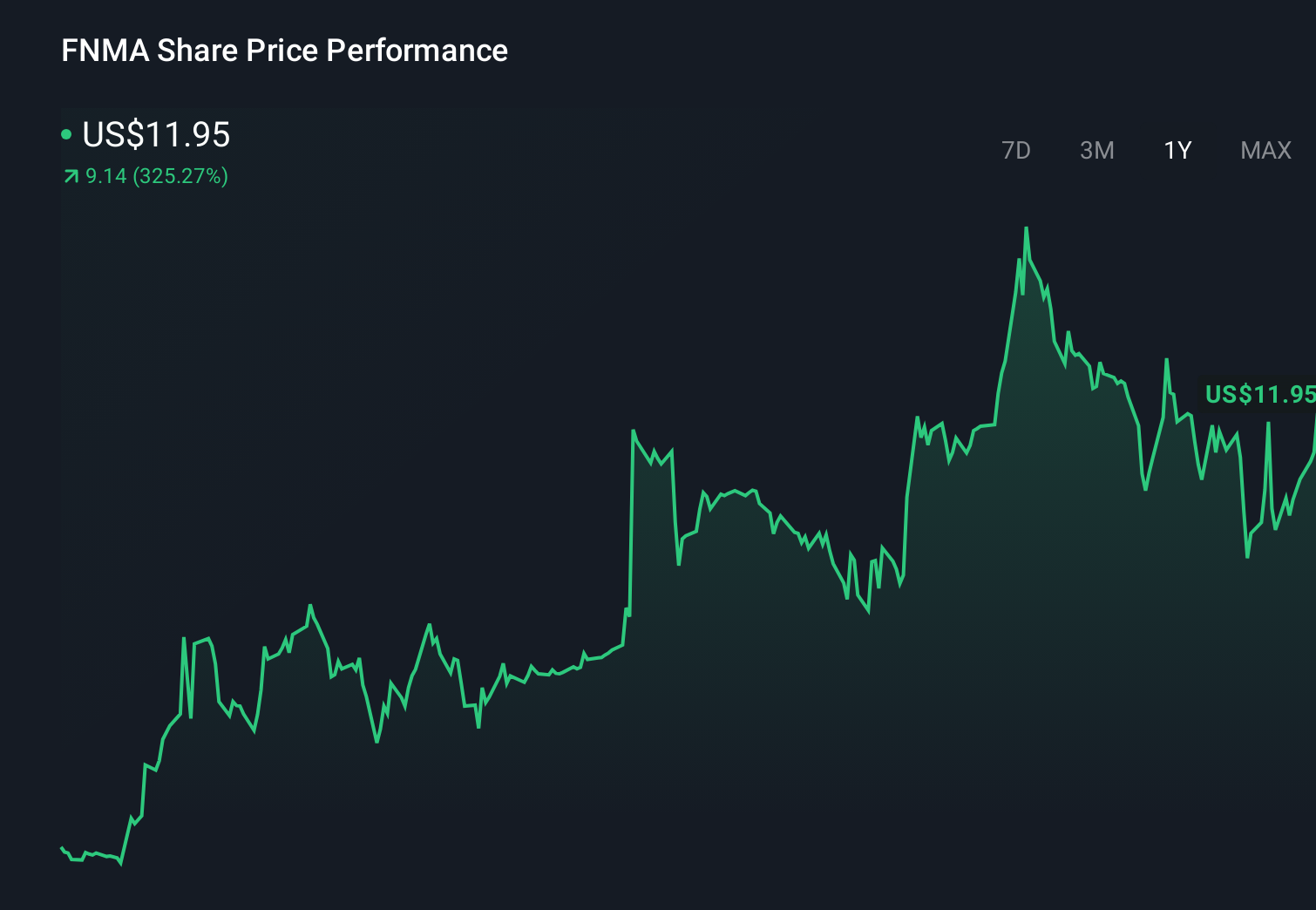
Some of the most optimistic analysts were assuming revenue could reach about US$33.0 billion and still saw rising market risk as manageable, yet this latest balance sheet shift may challenge those views and shows how differently you and other investors might interpret the same numbers.
Explore 10 other fair value estimates on Federal National Mortgage Association - why the stock might be worth just $9.31!
Form Your Own Verdict
Disagree with existing narratives? Extraordinary investment returns rarely come from following the herd, so go with your instincts.
- A great starting point for your Federal National Mortgage Association research is our analysis highlighting 3 key rewards and 3 important warning signs that could impact your investment decision.
- Our free Federal National Mortgage Association research report provides a comprehensive fundamental analysis summarized in a single visual - the Snowflake - making it easy to evaluate Federal National Mortgage Association's overall financial health at a glance.
Ready For A Different Approach?
Every day counts. These free picks are already gaining attention. See them before the crowd does:
- Capitalize on the AI infrastructure supercycle with our selection of the 49 best 'picks and shovels' of the AI gold rush converting record-breaking demand into massive cash flow.
- This technology could replace computers: discover 30 stocks that are working to make quantum computing a reality.
- Outshine the giants: these 15 early-stage AI stocks could fund your retirement.
This article by Simply Wall St is general in nature. We provide commentary based on historical data and analyst forecasts only using an unbiased methodology and our articles are not intended to be financial advice. It does not constitute a recommendation to buy or sell any stock, and does not take account of your objectives, or your financial situation. We aim to bring you long-term focused analysis driven by fundamental data. Note that our analysis may not factor in the latest price-sensitive company announcements or qualitative material. Simply Wall St has no position in any stocks mentioned.