
Is Fidelity National Information Services (FIS) Price Weakness Creating A Long Term Opportunity?
Fidelity National Information Services, Inc. FIS | 46.29 | +2.48% |
- If you are wondering whether Fidelity National Information Services is priced attractively right now, you are not alone. Many investors are asking if the current share price lines up with the company’s underlying value.
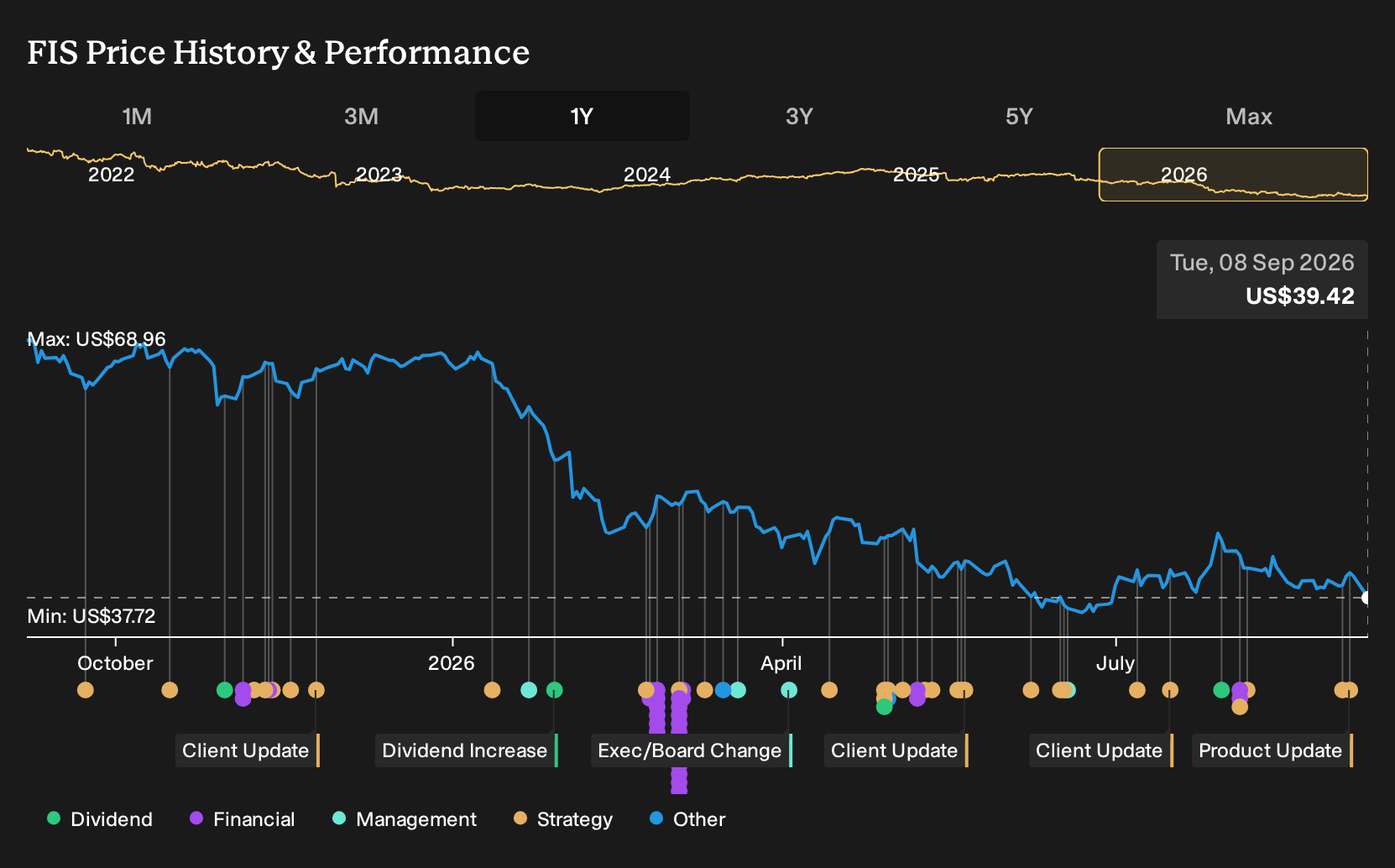
- The stock recently closed at US$64.23, with returns of a 4.2% decline over 7 days, a 4.3% decline over 30 days, a 2.1% decline year to date, a 16.2% decline over 1 year, and a 44.0% decline over 5 years, which may influence how you think about its potential and its risks.
- Recent coverage around Fidelity National Information Services has focused on how investors are reassessing the business in light of ongoing changes in the payments and financial technology sector. This context helps explain why some shareholders are rethinking what they are prepared to pay for the stock and what might represent a reasonable entry point.
- On our valuation checks, Fidelity National Information Services currently scores 3 out of 6. This suggests there is more to unpack in how different models judge its price, and we will walk through those methods next before ending with a more rounded way to think about valuation overall.
Approach 1: Fidelity National Information Services Excess Returns Analysis
The Excess Returns model looks at how much profit a company is expected to earn above the return that shareholders require, then capitalizes those extra profits into an intrinsic value per share.
For Fidelity National Information Services, the model starts with a Book Value of US$26.70 per share and a Stable EPS of US$7.17 per share, based on weighted future Return on Equity estimates from 5 analysts. The Average Return on Equity used is 22.12%, which is compared with a Cost of Equity of US$2.63 per share.
The gap between what shareholders require and what the business is expected to earn is captured in an Excess Return of US$4.54 per share. That excess is then applied to a Stable Book Value of US$32.43 per share, sourced from weighted future Book Value estimates from 4 analysts, to estimate the long run value the equity can support.
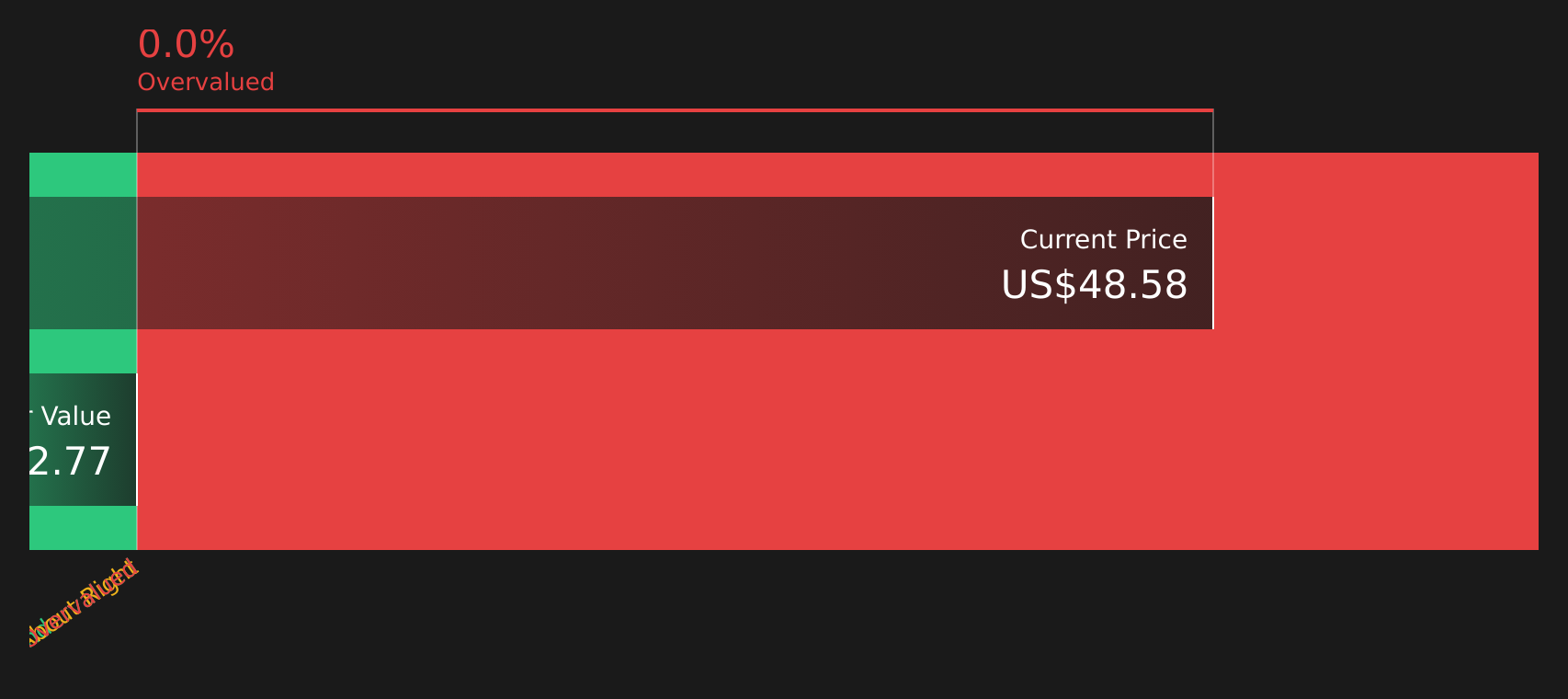
This Excess Returns valuation produces an intrinsic value of about US$125.99 per share, which implies the stock is 49.0% undervalued versus the recent price of US$64.23.
Result: UNDERVALUED
Our Excess Returns analysis suggests Fidelity National Information Services is undervalued by 49.0%. Track this in your watchlist or portfolio, or discover 885 more undervalued stocks based on cash flows.
Approach 2: Fidelity National Information Services Price vs Sales
The price to sales, or P/S, ratio is a useful cross check for companies that generate meaningful revenue, because it compares what the market is paying to each dollar of sales rather than to accounting earnings that can be more volatile.
What investors are willing to pay on a P/S basis often reflects how they see a company’s growth potential and risk profile. Higher expected growth or lower perceived risk can support a higher “normal” P/S, while lower growth or higher uncertainty can point to a lower one.
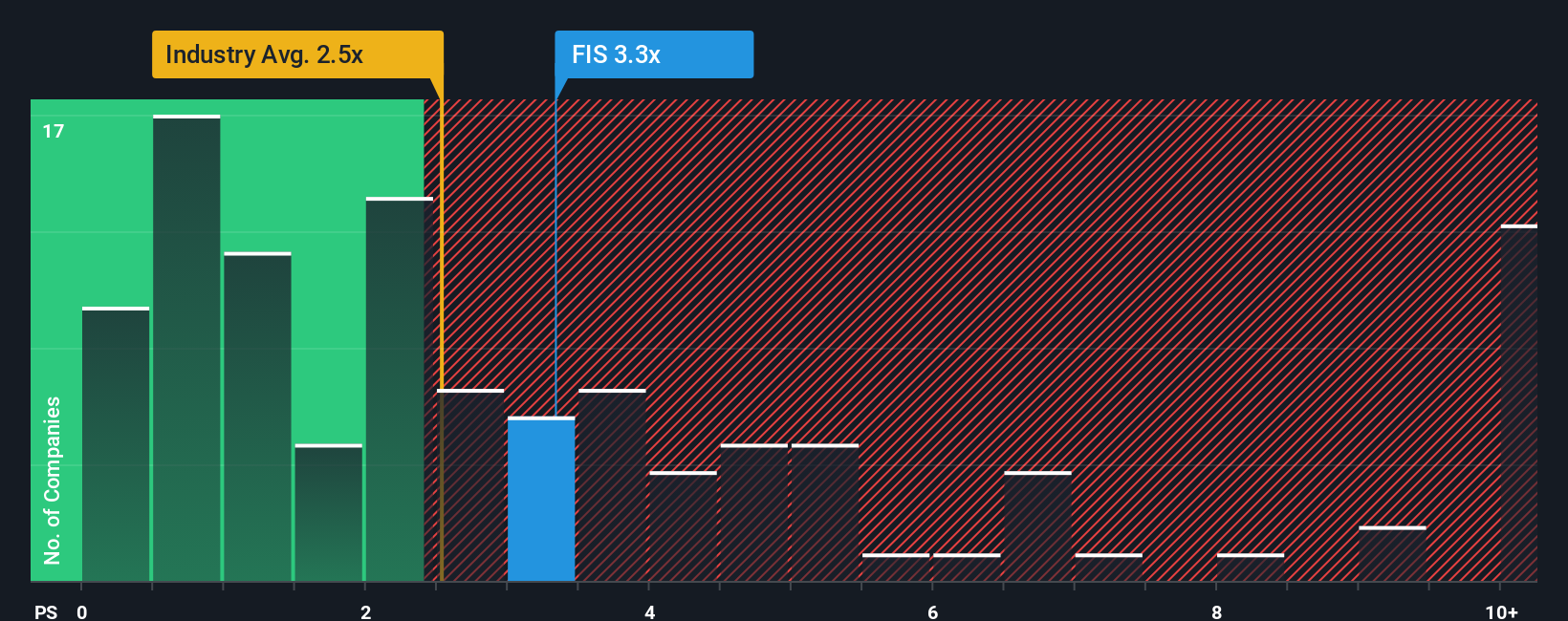
Fidelity National Information Services currently trades on a P/S ratio of 3.18x. This sits above the Diversified Financial industry average of 2.75x, and also above the peer group average of 2.59x. Simply Wall St’s Fair Ratio for the stock is 2.91x, which is its proprietary estimate of what a balanced P/S might look like after factoring in elements such as earnings growth, profit margins, industry, market cap and company specific risks.
Because the Fair Ratio blends these fundamentals, it gives you a more tailored reference point than a simple comparison with industry or peer averages.
With the current 3.18x P/S sitting above the 2.91x Fair Ratio, the shares screen as slightly expensive on this metric.
Result: OVERVALUED
P/S ratios tell one story, but what if the real opportunity lies elsewhere? Discover 1442 companies where insiders are betting big on explosive growth.
Upgrade Your Decision Making: Choose your Fidelity National Information Services Narrative
Earlier we mentioned that there is an even better way to understand valuation. On Simply Wall St you can use Narratives, which let you spell out your story for Fidelity National Information Services, link that story to your own revenue, earnings and margin assumptions, and then see a fair value that you can compare with the current price to help decide whether to buy, hold or sell. All of this is available within an easy Community page tool that updates as new news or earnings arrive. For example, one investor might build a higher fair value around the view that growing demand for digital and AI powered payment solutions, cloud based products and international expansion supports stronger recurring revenue and margins. Another investor might set a lower fair value that leans on risks from fintech competition, integration challenges and shifts toward decentralized finance. Both Narratives would automatically refresh when analyst estimates or company data change.
Do you think there's more to the story for Fidelity National Information Services? Head over to our Community to see what others are saying!
This article by Simply Wall St is general in nature. We provide commentary based on historical data and analyst forecasts only using an unbiased methodology and our articles are not intended to be financial advice. It does not constitute a recommendation to buy or sell any stock, and does not take account of your objectives, or your financial situation. We aim to bring you long-term focused analysis driven by fundamental data. Note that our analysis may not factor in the latest price-sensitive company announcements or qualitative material. Simply Wall St has no position in any stocks mentioned.