

Is It Time To Reconsider Harley-Davidson (HOG) After Mixed Returns And Brand Headlines
Harley-Davidson, Inc. HOG | 0.00 |
- If you are wondering whether Harley-Davidson at around US$23.84 is a bargain or fairly priced, the key is understanding what the current share price actually reflects.
- The stock has returned 0.9% over the last week, 13.5% over the past month and 15.5% year to date, while the 1 year return sits at 7.1% and the 3 and 5 year returns are negative at 24.9% and 41.3% respectively. Taken together, this gives you a mixed picture of recent momentum and past shareholder experience.
- Recent headlines have continued to focus on Harley-Davidson's position as a long standing motorcycle brand, including ongoing attention on how it balances its traditional heavyweight models with newer offerings and brand initiatives. These stories frame the debate around whether the current price reflects only near term sentiment or something more fundamental in how the business is perceived.
- Against that backdrop, Harley-Davidson currently records a valuation score of 3 out of 6. The rest of this article will walk through different valuation approaches before turning to a broader way of thinking about what that score really means for you.
Approach 1: Harley-Davidson Discounted Cash Flow (DCF) Analysis
A Discounted Cash Flow model takes estimates of the cash a company might generate in the future, then discounts those cash flows back to today to arrive at an estimated intrinsic value per share.
For Harley-Davidson, the latest twelve month Free Cash Flow (FCF) is reported at $41.47 million. Using a 2 Stage Free Cash Flow to Equity model, analysts and extrapolated estimates project FCF rising to $408.05 million in 2026 and $177.90 million in 2027, with further extrapolated figures extending out to 2035. These projections are all in $ and reflect Simply Wall St forecasts beyond the explicit analyst horizon.
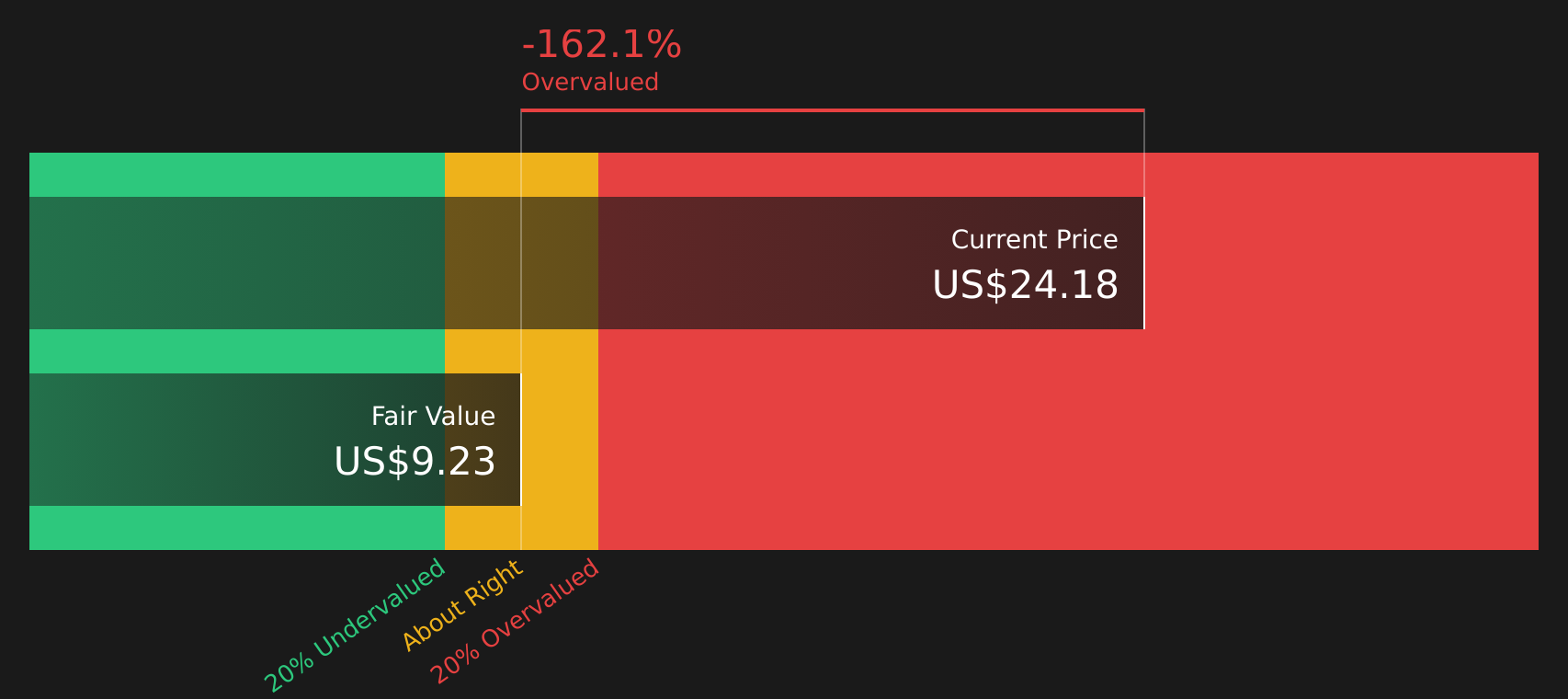
When those projected cash flows are discounted back to today, the model indicates an estimated intrinsic value of $8.90 per share. Compared with the recent share price of about $23.84, the DCF output implies the stock is 167.8% above this intrinsic value estimate, which points to a rich valuation on this particular set of cash flow assumptions.
Result: OVERVALUED
Our Discounted Cash Flow (DCF) analysis suggests Harley-Davidson may be overvalued by 167.8%. Discover 44 high quality undervalued stocks or create your own screener to find better value opportunities.
Approach 2: Harley-Davidson Price vs Earnings
For a profitable company like Harley-Davidson, the P/E ratio is a useful way to relate what you pay for the stock to the earnings it currently generates. It helps you see how many dollars investors are paying today for each dollar of reported earnings.
What counts as a "normal" P/E depends on how the market views a company’s growth prospects and risks. Higher expected growth or lower perceived risk can support a higher P/E, while slower expected growth or higher risk usually goes with a lower P/E.
Harley-Davidson currently trades on a P/E of 11.29x. That sits below the Auto industry average of 18.00x and also below the peer group average of 18.86x, which suggests the stock is priced more cautiously than many comparable companies on this simple measure.
Simply Wall St’s Fair Ratio for Harley-Davidson is 14.29x. This proprietary metric estimates what a reasonable P/E could be given factors such as earnings growth profile, profit margins, the Auto industry context, company size and specific risks. Because it blends these elements rather than just lining the stock up against broad industry or peer averages, it can give you a more tailored reference point.
Comparing the current P/E of 11.29x with the Fair Ratio of 14.29x indicates Harley-Davidson trades below this tailored reference level.
Result: UNDERVALUED

P/E ratios tell one story, but what if the real opportunity lies elsewhere? Start investing in legacies, not executives. Discover our 19 top founder-led companies.
Upgrade Your Decision Making: Choose your Harley-Davidson Narrative
Earlier it was mentioned that there is an even better way to understand valuation. Narratives let you attach a clear story about Harley-Davidson to your numbers, linking your view on its brand refresh, demand risks and financial path to a forecast for revenue, earnings and margins. This then drives a Fair Value that you can compare with the current price, track easily on Simply Wall St’s Community page as it updates with new news or earnings, and line up against other investors’ views, such as a more optimistic Fair Value around US$32.00 and a more cautious Fair Value around US$20.00 for the same stock.
For Harley-Davidson however, we will make it really easy for you with previews of two leading Harley-Davidson Narratives:
Fair value: US$32.00
Gap to this fair value: 25.6% below that level on the current US$23.84 share price
Assumed revenue trend: 6.09% annual decline
- This view assumes refreshed branding, more affordable models and a capital light HDFS structure help support the business over time even with lower revenue and margins.
- It builds in revenue declining 6.1% a year, profit margins easing from 10.7% to 8.8% and earnings at US$338.5m by around 2028, with the stock on a 13.6x P/E at that point.
- It requires comfort that share count can shrink by just over 5% a year and that these assumptions justify a fair value around US$32.00 despite analysts expecting a smaller business.
Fair value: US$22.14
Gap to this fair value: 7.7% above that level on the current US$23.84 share price
Assumed revenue trend: 5.61% annual decline
- This view starts from concerns around demand, dealer health and an aging core customer base, alongside tariff and macro pressures on big ticket spending.
- It builds in revenue declining 5.6% a year, margins falling from 7.6% to 4.0% and earnings down to US$148.8m by 2029, with a higher 19.0x P/E needed to support the consensus target.
- It sees current pricing as close to fair on these assumptions, with upside or downside hinging on how unit demand, affordability oriented models and the HDFS partnership actually play out.
If you want to move from these previews to a fully worked narrative, including detailed forecasts and valuation mechanics that update as new data comes in, the Community already has a set of Harley-Davidson narratives you can review or build on yourself, starting with these two at the optimistic and cautious ends of the range.
To see how these results tie into long-term growth, risks, and valuation, check out the full range of community narratives for Harley-Davidson on Simply Wall St. Add the company to your watchlist or portfolio so you'll be alerted when the story evolves.
Do you think there's more to the story for Harley-Davidson? Head over to our Community to see what others are saying!

This article by Simply Wall St is general in nature. We provide commentary based on historical data and analyst forecasts only using an unbiased methodology and our articles are not intended to be financial advice. It does not constitute a recommendation to buy or sell any stock, and does not take account of your objectives, or your financial situation. We aim to bring you long-term focused analysis driven by fundamental data. Note that our analysis may not factor in the latest price-sensitive company announcements or qualitative material. Simply Wall St has no position in any stocks mentioned.