

Is It Time To Revisit Etsy (ETSY) After Its Recent Share Price Rebound?
Etsy, Inc. ETSY | 0.00 |
- Investors may be wondering whether Etsy's current share price reflects its true worth, or if the stock is offering a margin of safety right now.
- Etsy's stock recently closed at US$67.92, with returns of 8.9% over the past week, 7.5% over the past month, 18.6% year to date and 22.7% over the past year, while also recording declines of 20.1% over three years and 58.6% over five years.
- Recent coverage has focused on how Etsy fits into the broader shift toward online and niche commerce, along with ongoing debates about competition from larger platforms and changing buyer behavior. These themes help frame why the stock has seen periods of both enthusiasm and caution over different timeframes.
- On Simply Wall St's valuation checks, Etsy scores 2 out of 6. The rest of this article will compare what different valuation methods indicate about that score, and then conclude with a more complete way to think about the stock's value beyond any single model.
Etsy scores just 2/6 on our valuation checks. See what other red flags we found in the full valuation breakdown.
Approach 1: Etsy Discounted Cash Flow (DCF) Analysis
A Discounted Cash Flow model estimates what a stock could be worth by projecting the company’s future cash flows and discounting them back to today’s value. It is essentially asking what all those future dollars are worth in today’s terms.
For Etsy, the model uses a 2 Stage Free Cash Flow to Equity approach based on cash flow projections. The latest twelve month Free Cash Flow is about US$676.9 million. Analyst and extrapolated estimates suggest Free Cash Flow in the US$686 million to US$1.1 billion range over the coming decade, with a projected Free Cash Flow of US$906.5 million in 2030. All cash flows here are considered in US$.
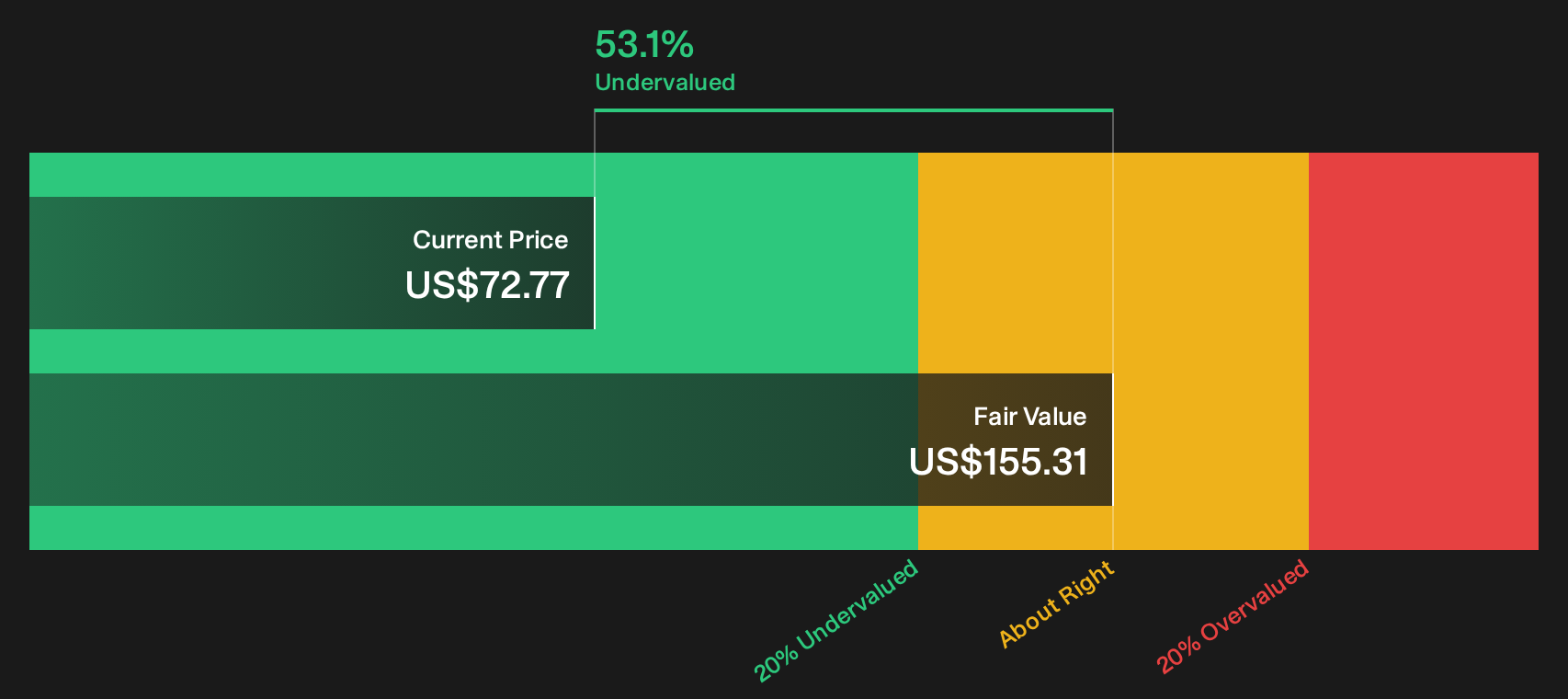
When these projected cash flows are discounted, Simply Wall St’s DCF model arrives at an estimated intrinsic value of US$124.43 per share. Compared with the recent share price of US$67.92, this implies the stock is about 45.4% undervalued according to this single model.
Result: UNDERVALUED
Our Discounted Cash Flow (DCF) analysis suggests Etsy is undervalued by 45.4%. Track this in your watchlist or portfolio, or discover 46 more high quality undervalued stocks.
Approach 2: Etsy Price vs Earnings
For a profitable company, the P/E ratio is a useful way to think about value because it links what you pay for each share to what the business is currently earning per share. It gives you a quick sense of how many dollars investors are willing to pay today for one dollar of current earnings.
What counts as a "normal" P/E ratio depends a lot on growth expectations and risk. Higher expected growth and lower perceived risk usually justify a higher P/E, while slower growth or higher risk tend to be associated with a lower P/E.
Etsy’s current P/E ratio is about 21.29x. That is above the Multiline Retail industry average of 18.79x and also above the peer group average of 12.43x, which suggests investors are currently paying more per dollar of earnings than they are for many peers.
Simply Wall St’s Fair Ratio for Etsy is 19.61x. This is a proprietary estimate of what Etsy’s P/E might reasonably be given factors such as its earnings growth profile, industry, profit margins, market capitalization and key risks. Because it blends these company specific inputs instead of relying only on simple comparisons, it can give a more tailored reference point than peer or industry averages alone.
Comparing the Fair Ratio of 19.61x with the actual P/E of 21.29x suggests Etsy’s shares are trading above that modelled level, so by this approach the stock screens as overvalued.
Result: OVERVALUED

P/E ratios tell one story, but what if the real opportunity lies elsewhere? Start investing in legacies, not executives. Discover our 20 top founder-led companies.
Upgrade Your Decision Making: Choose your Etsy Narrative
Earlier it was mentioned that there is an even better way to understand valuation. Meet Narratives, a simple framework on Simply Wall St’s Community page where you link your view of Etsy’s story to your own forecast for revenue, earnings and margins. You can compare the Fair Value that results from that forecast with today’s price to help decide whether the stock looks attractive to you, and then see that view update automatically as new earnings, news or data arrive so your buy or sell thinking stays tied to fresh information rather than static assumptions.
For Etsy, we will make it really easy for you with previews of two leading Etsy narratives.
Start by deciding which story feels closer to how you see the business. Then check whether the assumptions behind that story line up with your own expectations for revenue, margins and valuation.
Fair value in this bullish narrative: US$71.72 per share
Implied discount to that fair value compared with the recent US$67.92 share price: about 5.3% undervalued
Revenue growth assumption used in this narrative: 1.59% per year
- Focuses on AI-driven personalization, mobile app engagement and social commerce as key levers for improving buyer retention, loyalty and margins over time.
- Assumes that demand for unique, creator-driven and sustainable products continues to support gross merchandise sales and earnings, with buybacks and the Depop sale helping concentrate capital on the core marketplace.
- Flags risks around declining buyer engagement, higher marketing spend, competition from larger platforms and execution on AI and loyalty initiatives as key factors that could challenge the thesis.
Fair value in this more cautious narrative: US$64.45 per share
Implied premium to that fair value compared with the recent US$67.92 share price: about 5.4% overvalued
Revenue growth assumption used in this narrative: 4.66% per year
- Highlights Etsy as a marketplace built on identity and emotional commerce rather than speed and low prices, which can mean less frequent, event-driven purchases that are sensitive to consumer sentiment.
- Emphasizes the importance of seller trust and loyalty, pointing out that fee changes, advertising mechanics and discovery algorithms can either support or strain the health of the ecosystem.
- Points to rising competitive pressure from large e-commerce platforms and social commerce, and suggests that while the business remains differentiated, execution on fees, discovery and seller support will be crucial for long-term economics.
If neither preview fully matches your view, you can use these as starting points. You can then build a narrative that fits your own expectations for Etsy’s growth, profitability and risk profile.See what the community is saying about Etsy
Do you think there's more to the story for Etsy? Head over to our Community to see what others are saying!

This article by Simply Wall St is general in nature. We provide commentary based on historical data and analyst forecasts only using an unbiased methodology and our articles are not intended to be financial advice. It does not constitute a recommendation to buy or sell any stock, and does not take account of your objectives, or your financial situation. We aim to bring you long-term focused analysis driven by fundamental data. Note that our analysis may not factor in the latest price-sensitive company announcements or qualitative material. Simply Wall St has no position in any stocks mentioned.