

Is It Too Late To Reassess EchoStar (SATS) After Its Huge Multi‑Year Share Price Run?
EchoStar Corporation Class A SATS | 0.00 |
- Wondering whether EchoStar's share price still makes sense after its huge run, or if the value story has already played out? This article focuses squarely on what the current valuation is really telling you.
- The stock recently closed at US$129.14, with very large 1 year returns and a roughly 7x 3 year return. The 7 day move of 7.3% and year to date return of 15.1% contrast with a relatively flat 30 day return of 0.4%.
- These moves sit against a backdrop of ongoing attention on EchoStar's position in the media sector and its role in satellite and connectivity services. This continues to shape how investors think about its long term prospects and risk profile. Broader sector sentiment and expectations for future demand in communications infrastructure remain key parts of the story behind recent trading.
- EchoStar currently holds a valuation score of 3/6, which means it screens as undervalued on half of Simply Wall St's six checks. Next you will see how standard valuation approaches line up on this stock and why an even richer way of thinking about value sits at the end of this article.
Approach 1: EchoStar Discounted Cash Flow (DCF) Analysis
A Discounted Cash Flow, or DCF, model takes projections of the cash EchoStar could generate in the future and discounts those back to what they are worth in $ today. It is essentially asking what a stream of future cash flows is worth right now, given the time value of money and risk.
For EchoStar, the latest twelve month free cash flow shows an outflow of about $2.74b, so the starting point is a loss rather than an inflow. The model then uses analyst estimates for the next few years and extends them further out. By 2030, Simply Wall St is projecting free cash flow of about $3.16b, with intermediate years between 2026 and 2035 ranging from hundreds of millions to several billions of $ in projected cash flows.
Discounting these projected cash flows back to today using a 2 Stage Free Cash Flow to Equity model gives an estimated intrinsic value of $178.08 per share. Compared with the recent share price of $129.14, this implies EchoStar trades at about a 27.5% discount to this DCF estimate, so the stock screens as undervalued on this approach.
Result: UNDERVALUED
Our Discounted Cash Flow (DCF) analysis suggests EchoStar is undervalued by 27.5%. Track this in your watchlist or portfolio, or discover 47 more high quality undervalued stocks.
Approach 2: EchoStar Price vs Sales
For profitable companies with meaningful revenue, the P/S ratio is a useful way to see how much you are paying for each dollar of sales. It is especially handy where earnings are volatile or temporarily depressed, because it focuses on the top line rather than short term profit swings.
Growth expectations and risk both influence what counts as a normal P/S ratio. Higher expected revenue growth or steadier business models can justify higher multiples, while slower growth or higher risk usually point to lower, more conservative P/S levels.
EchoStar currently trades on a P/S of 2.49x. That sits above the Media industry average of about 1.07x, and just under the peer group average of 2.83x. Simply Wall St also calculates a Fair Ratio of 1.32x for EchoStar, which reflects its earnings growth profile, profit margins, industry, market cap and key risk factors.
This Fair Ratio is more tailored than a simple industry or peer comparison, because it adjusts for EchoStar specific characteristics instead of assuming that all companies with similar products deserve the same multiple. Comparing the current 2.49x P/S to the 1.32x Fair Ratio suggests the stock is pricing in more than this framework would imply.
Result: OVERVALUED

P/S ratios tell one story, but what if the real opportunity lies elsewhere? Start investing in legacies, not executives. Discover our 19 top founder-led companies.
Upgrade Your Decision Making: Choose your EchoStar Narrative
Earlier the article mentioned that there is an even better way to understand valuation, and this is where Narratives come in, allowing you to attach a clear story about EchoStar to specific assumptions for its future revenue, earnings, margins and fair value, then compare that to the current price to decide whether the stock looks attractive or not.
On Simply Wall St's Community page, Narratives are set up as an accessible tool used by millions of investors, so you can pick or build a view that links EchoStar's business story to a forecast and a fair value, then see how that changes as new news, earnings or filings are incorporated into the data.
For EchoStar, one investor might build a bullish Narrative around the higher fair value of about US$147.00 that assumes stronger earnings and margin potential, while another might choose a more cautious Narrative closer to the US$120.00 fair value that reflects higher concern about debt, regulation and execution risk. The platform lets you see both side by side and decide which story better matches your own expectations.
For EchoStar however we will make it really easy for you with previews of two leading EchoStar Narratives:
Together, they give you a clear sense of how bullish and cautious investors are framing the same stock, using the same core data but very different assumptions and emphasis.
Fair value in this bullish narrative: US$147.00
Implied discount to this fair value versus the recent US$129.14 price: about 12.2% below the narrative fair value.
Revenue trend used in this narrative: revenue is assumed to decline about 2.66% a year over the next few years.
- Sees EchoStar's combined satellite and 5G footprint, plus S band spectrum, as a way to build global direct to device and IoT coverage that could support recurring, higher margin contracts over time.
- Builds in a sharp swing from heavy losses to profit, with margins moving from a large loss today to just over 21% within three years, and earnings rising to US$2.9b by 2029, then valued on an 18.5x P/E.
- Flags meaningful execution and financing risks, including heavy capital expenditure plans, regulatory scrutiny of spectrum, competition from other LEO constellations, and integration risk around DISH, but views the current price as below the US$147.00 fair value implied by these assumptions.
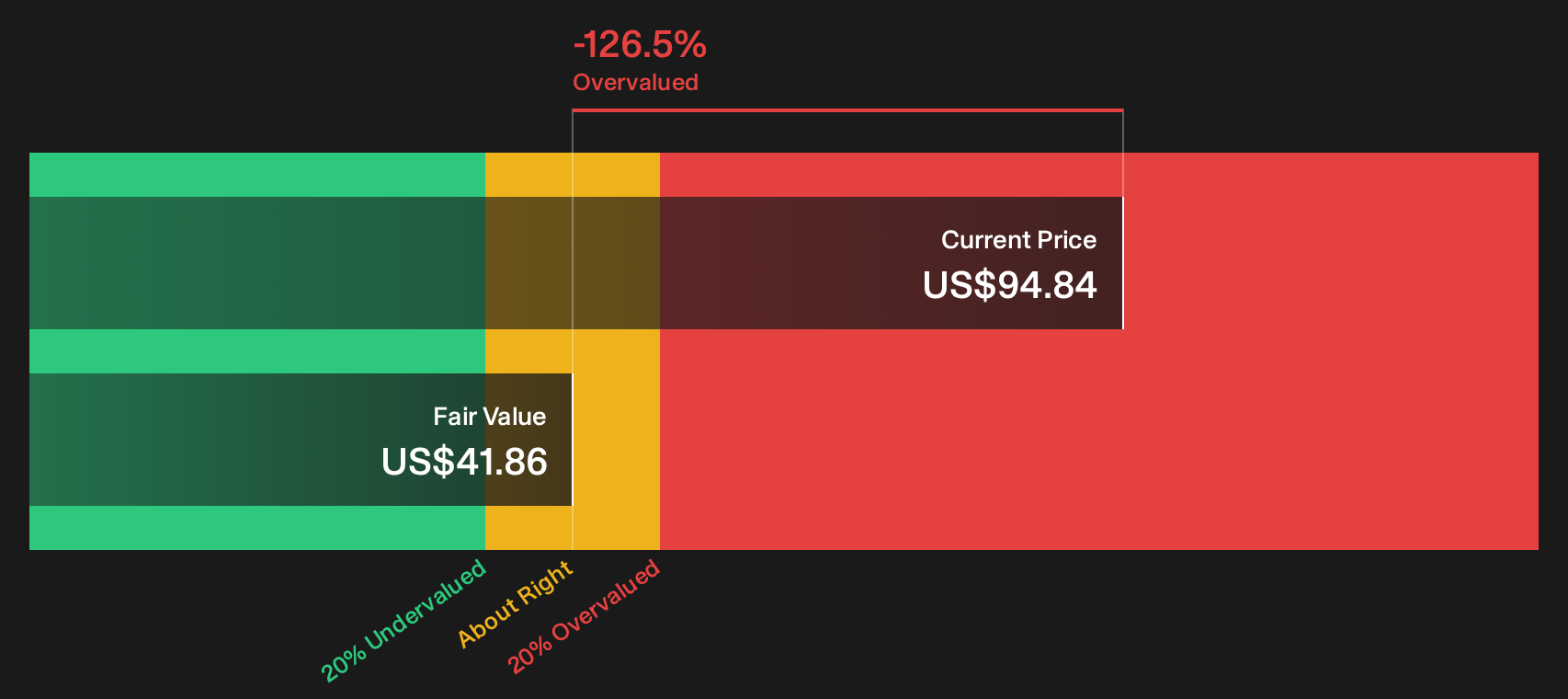
Fair value in this cautious narrative: US$43.91
Implied premium to this fair value versus the recent US$129.14 price: about 194% above the narrative fair value.
Revenue trend used in this narrative: revenue is assumed to decline about 2.30% a year over the next few years.
- Frames EchoStar mainly as a way to get exposure to the private space economy through its stake in SpaceX, alongside a large net cash position, rather than as a traditional telecom or media stock.
- Highlights how much of the story rests on what valuation the market may eventually place on SpaceX and how that filters through EchoStar's holding, with the author using back of the envelope estimates to anchor a much lower fair value for EchoStar itself.
- Accepts that index inclusion and links to high profile space and AI themes could keep attention on the stock, but treats the current share price as well above the US$43.91 fair value implied by these more conservative assumptions.
If you want to see the full range of Community views on EchoStar and how the numbers evolve as new filings and forecasts come in, you can step through the different narratives side by side and stress test which assumptions you are most comfortable with.
To see how these results tie into long-term growth, risks, and valuation, check out the full range of community narratives for EchoStar on Simply Wall St. Add the company to your watchlist or portfolio so you'll be alerted when the story evolves.
Do you think there's more to the story for EchoStar? Head over to our Community to see what others are saying!

This article by Simply Wall St is general in nature. We provide commentary based on historical data and analyst forecasts only using an unbiased methodology and our articles are not intended to be financial advice. It does not constitute a recommendation to buy or sell any stock, and does not take account of your objectives, or your financial situation. We aim to bring you long-term focused analysis driven by fundamental data. Note that our analysis may not factor in the latest price-sensitive company announcements or qualitative material. Simply Wall St has no position in any stocks mentioned.