

Is Lincoln National’s (LNC) Shift Toward Less Market‑Sensitive Products Redefining Its Core Earnings Power?
Lincoln National Corp LNC | 0.00 |
- In early May 2026, Lincoln National reported first‑quarter revenue of US$5,306 million and a net loss of US$172 million, while also announcing expanded managed account offerings with Stadion and Morningstar Retirement and deeper API integration with Centro Benefits Research to streamline broker workflows.
- Despite the GAAP loss, Lincoln National delivered its seventh consecutive quarter of adjusted operating income growth and continued shifting toward less market‑sensitive products, while partnering with fintech and retirement platforms to enhance personalization and efficiency across its retirement and benefits businesses.
- Now we’ll examine how this continued adjusted operating income growth and product repositioning could influence Lincoln National’s investment narrative.
The future of work is here. Discover the 30 top robotics and automation stocks leading the charge in AI-driven automation and industrial transformation.
Lincoln National Investment Narrative Recap
To own Lincoln National, you need to believe its shift toward less market sensitive, capital efficient products and steady adjusted operating income can matter more than GAAP volatility tied to legacy guarantees. Right now, the key near term catalyst is whether the company can keep growing adjusted earnings while stabilizing capital, with the biggest risk being ongoing earnings swings from market risk benefits and legacy variable annuities. The latest quarter does not appear to materially change that balance.
Among recent announcements, the expansion of API integration with Centro Benefits Research stands out for the near term story. By reducing manual broker workflows and speeding up RFP processing, Lincoln could make its Group Protection and benefits offerings easier to place, directly supporting one of its core catalysts: using technology to improve efficiency and strengthen distribution, even as it works through legacy product and earnings volatility risks elsewhere in the portfolio.
Yet investors should also be aware that if disability trends or legacy guarantees turn more adverse, the pressure on Lincoln’s capital and earnings could...
Lincoln National's narrative projects $21.4 billion revenue and $1.8 billion earnings by 2029. This requires 5.5% yearly revenue growth and a roughly $0.7 billion earnings increase from $1.1 billion today.
Uncover how Lincoln National's forecasts yield a $45.46 fair value, a 33% upside to its current price.
Exploring Other Perspectives
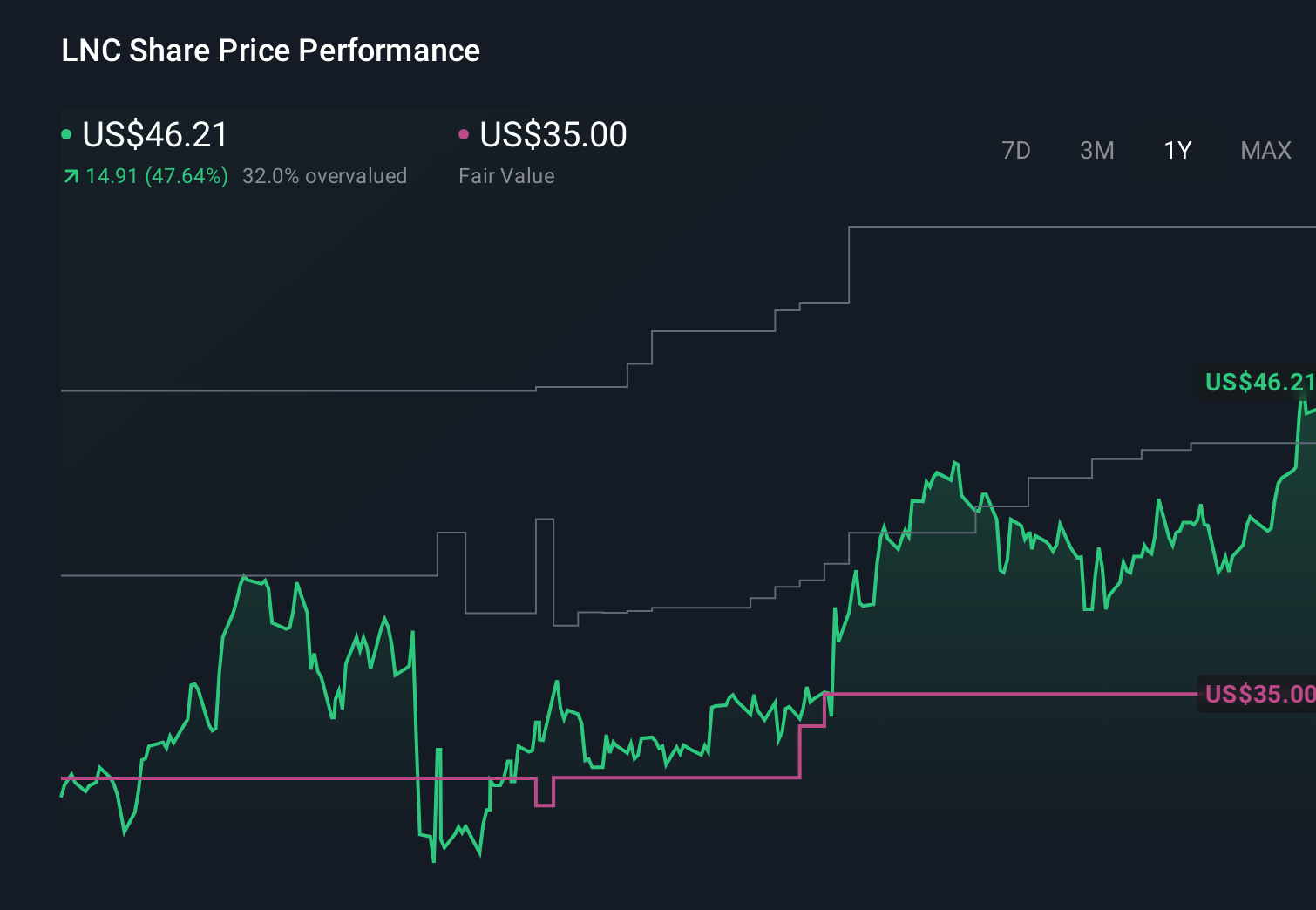
While consensus focuses on gradual product mix improvement, the most optimistic analysts assume revenues near US$22.9 billion and earnings around US$1.9 billion by 2029, so you should weigh how Q1’s managed account and API moves could either support that stronger earnings trajectory or reinforce concerns about volatility and legacy risks.
Explore 3 other fair value estimates on Lincoln National - why the stock might be worth over 2x more than the current price!
Reach Your Own Conclusion
Disagree with existing narratives? Extraordinary investment returns rarely come from following the herd, so go with your instincts.
- A great starting point for your Lincoln National research is our analysis highlighting 4 key rewards and 2 important warning signs that could impact your investment decision.
- Our free Lincoln National research report provides a comprehensive fundamental analysis summarized in a single visual - the Snowflake - making it easy to evaluate Lincoln National's overall financial health at a glance.
Seeking Other Investments?
Our top stock finds are flying under the radar-for now. Get in early:
- AI is about to change healthcare. These 33 stocks are working on everything from early diagnostics to drug discovery. The best part - they are all under $10b in market cap - there's still time to get in early.
- Uncover the next big thing with 28 elite penny stocks that balance risk and reward.
- We've uncovered the 14 dividend fortresses yielding 5%+ that don't just survive market storms, but thrive in them.
This article by Simply Wall St is general in nature. We provide commentary based on historical data and analyst forecasts only using an unbiased methodology and our articles are not intended to be financial advice. It does not constitute a recommendation to buy or sell any stock, and does not take account of your objectives, or your financial situation. We aim to bring you long-term focused analysis driven by fundamental data. Note that our analysis may not factor in the latest price-sensitive company announcements or qualitative material. Simply Wall St has no position in any stocks mentioned.