

Is Pitney Bowes’ (PBI) Debt Recast Quietly Rewriting Its Long-Term Capital Structure Narrative?
Pitney Bowes Inc. PBI | 0.00 |
- Pitney Bowes recently amended its 2025 Credit Agreement, extending the maturities of its US$450,000,000 revolving credit facility and US$152,000,000 Term Loan A by five years, tightening leverage and interest coverage covenants that will be tested quarterly.
- The amendment, together with Fitch’s initiation of coverage at BB- with a Stable Outlook and BB+ on secured debt, highlights lender confidence in Pitney Bowes’ collateral-backed borrowing structure and capital access despite ongoing revenue pressure.
- We’ll now examine how the extended credit maturities and revised leverage covenants may influence Pitney Bowes’ broader investment narrative.
Outshine the giants: these 13 early-stage AI stocks could fund your retirement.
Pitney Bowes Investment Narrative Recap
To own Pitney Bowes, you need to believe that management can manage through a shrinking mail market and reinvest cash from mature businesses into higher quality earnings, while keeping leverage under control. The amended 2025 Credit Agreement and new quarterly leverage and coverage tests tighten the focus on balance sheet discipline, but they do not directly change the near term revenue headwinds or the key risk that demand for core mailing and Presort services continues to soften.
Against that backdrop, the recent extension of the US$450,000,000 revolving credit facility and US$152,000,000 Term Loan A to May 2031, together with Fitch’s BB minus Issuer Default Rating and Stable Outlook, is the most relevant development. It signals continued access to secured funding at scale, which matters for the company’s ability to refinance existing debt while still returning capital through dividends and buybacks and supporting targeted acquisitions in Presort and SendTech.
Yet despite this added funding visibility, investors should still be aware that...
Pitney Bowes' narrative projects $1.8 billion revenue and $239.7 million earnings by 2029. This requires a 1.8% yearly revenue decline and about a $95 million earnings increase from $144.7 million today.
Uncover how Pitney Bowes' forecasts yield a $15.05 fair value, in line with its current price.
Exploring Other Perspectives
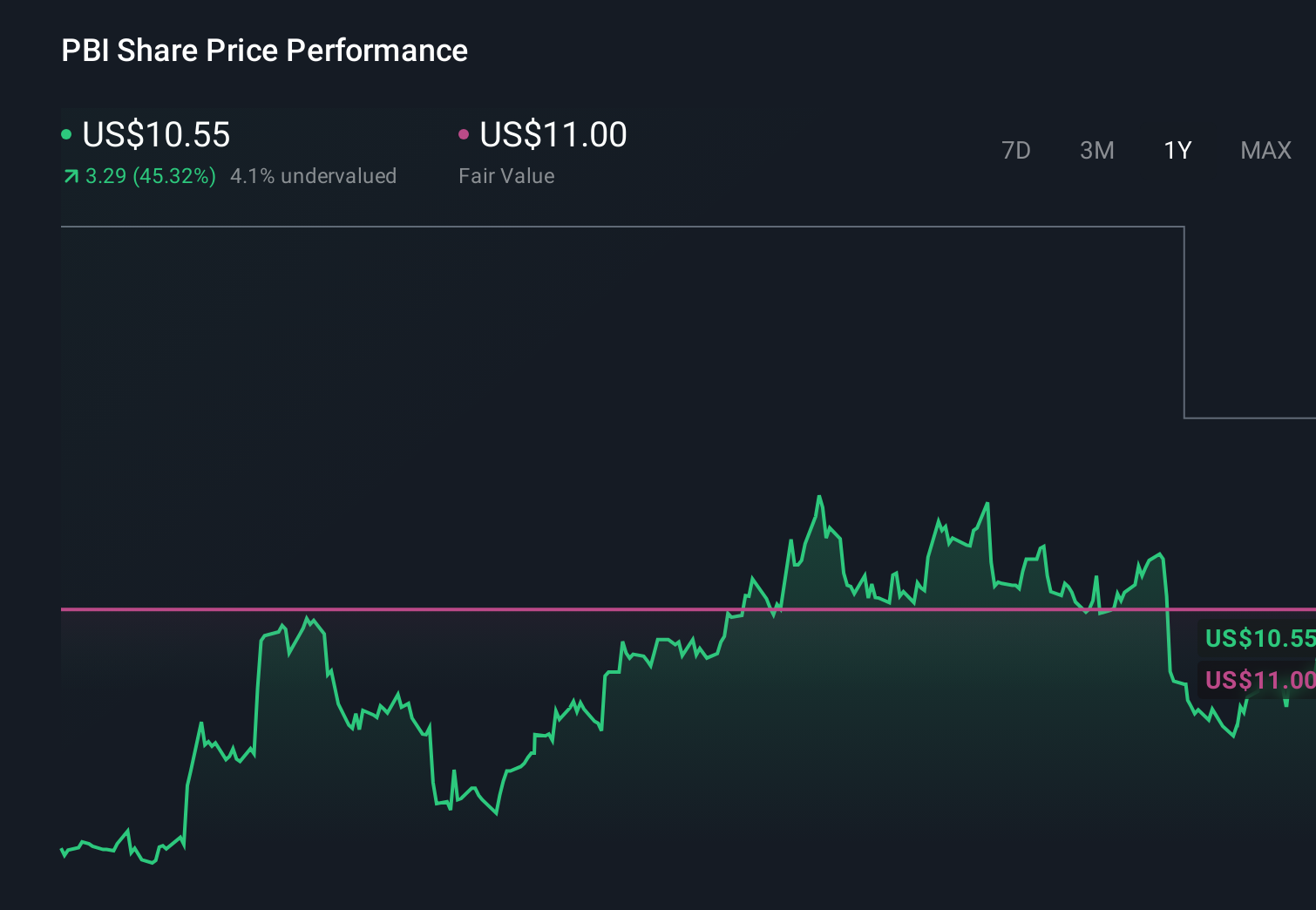
While the new credit terms tighten leverage covenants, the most pessimistic analysts were already assuming revenue would fall about 2.6 percent a year and still reach roughly US$303.7 million of earnings by 2028, so you should expect views on Pitney Bowes’ risk and reward to shift as the impact of this amendment becomes clearer.
Explore 5 other fair value estimates on Pitney Bowes - why the stock might be worth just $14.56!
Decide For Yourself
Don't just follow the ticker - dig into the data and build a conviction that's truly your own.
- A great starting point for your Pitney Bowes research is our analysis highlighting 4 key rewards and 3 important warning signs that could impact your investment decision.
- Our free Pitney Bowes research report provides a comprehensive fundamental analysis summarized in a single visual - the Snowflake - making it easy to evaluate Pitney Bowes' overall financial health at a glance.
Curious About Other Options?
Opportunities like this don't last. These are today's most promising picks. Check them out now:
- Capitalize on the AI infrastructure supercycle with our selection of the 46 best 'picks and shovels' of the AI gold rush converting record-breaking demand into massive cash flow.
- The latest GPUs need a type of rare earth metal called Neodymium and there are only 27 companies in the world exploring or producing it. Find the list for free.
- Explore 28 top quantum computing companies leading the revolution in next-gen technology and shaping the future with breakthroughs in quantum algorithms, superconducting qubits, and cutting-edge research.
This article by Simply Wall St is general in nature. We provide commentary based on historical data and analyst forecasts only using an unbiased methodology and our articles are not intended to be financial advice. It does not constitute a recommendation to buy or sell any stock, and does not take account of your objectives, or your financial situation. We aim to bring you long-term focused analysis driven by fundamental data. Note that our analysis may not factor in the latest price-sensitive company announcements or qualitative material. Simply Wall St has no position in any stocks mentioned.