

Is Twilio (TWLO) Quietly Rewiring Its Moat With an Embeddable Flex SDK Strategy?
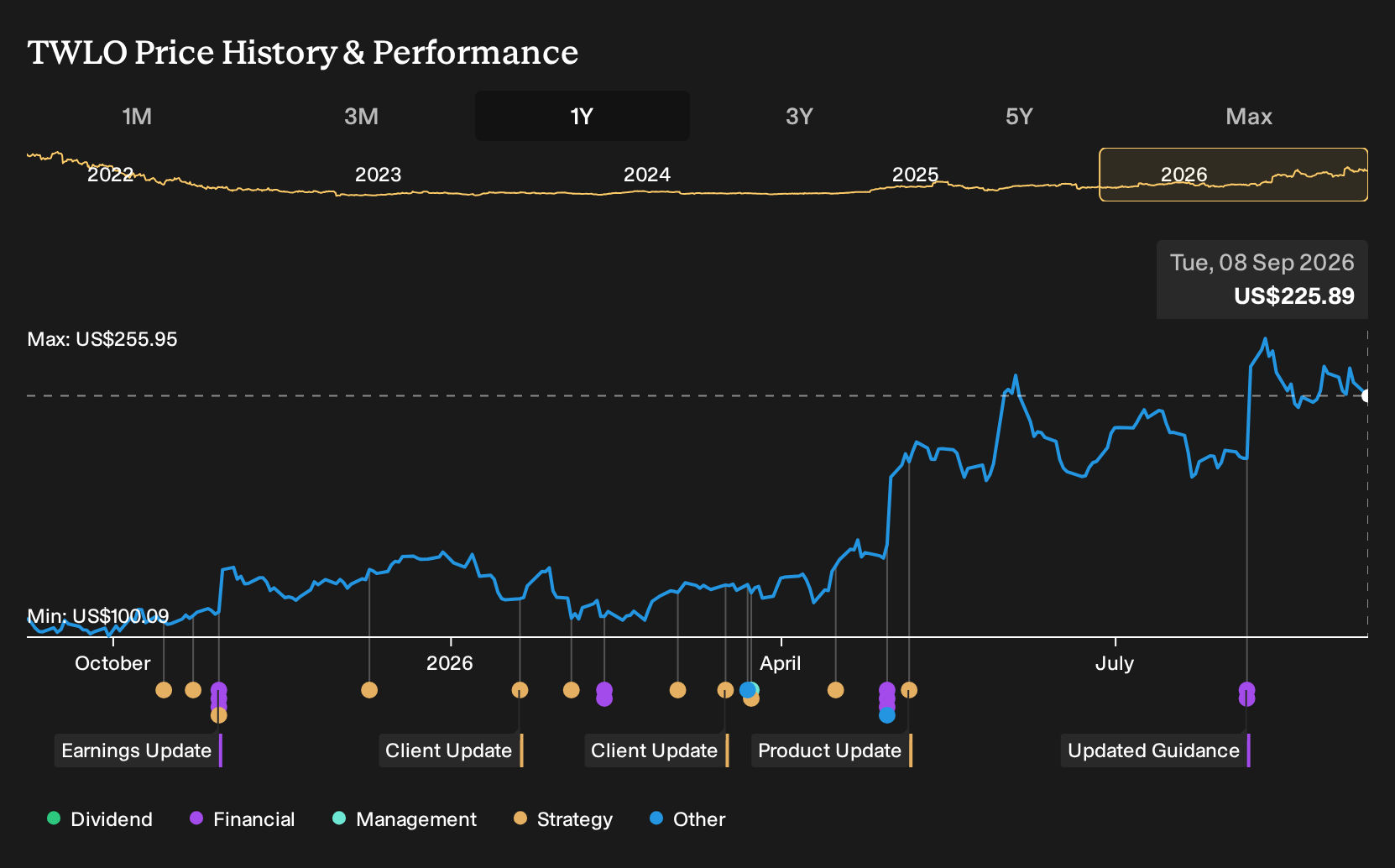
Twilio TWLO | 142.71 | -0.75% |
- On 16 April 2026, Twilio launched a new Flex SDK that lets businesses embed contact center capabilities, including Agentforce Service voice, directly into existing applications, while adding enhanced insights, sub-account support, and a new User + Usage pricing model for greater deployment flexibility.
- This move highlights Twilio’s push to unify CPaaS and CCaaS into a single, embeddable platform, aiming to help enterprises modernize AI-driven customer experiences without overhauling their current technology stacks.
- We’ll now examine how Twilio’s new Flex SDK and flexible User + Usage pricing reshape the company’s investment narrative for customer engagement.
AI is about to change healthcare. These 37 stocks are working on everything from early diagnostics to drug discovery. The best part - they are all under $10b in market cap - there's still time to get in early.
Twilio Investment Narrative Recap
To own Twilio, you need to believe that its customer engagement platform can shift more revenue toward higher value software and AI, while defending margins in a competitive communications market. The new Flex SDK looks directionally helpful to the short term catalyst of deepening AI powered engagement within existing enterprise stacks, but it does not directly resolve the biggest near term risk around mix and pricing pressure in lower margin communications volumes.
Among recent announcements, Twilio’s addition to the NASDAQ Internet Index in March 2026 feels especially relevant here, because it has brought more attention to the company just as it is rolling out Flex SDK and the User + Usage pricing model. Together, higher visibility and a more flexible contact center offering could influence how quickly enterprises test and adopt Twilio’s AI centric tools, which in turn affects how investors judge the balance between its margin risks and platform led growth opportunities.
However, beneath Twilio’s AI story, investors should also be aware that rising compliance costs and privacy rules could eventually constrain how far these new tools can really go...
Twilio's narrative projects $5.9 billion revenue and $449.9 million earnings by 2028. This requires 7.9% yearly revenue growth and about a $429.7 million earnings increase from $20.2 million today.
Uncover how Twilio's forecasts yield a $143.14 fair value, in line with its current price.
Exploring Other Perspectives
While consensus focuses on steady AI driven growth, the most optimistic analysts see Twilio targeting about US$7.1 billion revenue and US$777.8 million earnings by 2029, which contrasts sharply with concerns that large enterprises could still build in house alternatives or multi source communications and leave today’s bullish projections open to revision after launches like Flex SDK.
Explore 8 other fair value estimates on Twilio - why the stock might be worth as much as 32% more than the current price!
The Verdict Is Yours
Don't just follow the ticker - dig into the data and build a conviction that's truly your own.
- A great starting point for your Twilio research is our analysis highlighting 3 key rewards and 2 important warning signs that could impact your investment decision.
- Our free Twilio research report provides a comprehensive fundamental analysis summarized in a single visual - the Snowflake - making it easy to evaluate Twilio's overall financial health at a glance.
Ready For A Different Approach?
Our daily scans reveal stocks with breakout potential. Don't miss this chance:
- Find 60 companies with promising cash flow potential yet trading below their fair value.
- The latest GPUs need a type of rare earth metal called Terbium and there are only 31 companies in the world exploring or producing it. Find the list for free.
- We've uncovered the 12 dividend fortresses yielding 5%+ that don't just survive market storms, but thrive in them.
This article by Simply Wall St is general in nature. We provide commentary based on historical data and analyst forecasts only using an unbiased methodology and our articles are not intended to be financial advice. It does not constitute a recommendation to buy or sell any stock, and does not take account of your objectives, or your financial situation. We aim to bring you long-term focused analysis driven by fundamental data. Note that our analysis may not factor in the latest price-sensitive company announcements or qualitative material. Simply Wall St has no position in any stocks mentioned.