

Is Urban Outfitters’ Yes Day Beauty Rollout Reshaping Its Long‑Term Growth Story (URBN)?
Urban Outfitters, Inc. URBN | 0.00 |
- In July 2026, Urban Outfitters expanded its beauty assortment by launching emerging skincare label Yes Day Beauty across 60 U.S. stores and online, offering products such as the Float Foam™ Cleanser (US$24) and Whip Dream Moisturizer (US$32) powered by the brand’s Yes Magic™ complex.
- This exclusive partnership gives Yes Day Beauty its first physical retail presence in the United States, highlighting Urban Outfitters’ push into higher-margin, trend-focused beauty categories that resonate with Millennial and Gen Z shoppers.
- We’ll now examine how Urban Outfitters’ exclusive rollout of Yes Day Beauty influences the company’s investment narrative and longer-term growth drivers.
Capitalize on the AI infrastructure supercycle with our selection of the 55 best 'picks and shovels' of the AI gold rush converting record-breaking demand into massive cash flow.
Urban Outfitters Investment Narrative Recap
To own Urban Outfitters, you generally need to believe the company can keep deepening its connection with Millennial and Gen Z shoppers while protecting margins. The Yes Day Beauty rollout fits that idea by leaning into trend-driven, higher-margin beauty, but its near-term financial impact looks modest beside bigger swing factors such as tariff pressure on margins and whether elevated marketing and store investments translate into healthy sales growth.
The most relevant recent announcement here is Urban Outfitters’ sizeable buyback activity, with about US$524.44 million spent to repurchase nearly 11% of shares under the current program. That capital return sits alongside initiatives like Yes Day Beauty and other lifestyle partnerships, and together they frame the key question for the stock: can management keep improving earnings quality while continuing to invest in new concepts that bring younger customers into the ecosystem?
But against these positives, investors also need to factor in the risk that higher tariffs on sourced product could quietly erode margins over time and...
Urban Outfitters' narrative projects $7.8 billion revenue and $603.7 million earnings by 2029. This requires 7.2% yearly revenue growth and about a $131.4 million earnings increase from $472.3 million today.
Uncover how Urban Outfitters' forecasts yield a $84.00 fair value, a 20% upside to its current price.
Exploring Other Perspectives
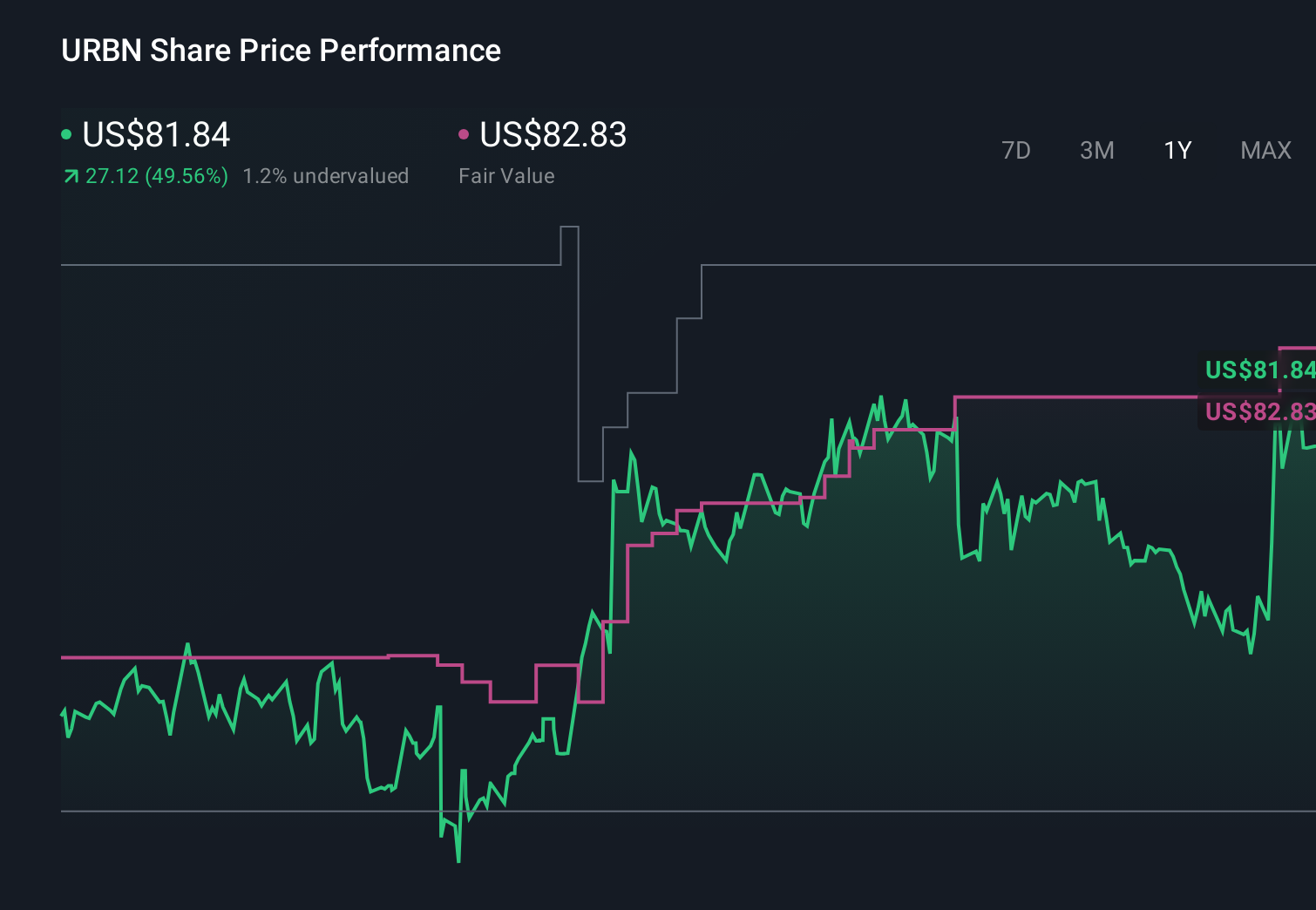
Some of the most optimistic analysts were already assuming revenue could reach about US$8.0 billion with earnings near US$609.9 million, yet if tariffs and trend risk bite harder than they expected, that more bullish view of Urban Outfitters’ future could prove far too rosy for you as an investor.
Explore 3 other fair value estimates on Urban Outfitters - why the stock might be worth as much as 40% more than the current price!
Form Your Own Verdict
Don't just follow the ticker - dig into the data and build a conviction that's truly your own.
- A great starting point for your Urban Outfitters research is our analysis highlighting 5 key rewards and 1 important warning sign that could impact your investment decision.
- Our free Urban Outfitters research report provides a comprehensive fundamental analysis summarized in a single visual - the Snowflake - making it easy to evaluate Urban Outfitters' overall financial health at a glance.
Searching For A Fresh Perspective?
Every day counts. These free picks are already gaining attention. See them before the crowd does:
- The future of work is here. Discover the 34 top robotics and automation stocks leading the charge in AI-driven automation and industrial transformation.
- Rare earth metals are an input to most high-tech devices, military and defence systems and electric vehicles. The global race is on to secure supply of these critical minerals. Beat the pack to uncover the 29 best rare earth metal stocks of the very few that mine this essential strategic resource.
- Find 49 companies with promising cash flow potential yet trading below their fair value.
This article by Simply Wall St is general in nature. We provide commentary based on historical data and analyst forecasts only using an unbiased methodology and our articles are not intended to be financial advice. It does not constitute a recommendation to buy or sell any stock, and does not take account of your objectives, or your financial situation. We aim to bring you long-term focused analysis driven by fundamental data. Note that our analysis may not factor in the latest price-sensitive company announcements or qualitative material. Simply Wall St has no position in any stocks mentioned.