

Is Vishay (VSH) Quietly Rewiring Its Power Electronics Edge With New High Voltage Components?
Vishay Intertechnology, Inc. VSH | 0.00 |
- Earlier in June 2026, Vishay Intertechnology introduced new 1.5 kV IHDV high voltage power inductors, expanded its Gen 7 1200 V Hyperfast rectifier line, and broadened its ILHB Automotive Grade ferrite bead range for demanding automotive, industrial, and energy applications.
- By pushing isolation voltages higher, improving high frequency filtering, and tightening EMC noise control in compact packages, Vishay is positioning its components deeper inside power electronics for electric vehicles, renewable energy systems, and industrial automation.
- We’ll now examine how Vishay’s higher voltage IHDV inductors for EV chargers and industrial power systems may reshape its investment narrative.
The latest GPUs need a type of rare earth metal called Neodymium and there are only 30 companies in the world exploring or producing it. Find the list for free.
Vishay Intertechnology Investment Narrative Recap
To own Vishay Intertechnology, you need to believe its heavy capex and broad catalog of “must have” power components will translate into stronger earnings as EVs, industrial power, and grid projects demand more high voltage, high reliability parts. The new 1.5 kV IHDV inductors and related power products support that thesis but do not, by themselves, change the key near term catalyst of improving margins or the main risk around cash flow pressure from capacity build out.
Among the June announcements, the launch of the IHDV high voltage inductors matters most for the current story, because it pushes Vishay further into higher value power content in EV chargers, onboard chargers, and industrial power factor correction. If these parts see solid design adoption, they could help utilization and product mix as new fabs ramp, which is important given the company’s ongoing margin recovery efforts and forecast revenue growth.
Yet in contrast, investors should also be aware that if capacity ramps in Germany and Newport stumble or demand cools, Vishay could be left with underutilized assets and rising...
Vishay Intertechnology's narrative projects $4.8 billion revenue and $659.1 million earnings by 2029.
Uncover how Vishay Intertechnology's forecasts yield a $34.00 fair value, a 48% downside to its current price.
Exploring Other Perspectives
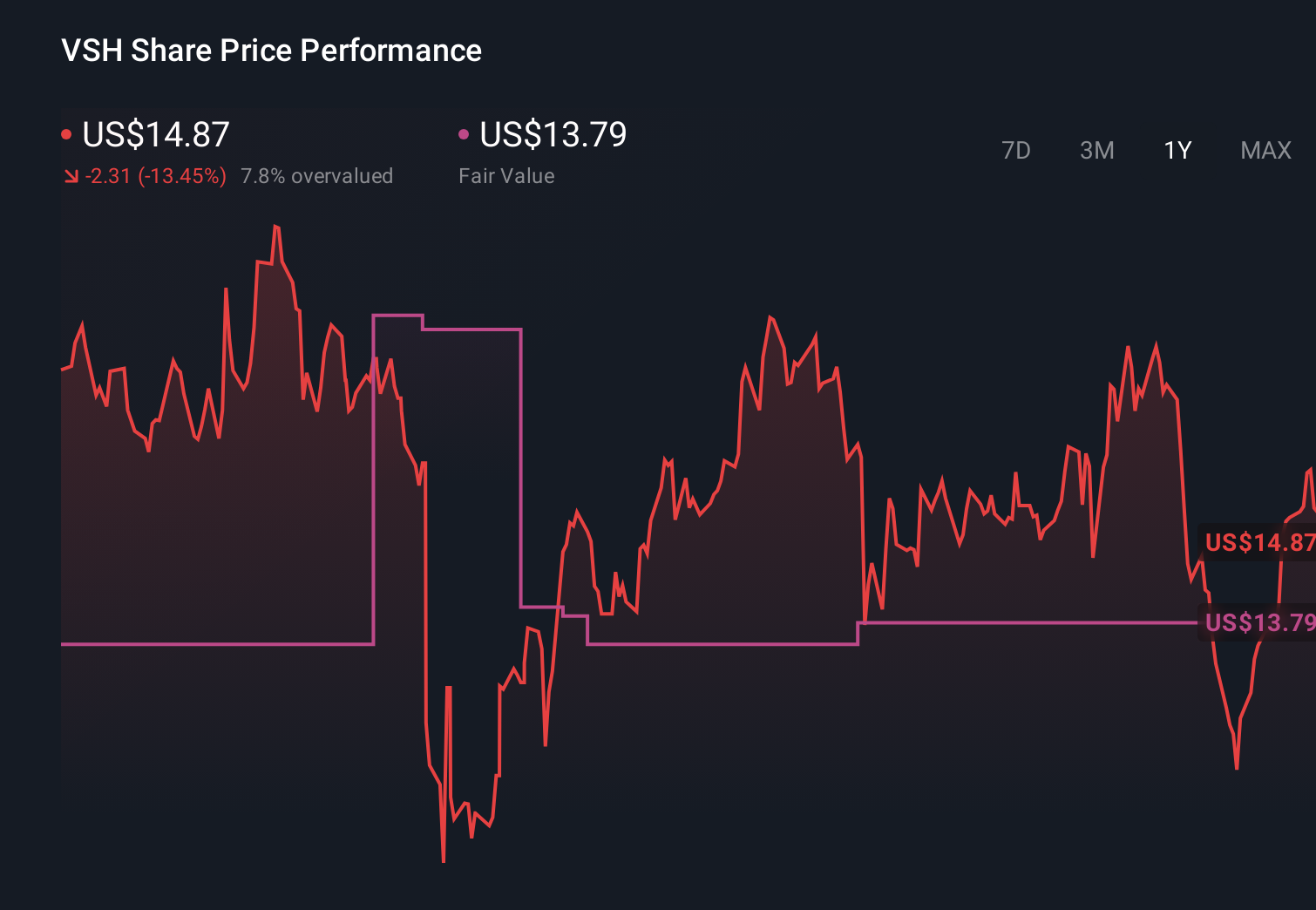
The most optimistic analysts already expected revenue to reach about US$4.0 billion and earnings near US$413 million by 2029, and the latest high voltage product launches could either reinforce that upbeat view or challenge it if AI power or EV demand does not meet those expectations.
Explore 3 other fair value estimates on Vishay Intertechnology - why the stock might be worth 48% less than the current price!
The Verdict Is Yours
Don't just follow the ticker - dig into the data and build a conviction that's truly your own.
- A great starting point for your Vishay Intertechnology research is our analysis highlighting 2 key rewards and 1 important warning sign that could impact your investment decision.
- Our free Vishay Intertechnology research report provides a comprehensive fundamental analysis summarized in a single visual - the Snowflake - making it easy to evaluate Vishay Intertechnology's overall financial health at a glance.
No Opportunity In Vishay Intertechnology?
Our daily scans reveal stocks with breakout potential. Don't miss this chance:
- Uncover the next big thing with 24 elite penny stocks that balance risk and reward.
- Capitalize on the AI infrastructure supercycle with our selection of the 49 best 'picks and shovels' of the AI gold rush converting record-breaking demand into massive cash flow.
- We've uncovered the 8 dividend fortresses yielding 5%+ that don't just survive market storms, but thrive in them.
This article by Simply Wall St is general in nature. We provide commentary based on historical data and analyst forecasts only using an unbiased methodology and our articles are not intended to be financial advice. It does not constitute a recommendation to buy or sell any stock, and does not take account of your objectives, or your financial situation. We aim to bring you long-term focused analysis driven by fundamental data. Note that our analysis may not factor in the latest price-sensitive company announcements or qualitative material. Simply Wall St has no position in any stocks mentioned.