

KKR (KKR) Stock Looks Undervalued As Fair Value Sits Higher
KKR & Co KKR | 0.00 |
KRR stock has fallen 27.5% over the past year but is still up 69.6% over three years, while valuation checks send mixed signals as the intrinsic value estimate suggests upside and earnings based multiples lean the other way. That split, set against a busy deal pipeline in infrastructure, energy and healthcare, is what current holders and potential buyers are trying to make sense of.
- KKR’s 69.6% gain over three years highlights how much of the long term value case has already been reflected in the share price.
- Large fundraisings and acquisitions in infrastructure and healthcare can support expectations for future fee and investment income; however, execution and integration risks on these big, complex deals may weigh on how much value ultimately reaches shareholders.
- On Simply Wall St’s checks, KKR scores 4 out of 6 on valuation, which points to a mixed picture rather than a clear bargain or clear overvaluation.
The issue now is whether the current price around US$102.81 already reflects the intrinsic value that the Excess Returns model implies, given what the market is willing to pay based on standard valuation multiples.
Does KKR Look Undervalued on Excess Returns?
The Excess Returns model looks at how much profit KKR can earn on its equity above its own cost of capital, then capitalises those excess profits into an intrinsic value per share. For KKR, the model assumes a stable earnings power of $10.07 per share on a stable book value base of $76.63 per share, with an average Return on Equity of 13.14%.
With a cost of equity of $6.90 per share and excess return of $3.16 per share, the model arrives at an intrinsic value of about $136.19 per share. Compared with the current price around $102.81, that implies a discount of roughly 24.5%, so KKR screens as undervalued on this framework. KKR’s record $19.2b global infrastructure fund closing helps explain why the model gives credit for sustained returns on a growing equity base, even if the market is more cautious right now.
On these Excess Returns assumptions, KKR stock currently appears undervalued relative to its estimated intrinsic value.
Our Excess Returns analysis suggests KKR is undervalued by 24.5%. Track this in your watchlist or portfolio, or discover 51 more high quality undervalued stocks.

Does KKR Look Pricey on Earnings?
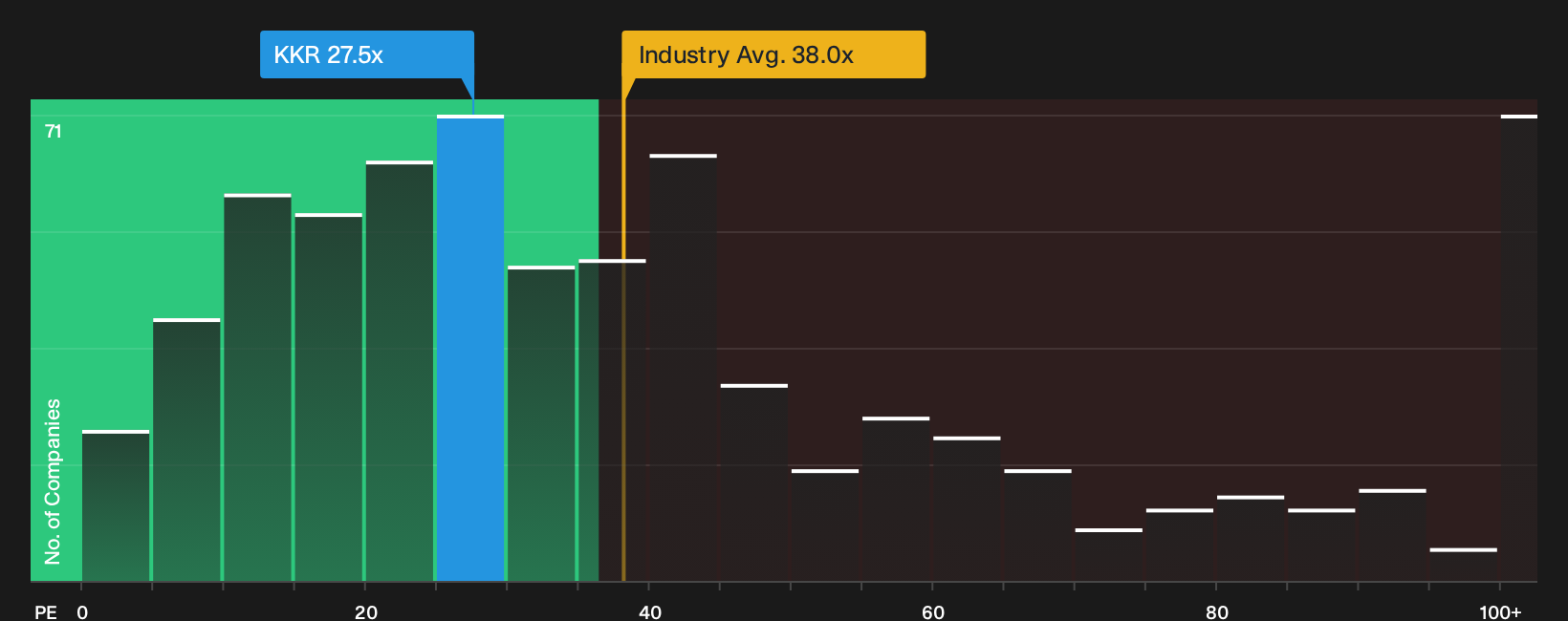
P/E works well for KKR because the market tends to focus on its fee related and investment earnings per share. Right now KKR trades on a P/E of about 31.0x, which sits below the broader Capital Markets industry average of 37.8x but above the peer average of 18.2x.
On Simply Wall St’s fair multiple estimate of 25.9x, KKR looks expensive on earnings since the current 31.0x implies investors are paying a premium to what the model suggests would be reasonable given its profile. That premium sits alongside a busy deal slate in infrastructure and healthcare. However, it still means you are paying more for each dollar of KKR earnings than the tailored fair ratio would indicate.
On the P/E multiple, KKR stock currently screens as overvalued relative to its modelled fair earnings multiple.
The KKR Narrative: What Would Justify Today's Price?
Simply Wall St Narratives pick up where this KKR valuation puzzle leaves off by setting out the growth, margin and earnings paths that would need to play out for the stock to be worth materially more or materially less than today’s price, and they sit on KKR’s Community page. Each one presents a fair value as a thesis about how KKR’s business might develop, so you can observe how that view holds up over time.
Community investors are split on KKR, with one camp focused on fee power and data centers and the other stressing credit risk and complexity.
Bull case: 27% undervalued
"Strong and accelerating fundraising momentum across asset classes, especially with institutional investors and the fast-growing private wealth/retail segment, are expanding fee-paying AUM and supporting double-digit management fee growth…"
Bear case: 22% overvalued
"El crédito privado puede ocultar deterioro latente."
Do you think there's more to the story for KKR? Head over to our Community to see what others are saying!
The Bottom Line
For KKR, the Excess Returns intrinsic value estimate points to meaningful upside, while the P/E multiple suggests the stock already trades at a premium to a tailored fair ratio. That split reflects different emphases. The intrinsic view leans on the durability of fee and investment economics, while the multiple view leans on how much growth and deal execution investors are willing to pay for right now. The crux from here is whether KKR can convert its large infrastructure, energy and healthcare pipeline into sustained, high quality earnings without integration or credit issues eroding that apparent discount.
This article by Simply Wall St is general in nature. We provide commentary based on historical data and analyst forecasts only using an unbiased methodology and our articles are not intended to be financial advice. It does not constitute a recommendation to buy or sell any stock, and does not take account of your objectives, or your financial situation. We aim to bring you long-term focused analysis driven by fundamental data. Note that our analysis may not factor in the latest price-sensitive company announcements or qualitative material. Simply Wall St has no position in any stocks mentioned.