

NextEra Energy (NEE) Stock Looks Above Fair Value After Its 30% 5 Year Return
NextEra Energy, Inc. NEE | 0.00 |
NextEra Energy stock sits at the center of a clear valuation split, with its intrinsic value estimate from a Dividend Discount Model (DDM) pointing to a premium to the current market price, while market based multiples suggest the shares look inexpensive.
- Over the past 5 years, NextEra Energy has delivered a total return of 30.5%, which frames today’s valuation debate against a backdrop of steady long term gains.
- Growing attention on power infrastructure constraints linked to data center demand can support investor expectations for regulated and clean energy projects. At the same time, regulatory pressure such as the Maryland challenge to certain allowed returns highlights the risk that future rate decisions may cap profitability.
- With a low valuation score, where NextEra Energy passes just 1 of 6 key checks, the stock does not screen as a clear bargain on the broader tests.
The issue now is whether investors should treat the DDM premium or the cheaper looking market multiples as the more reliable guide to what NextEra Energy is worth.
Does NextEra Energy Look Pricey on Dividends?
The Dividend Discount Model (DDM) values NextEra Energy by projecting its future dividends and discounting them back to today. For this stock, the model uses an annual dividend per share of about $2.69, a return on equity close to 9.9% and a payout ratio around 59.5%, which suggests the company is retaining a meaningful portion of earnings while still returning cash to shareholders.
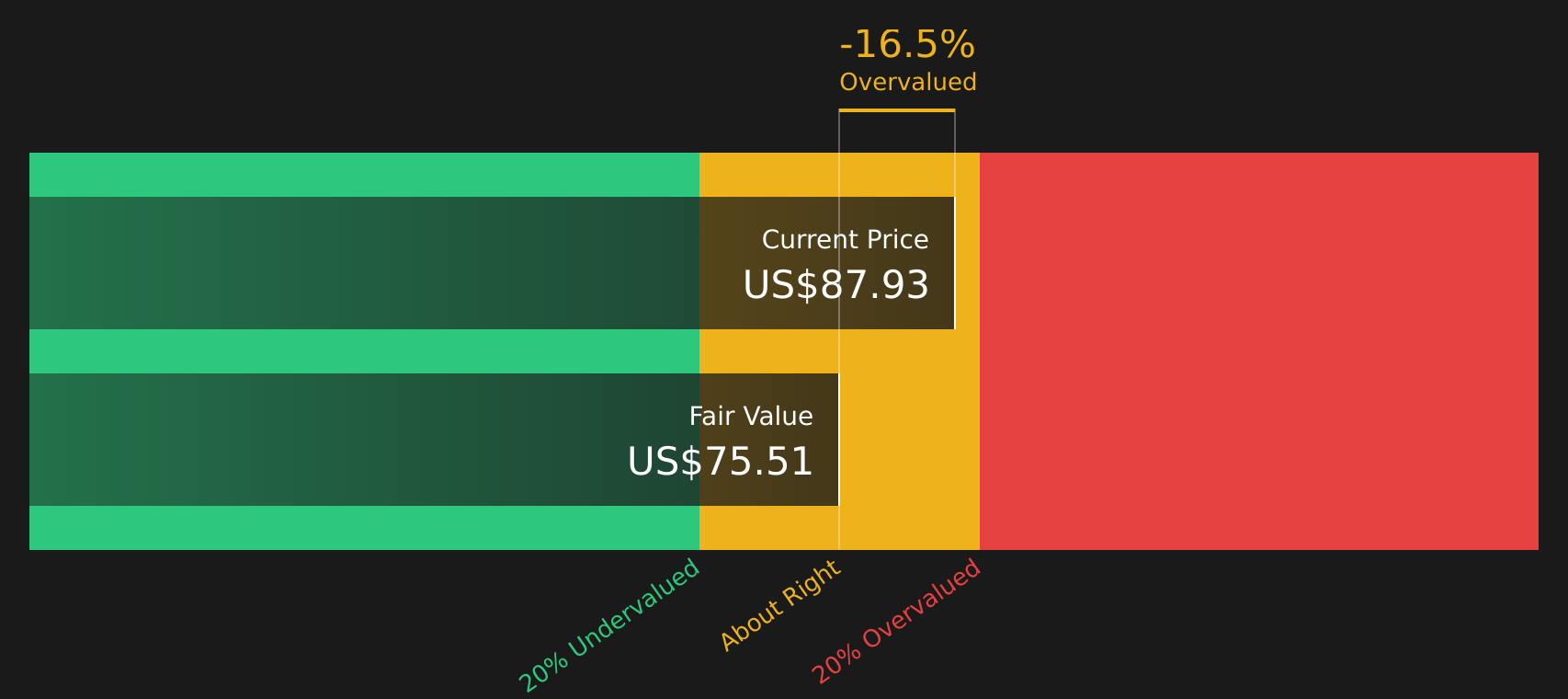
To keep expectations in check, the DDM growth rate is capped at 3.54%, slightly below the model’s underlying 4.01% input and paired with an expected long run growth assumption of about 4.0%. Plugging these into the model produces an estimated intrinsic value of roughly $75.51 per share, which indicates NextEra Energy screens as about 16.5% overvalued relative to the current share price. Because Maryland’s challenge to certain allowed returns points to potential pressure on regulated profitability, that regulatory risk helps explain why the market is not fully embracing the DDM’s richer valuation.
On this dividend based view, NextEra Energy stock currently screens as overvalued relative to its DDM intrinsic value estimate.
Our Dividend Discount Model (DDM) analysis suggests NextEra Energy may be overvalued by 16.5%. Discover 45 high quality undervalued stocks or create your own screener to find better value opportunities.
Does NextEra Energy Look Undervalued on Earnings?
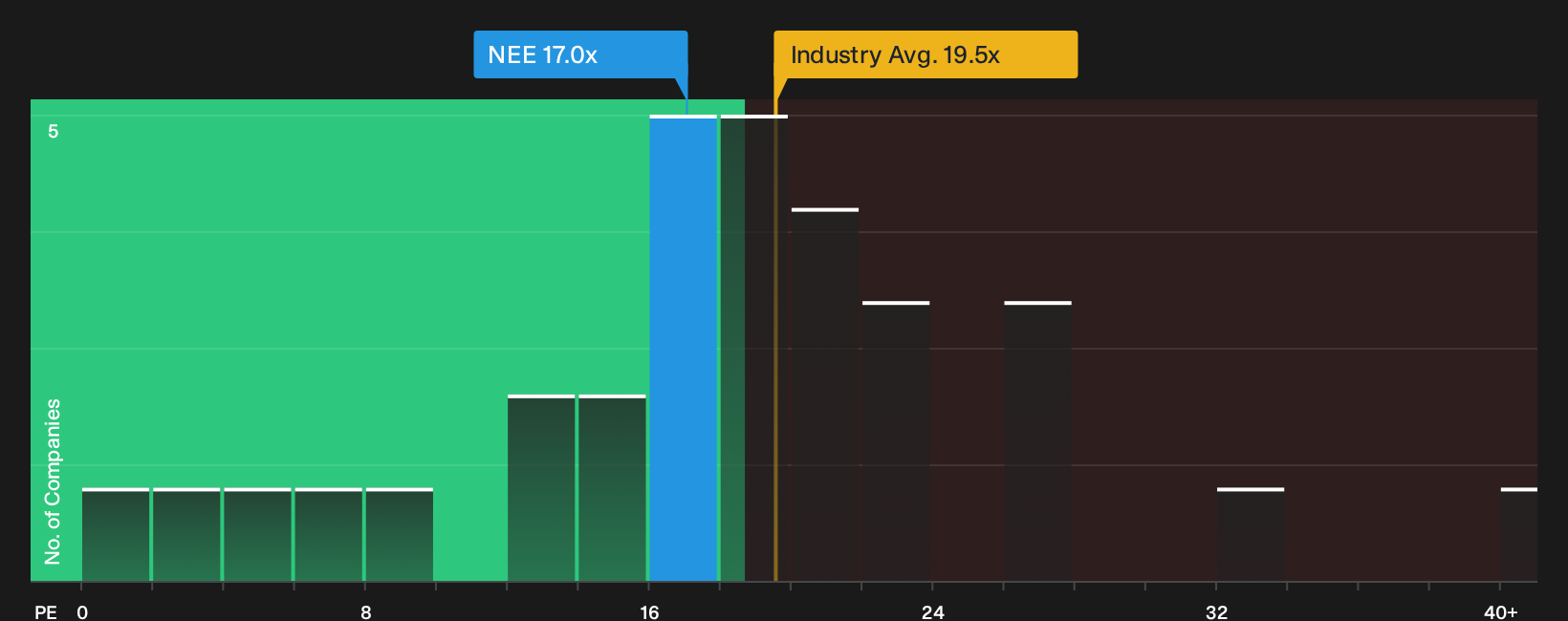
The P/E multiple fits NextEra Energy because earnings are a key focus for regulated utilities. NextEra Energy trades on a P/E of about 22.4x, which sits close to both the Electric Utilities industry average of roughly 22.3x and the peer group average of about 21.8x, so on simple comparison the stock looks broadly aligned with the sector.
The tailored fair P/E ratio for NextEra Energy is about 26.0x, which is higher than the current 22.4x and indicates a discount relative to what this model suggests for the company’s earnings, risk profile and industry position. That gap suggests the market is not fully reflecting the characteristics that feed into the fair multiple, even as interest in grid capacity for data centers and clean energy projects keeps attention on the sector.
On the P/E framework, NextEra Energy stock appears undervalued relative to the earnings multiple implied by the fair value model.
The NextEra Energy Narrative: What Would Justify Today's Price?
Simply Wall St Narratives pick up where the valuation split for NextEra Energy leaves off, by spelling out which paths for growth, margins and earnings would need to occur for the stock to be worth materially more or less than today’s price. Each narrative ties a fair value to a particular view of NextEra Energy's potential catalysts and risks, so you can track over time which story appears to be closest to reality on the Community page.
The community is split on NextEra Energy, with one camp leaning into data center power demand and the Dominion deal, and the other focused on financing and policy risks that could keep a lid on returns.
Bull case: 11% undervalued
"Accelerating and sustained demand growth for electricity, driven by AI, data center expansion, and electrification of sectors like transportation and heating, positions NextEra to grow volumes and capture higher average revenue per MWh as utilities compete to provide essential infrastructure for hyperscalers and traditional customers…"
Bear case: 21% overvalued
"The phase-out of wind and solar tax credits under the One Big Beautiful Bill Act will significantly reduce the financial incentives underpinning much of NextEra's renewables pipeline after 2029, leading to lower project returns and putting long-term earnings growth at risk as tax equity structures become less attractive and margins compress…"
Do you think there's more to the story for NextEra Energy? Head over to our Community to see what others are saying!
The Bottom Line
NextEra Energy sits between an intrinsic value view that screens the stock as overvalued and a P/E based view that points to some undervaluation. The gap reflects how the Dividend Discount Model (DDM) leans heavily on future funding needs and dividend timing, while the multiples view is more about how the market prices earnings growth and sector sentiment. Broader valuation checks are weak, so that single supportive multiple signal needs treating with care. What really decides it from here is whether power demand and project returns offset regulatory and policy risks enough for earnings and the valuation multiple to hold or improve.
This article by Simply Wall St is general in nature. We provide commentary based on historical data and analyst forecasts only using an unbiased methodology and our articles are not intended to be financial advice. It does not constitute a recommendation to buy or sell any stock, and does not take account of your objectives, or your financial situation. We aim to bring you long-term focused analysis driven by fundamental data. Note that our analysis may not factor in the latest price-sensitive company announcements or qualitative material. Simply Wall St has no position in any stocks mentioned.