

Pool (POOL) Stock May Be 33% Undervalued Despite Confirmed Annual Guidance
Pool Corporation POOL | 0.00 |
Pool stock has had a tough run over the past five years, yet there is now a clear split between valuation signals, with a Discounted Cash Flow (DCF) estimate pointing to meaningful upside while market based multiples suggest the shares are not cheap.
- Pool has declined 58.7% over the past five years, which means any case for the stock today rests heavily on what investors are willing to pay for its future cash flows rather than its recent share price history.
- Recent results and maintained earnings expectations can support the intrinsic value case, while any disappointment in cash flow delivery or margin resilience may weigh on how much of that DCF based upside the market is prepared to recognize.
- On the broader checks, Pool earns a mixed value profile, screening as attractive on some measures but not others, with the stock passing 3 out of 6 tests, which you can review in detail at 3 out of 6.
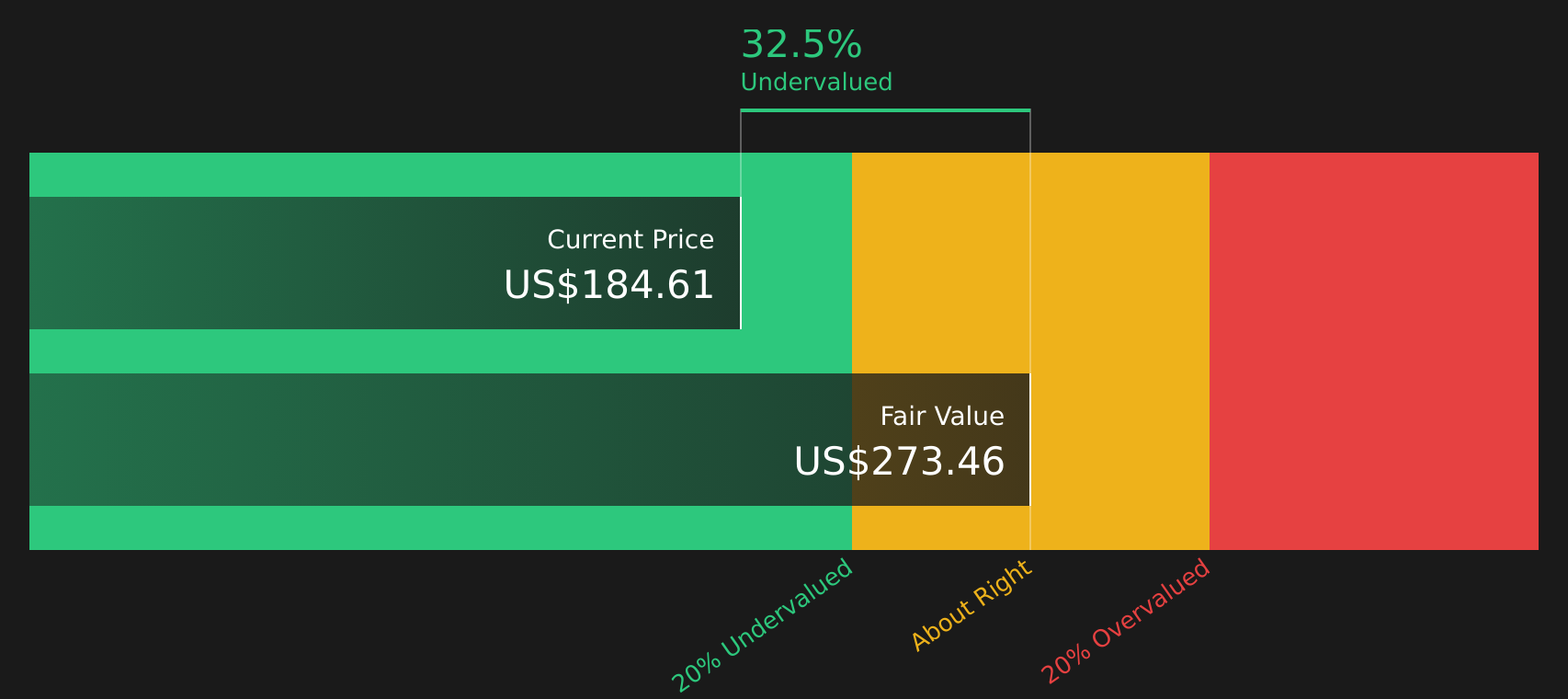
The issue now is whether Pool’s current price around US$183.77 leans closer to the intrinsic value signaled by the Discounted Cash Flow estimate that suggests the stock is 32.8% undervalued, or to the richer picture implied by earnings based multiples.
Is Pool a Bargain on Cash Flow?
The Discounted Cash Flow (DCF) method looks at the cash Pool is expected to generate in the future and discounts it back to today. For Pool, the model starts with latest twelve month free cash flow of about $305.3 million and assumes cash flows that are broadly growing rather than shrinking, which fits a business that already produces substantial cash but is not modeled for explosive expansion.
On these assumptions, the DCF points to an intrinsic value of about $273 per share, compared with the current price around $183.77, implying the stock screens as roughly 32.8% undervalued. Because Pool recently confirmed its 2026 earnings guidance range, the maintained outlook helps explain why the model is projecting ongoing free cash generation even if market sentiment has been weak.
On this cash flow view, Pool stock currently appears undervalued relative to what its projected free cash generation would support.
Our Discounted Cash Flow (DCF) analysis suggests Pool is undervalued by 32.8%. Track this in your watchlist or portfolio, or discover 50 more high quality undervalued stocks.
Is Pool Getting Expensive on Earnings?
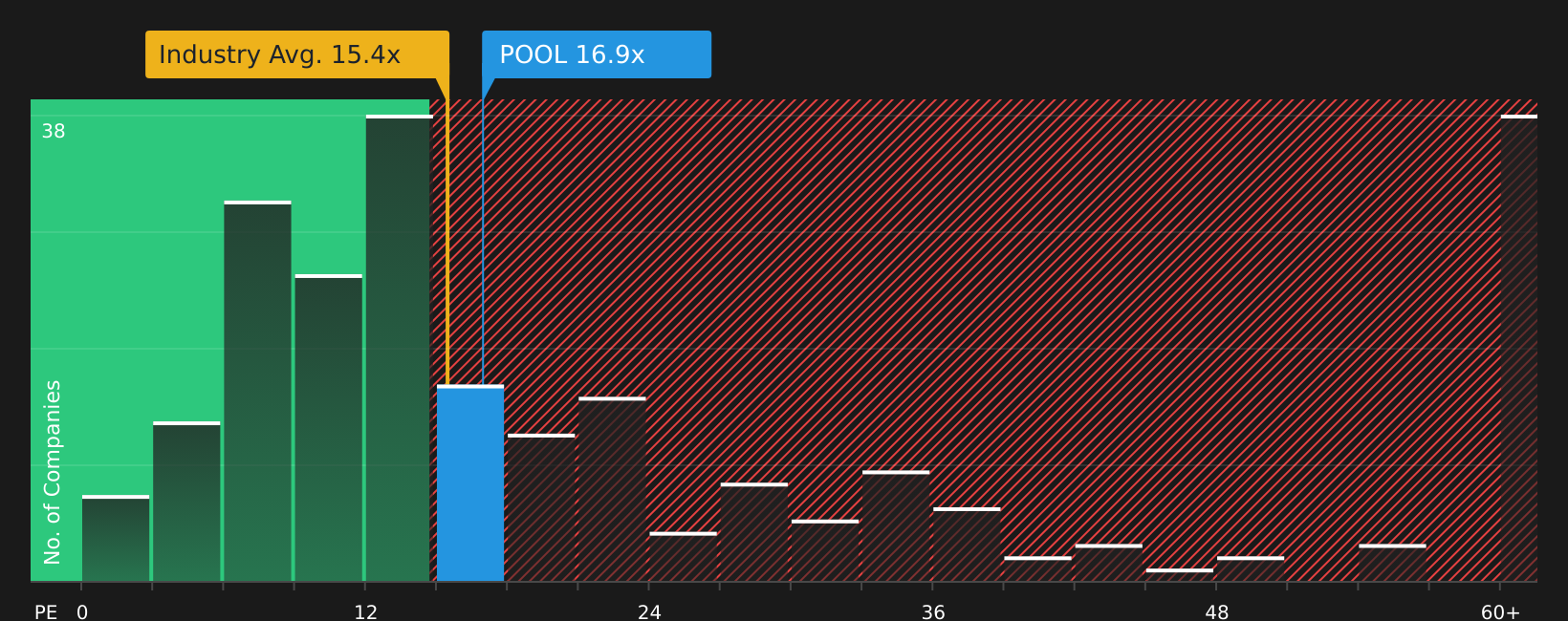
P/E is a useful lens for Pool because earnings per share are at the center of how many investors price mature, cash generative businesses. On this metric, Pool trades at a P/E of about 16.8x, compared with an industry average of roughly 15.2x for Retail Distributors and a peer group average near 12.8x.
The fair P/E ratio implied by the model, which factors in Pool’s profitability profile, risk and size, is about 13.7x, so the current multiple sits a few turns above what that framework points to. That premium suggests investors are currently paying more for each dollar of Pool’s earnings than both the sector average and the model based marker would indicate, even after the stock’s longer term share price pressure.
On the P/E test, Pool stock appears overvalued relative to both its modeled fair multiple and the broader peer group.
The Pool Narrative: What Would Justify Today's Price?
Simply Wall St Narratives pick up where this valuation split for Pool leaves off by spelling out which assumptions about Pool's growth, margins and earnings would need to hold for the stock to be worth materially more or less than today’s price, and they sit on the company’s Community page.
Each Narrative ties a fair value estimate to a specific storyline about Pool's possible catalysts and risks, so you can track over time which version of events appears to be unfolding in the actual results.
One of the top community narratives on Pool: 11% undervalued
"This narrative explores a more pessimistic perspective on Pool compared to the consensus, based on a Fair Value that aligns with the bearish cohort of analysts..."
Do you think there's more to the story for Pool? Head over to our Community to see what others are saying!
The Bottom Line
Pool’s Discounted Cash Flow (DCF) estimate points to meaningful intrinsic value upside, while the P/E based view suggests the stock already trades at a premium to peers. That split reflects different anchors, with the intrinsic value model leaning on future cash generation and the market multiple shaped by sentiment and how comparable companies are priced.
Broader checks are mixed rather than strongly compelling either way. The key question is whether Pool can deliver the cash flows and margins implied in the intrinsic value case. For investors, the crux is whether the current discount to intrinsic value is an opportunity or a sign that the market is correctly pricing in risk.
This article by Simply Wall St is general in nature. We provide commentary based on historical data and analyst forecasts only using an unbiased methodology and our articles are not intended to be financial advice. It does not constitute a recommendation to buy or sell any stock, and does not take account of your objectives, or your financial situation. We aim to bring you long-term focused analysis driven by fundamental data. Note that our analysis may not factor in the latest price-sensitive company announcements or qualitative material. Simply Wall St has no position in any stocks mentioned.